Artist
Maria Vos

Kingdom of the Netherlands
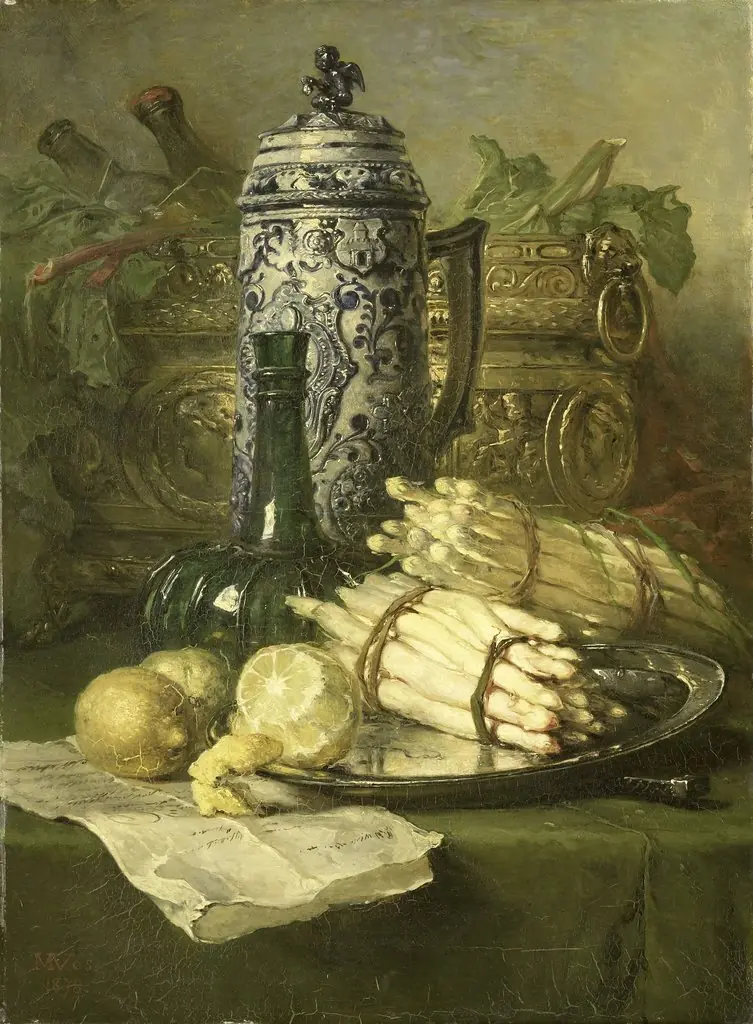
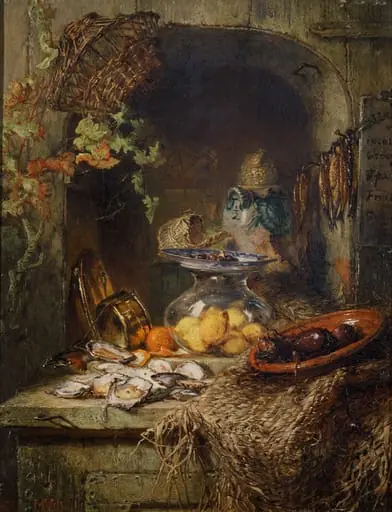
Maria Vos is a Kingdom of the Netherlands Impressionism artist. 2 works are cataloged here, principally at Rijksmuseum.
Maria Vos kept a studio in Utrecht with a north-facing window, which gave her still lifes their quiet, cool glow. She painted the same copper pot and blue-and-white vase for years, not because she was stuck but because she kept seeing new light in them. Her still lifes don’t shout for attention; they sit patiently, like the quiet friend who notices the way dust settles on the rim of a glass. If you’ve ever lingered in front of a Dutch still life at the museum and forgotten to blink, look her up next—try Natură statică.
Overview
Maria Vos (21 December 1824-11 January 1906) was a Dutch painter best known for her still lifes, though her practice also encompassed portraits, landscapes, and cityscapes. Born into an upper-class Amsterdam family, she received formal training at a time when women artists faced significant barriers, and she went on to build a long, productive career centered in the artists' colony of Oosterbeek. Vos exhibited widely in the Netherlands, Belgium, and the United States, earned institutional recognition, and left behind a substantial body of work despite significant losses. Retrospectives held in 1973 and 2002 have helped secure her place in the history of nineteenth-century Dutch art.
Biography & dates
Vos was born in Amsterdam on 21 December 1824 to Gerrit Vos, a broker, and Gerarda Bouwmeester (1793-1833). She initially studied domestic economy at a French boarding school in Weesp, but like many women of her social class, she also received drawing instruction from Christiaan Andriessen. Around 1841 she began studying painting with Petrus Kiers, who taught her drawing, painting, and watercolor. In 1844 she exhibited at the Exhibition of Living Masters, and in 1847 she was made an honorary member of the Royal Academy of Fine Arts in Amsterdam. She remained active in Amsterdam until 1853, when she moved to Oosterbeek and joined the Hollandse Barbizon, a group of painters working in the Barbizon-influenced landscape tradition. In 1863 her friend Adriana Johanna Haanen, who was also the sister-in-law of her teacher Kiers, came to join her in Oosterbeek. Together they commissioned the construction of Villa Grada in 1870, where they lived, worked, and gave drawing and painting lessons. Haanen died in 1895, but Vos continued to live and work at Villa Grada, becoming one of the last artists in residence there. On her eightieth birthday in 1904, she received a personal tribute from seventy members of Arti et Amicitiae. She died in Oosterbeek on 11 January 1906 at the age of 81 and was buried at the Nieuwe Begraafplaats there.
Style & movement
Vos is primarily associated with still life painting, though her oeuvre demonstrates considerable range across genre. She painted portraits, landscapes, and cityscapes, and she produced a notable series of fourteen watercolors depicting Oosterbeek. Her move to Oosterbeek in 1853 connected her to the Hollandse Barbizon, the Dutch counterpart to the French Barbizon School, which emphasized naturalistic landscape painting and rural subjects. While her still lifes remain her most recognized works, her engagement with landscape and topographical watercolor suggests an artist responsive to the plein-air tendencies of her milieu. The watercolors of Oosterbeek in particular indicate a documentary impulse alongside her more conventional studio practice. She worked in oil and watercolor, and her long career allowed her to develop a substantial output across these media.
Major works
Among Vos's documented works, the Rijksmuseum holds a painting titled "Maria Vos in her Studio at the Eng in Oosterbeek," which provides valuable visual evidence of her working environment. Her series of fourteen watercolors of Oosterbeek constitutes an important topographical record of the village. These watercolors are significant both as artistic achievements and as historical documents of the area. Her works are held in several institutional collections, including the Rijksmuseum Amsterdam, the Historisch Museum Arnhem, Museum Veluwezoom, Kasteel Duivenvoorde, and the American Art Association in New York. Much of her work has been lost or misplaced over time, though the sheer quantity of her production means that substantial pieces survive.
Influences & students
Vos's early training came from two significant figures in Dutch art education. Christiaan Andriessen provided her initial drawing instruction, grounding her in fundamental draftsmanship. Petrus Kiers, with whom she studied from approximately 1841, was a more specialized influence; he was known for interior scenes with candlelight and moonlit landscapes, and he taught her drawing, painting, and watercolor. Kiers's sister-in-law, Adriana Johanna Haanen, became Vos's lifelong companion and artistic collaborator. Haanen joined Vos in Oosterbeek in 1863, and together they built Villa Grada in 1870, where they taught drawing and painting to students. This teaching activity, though not extensively documented in terms of individual pupils, represents an important transmission of artistic knowledge by women artists in a period when formal academies remained largely closed to women.
Legacy
Vos's posthumous reputation has been shaped by two major retrospectives: one held in 1973 at the Stedelijk Museum Zutphen, accompanied by a catalog by Martina Maria Doornik-Hoogenraad titled "Maria Vos: een Gelderse schilderes 1824-1906," and another in 2002 at the Historisch Museum Arnhem. These exhibitions helped recover her from relative obscurity and established her significance within Dutch regional art history. Her market presence is documented through Artnet and other commercial databases, and her work appears in major and regional Dutch museums as well as the American Art Association in New York. The 1973 exhibition catalog remains a foundational scholarly resource. Her longevity, prolific output, and role as a woman artist working professionally in the nineteenth century, combined with her position in the Oosterbeek artists' colony, secure her a place in studies of Dutch art beyond the canonical Hague School and Amsterdam Impressionism.
Works by Maria Vos
Collections represented


Artists in a similar vein
Artist