Artwork
Football Players
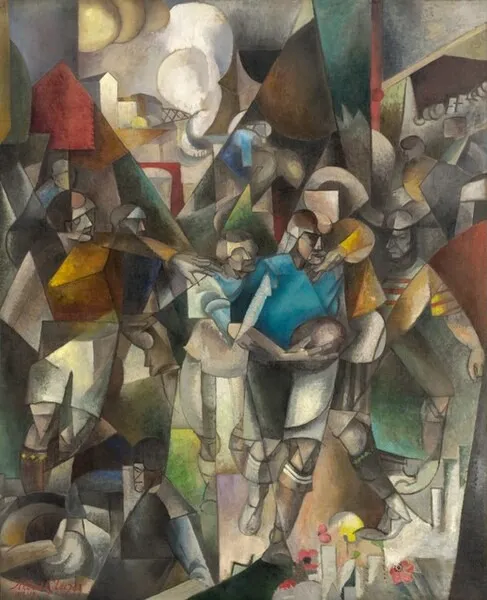
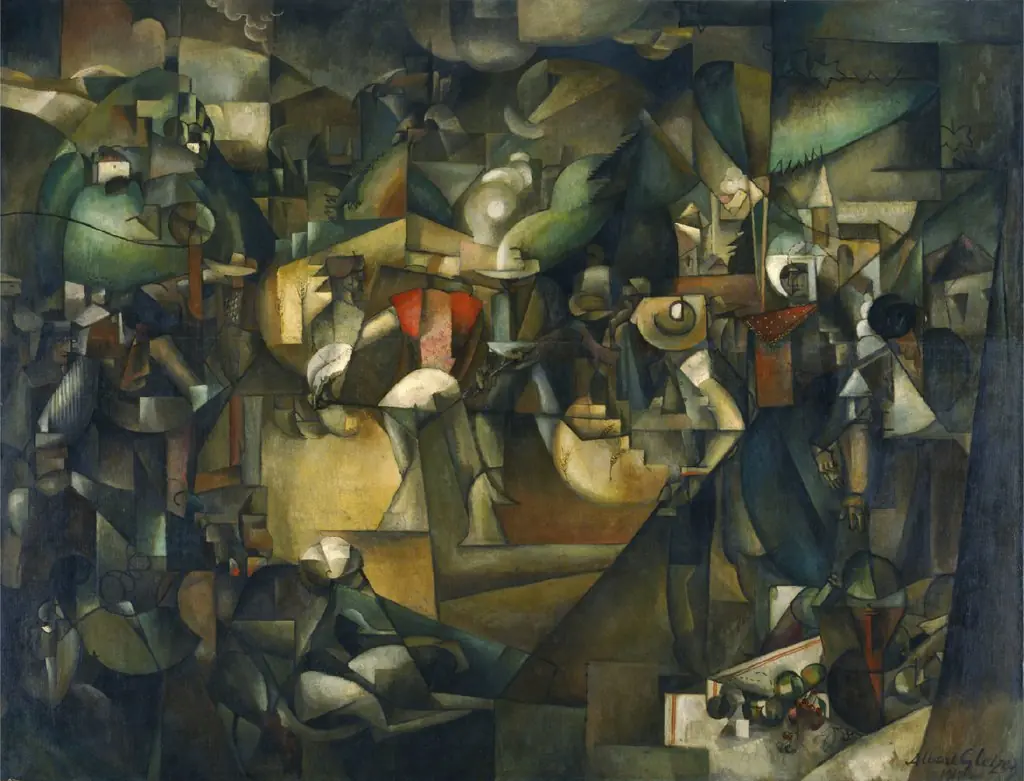
Football Players is an oil painting by the Cubist artist Albert Gleizes. It dates from 1912 and is held in the collection of the National Gallery of Art.
About this work
Painted by Albert Gleizes in 1912. The work was shown widely, at the Salon des Independants in Paris, the Erster Deutscher Herbstsalon in Berlin, and Galeries Dalmau in Barcelona, first in 1916 and again in 1926.
Subject & Meaning
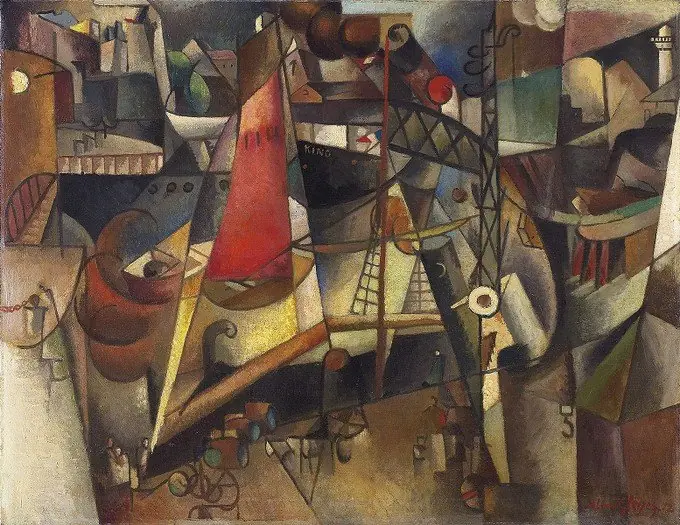
Albert Gleizes's Football Players depicts a dynamic rugby match, featuring six or seven players engaged in physical contact, with two men tackling a player in a blue jersey holding an oval ball. Unlike the still lifes typical of earlier Cubists, the work integrates this sporting action with a semi-urban background containing a town, a bridge, and billowing smoke. The composition juxtaposes the imminent violence of the tackle with unexpected floral motifs and cubic shapes in the lower right, while a fallen figure holding a round object appears in the lower left.
Symbolically, the painting embodies the Cubist principle of mobile perspective and simultaneity, aiming to represent multiple viewpoints and successive stages of motion simultaneously rather than a static moment. This approach reflects a philosophical conviction that art should capture the full experience of life, including the 'élan vital' and aggressive movement, rejecting mere retinal realism in favor of a more complete, evolving image of modern existence.
Technique & Style
Departing from his earlier quasi-monochromatic style, Gleizes employed a broad palette of primary colors, grays, earth tones, and umbers.
Albert Gleizes executed Football Players (1912–13) as a large-scale oil painting on canvas, measuring 225.4 by 183 cm. The work is signed and dated at the lower left. Departing from his earlier quasi-monochromatic style, Gleizes employed a broad palette of primary colors, grays, earth tones, and umbers. The composition unifies a complex scene of rugby players, spectators, and an industrial landscape through a Cubist idiom characterized by an interlocking grid of diagonal lines, facets, intersecting planes, and spheres.
This formal structure facilitates the principle of mobile perspective, depicting the subjects from multiple viewpoints simultaneously to convey motion and the physical contact of the tackle. The handling contrasts the implied violence of the sport with the inclusion of flowers and cubic shapes in the lower right, while background elements like bellowing smoke and a bridge are rendered with the same fractured, geometric logic as the foreground figures.
History & Provenance
Albert Gleizes began working on Football Players in 1912 after creating at least one preliminary sketch, completing the oil-on-canvas work by early 1913. The artist signed and dated the piece "Albert Gleizes 1912–13" at the lower left. Following its completion, the painting was entrusted to Galeries Dalmau in Barcelona, where it was exhibited in 1916 and 1926, with the latter showing noting the "Collection Joseph Dalmau."
Between 1953 and 1955, the work was acquired from the Dalmau family by Stephen Hahn and The Sidney Janis Gallery, before being sold to Nelson Aldrich Rockefeller in 1955. The painting subsequently passed to the Marlborough-Gerson Gallery in New York. In May 1970, the National Gallery of Art in Washington, D.C., purchased the artwork, where it remains part of the permanent collection today.
Football Players (1912–13) is part of the National Gallery of Art collection in Washington, D.C., where it was acquired by the museum in May 1970 from the Marlborough‑Gerson Gallery. The work was first shown at the Salon des Indépendants, Paris, March–May 1913 (no. 1293), then at the Erster Deutscher Herbstsalon in Berlin, September–December 1913. It later appeared at Galeries Dalmau, Barcelona, 29 November–12 December 1916 and again at the same gallery, 16 October–6 November 1926.
Context
Football Players occupies a central place in the historiography of Salon Cubism. Painted in 1912–13, it exemplifies the principle of mobile perspective and simultaneity elaborated in Du "Cubisme" (1912), the manifesto co-authored by Albert Gleizes and Jean Metzinger, which argued that a truer image emerges from showing multiple facets of a subject at successive intervals in time. Guillaume Apollinaire praised the canvas in L'Intransigeant and Montjoie!
(18 March 1913), calling it Gleizes's most varied and colored work and welcoming the return of the subject to Cubist painting. Art historian Peter Brooke later read the work as expressing "aggressive movement" through frozen gestures, while Daniel Robbins situated it within the Passy group's broader engagement with team sport. The painting also belongs to a wider prewar fascination with athletics shared by Rousseau, Metzinger, Boccioni, Delaunay, and Lhote.
Legacy
Football Players (Les Joueurs de football) occupies a central place in the historiography of Salon Cubism, frequently cited as a paradigm of the mobile perspective and simultaneity elaborated by Albert Gleizes and Jean Metzinger in their 1912 treatise Du "Cubisme". Guillaume Apollinaire's contemporaneous reviews in L'Intransigeant and Montjoie! singled it out as Gleizes's most ambitious and colorful canvas, and the work has continued to anchor discussions of how Cubist painters absorbed contemporary sporting culture. Its exhibition history, the 1913 Salon des Indépendants, the Erster Deutscher Herbstsalon in Berlin, and two shows at Galeries Dalmau in Barcelona (1916, 1926), helped disseminate Salon Cubism across Europe, while its later passage through the Stephen Hahn, Nelson Rockefeller, and Marlborough-Gerson collections culminated in its 1970 acquisition by the National Gallery of Art in Washington, cementing its canonical status.
Overview
Albert Gleizes' painting, Football Players, was created between 1912 and 1913. This oil on canvas work depicts a scene of athletes, reflecting the artist's engagement with modern subjects. It represents a significant example of his output during a pivotal period in early 20th-century art, characterized by formal experimentation.
Artist & collection

Artist
Albert Gleizes was a French artist, theoretician, philosopher, a self-proclaimed founder of Cubism and an influence on the School of Paris.