Artwork
Pandora
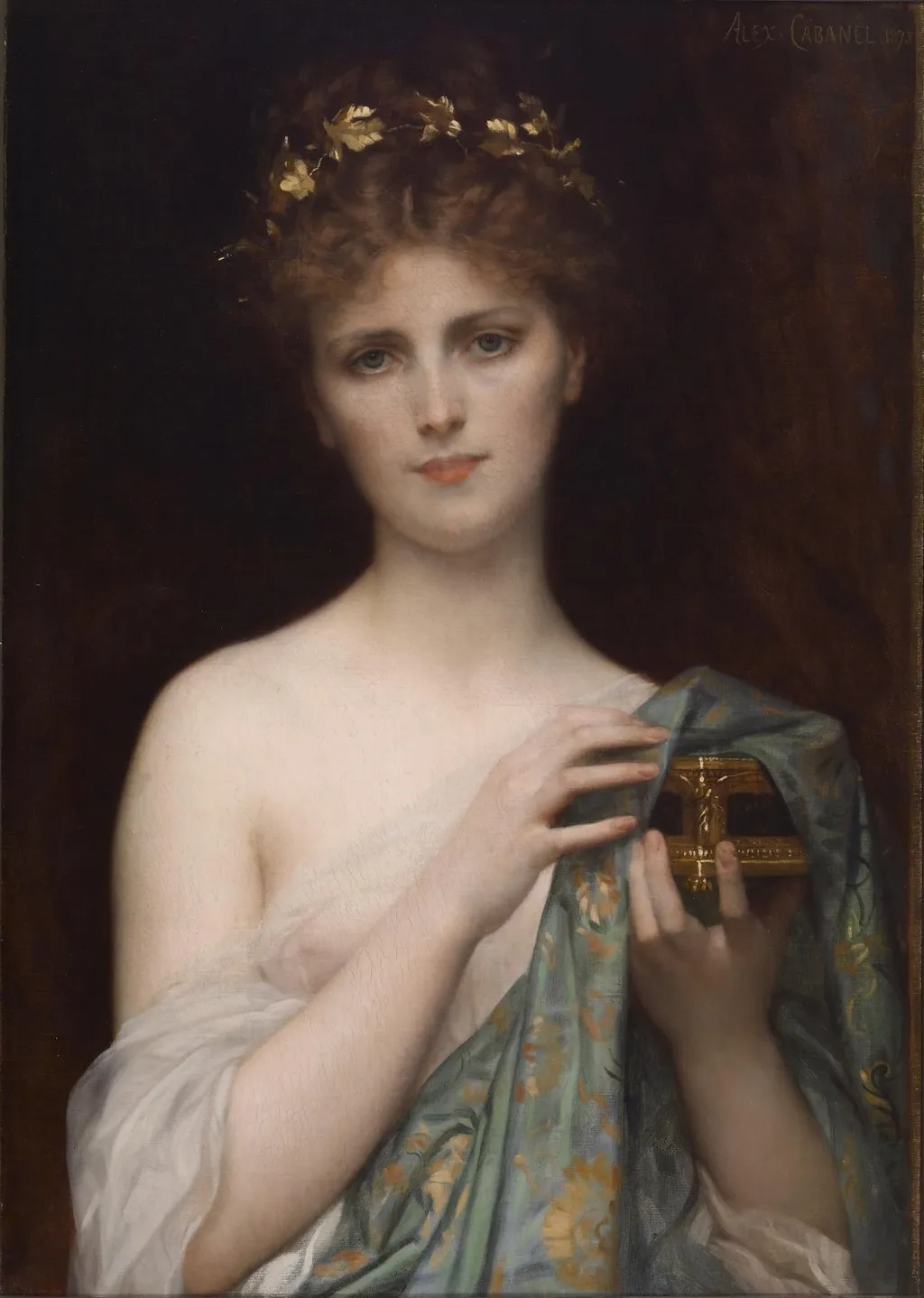
Pandora is an oil painting by the Academic Art artist Alexandre Cabanel. It dates from 1873 and is held in the collection of the Walters Art Museum.
About this work
Subject & Meaning
At the lower edge of the canvas, a casket, the iconographic equivalent of Pandora's box, sits as the visual key to her meaning.
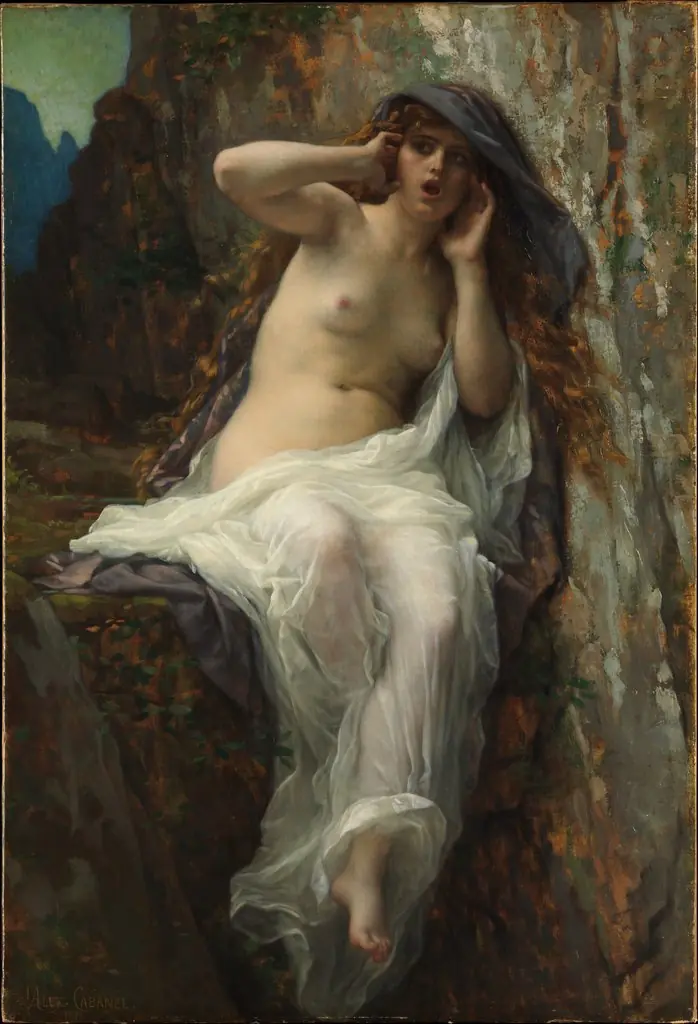
Cabanel's painting portrays Pandora, the mythological figure whose name became synonymous with unleashed misfortune. The composition presents her as a smiling woman with chestnut hair gathered in a chignon, crowned with a laurel wreath, and defined by arched eyebrows, blue accents, and red lipstick. Her bare shoulder and partially exposed breast emerge from sheer, draped fabric, lending the figure a sensual immediacy rather than a purely allegorical distance.
At the lower edge of the canvas, a casket, the iconographic equivalent of Pandora's box, sits as the visual key to her meaning. Its presence transforms the portrait from a conventional likeness into a meditation on curiosity, temptation, and the catastrophic release of evils into the world. The juxtaposition of her inviting smile and the container of unknown consequences encapsulates the paradox at the heart of the Pandora myth: beauty paired with the threat of irreversible loss.
Technique & Style
Alexandre Cabanel’s Pandora is painted in oil on canvas in 1873. The handling reflects Academic conventions, with smooth, blended transitions and polished modeling of the figure’s skin and drapery. The composition centers on Pandora’s idealized nude torso, framed by translucent drapery and a laurel wreath.
Her chestnut hair is arranged in a chignon, and she holds a small casket associated with Pandora’s box, anchoring the mythological subject. The palette emphasizes cool blues and warm flesh tones, while the background remains subdued to focus attention on the figure.
History & Provenance
The painting Pandora by Alexandre Cabanel was created in 1873, as indicated by both the artist’s date and the work’s Wikidata entry.
The work entered the collection of the Walters Art Museum, where it remains located. It depicts the mythological figure Pandora in an academic style, combining portraiture with allegorical elements such as Pandora’s box and drapery.
The painting is held by the Walters Art Museum in Baltimore, where it carries accession number 37.1935.
It was shown in the Paris Salon of 1873, the year of its creation, and later traveled in the 1977 exhibition “The Lure of Paris: Nineteenth-Century American Painters and Their French Teachers” at the Pennsylvania Academy of the Fine Arts, Philadelphia, and the Denver Art Museum.
Overview
Alexandre Cabanel, a prominent French academic painter, completed Pandora in 1873 using oil on canvas. This painting presents the mythological figure of Pandora, a popular subject in 19th-century art, rendered with the refined technique characteristic of Cabanel's style. The artwork is presently held in the collection of the Walters Art Museum, representing a key example of academic painting from the period.
Own this work as a print
Artist & collection
Artist
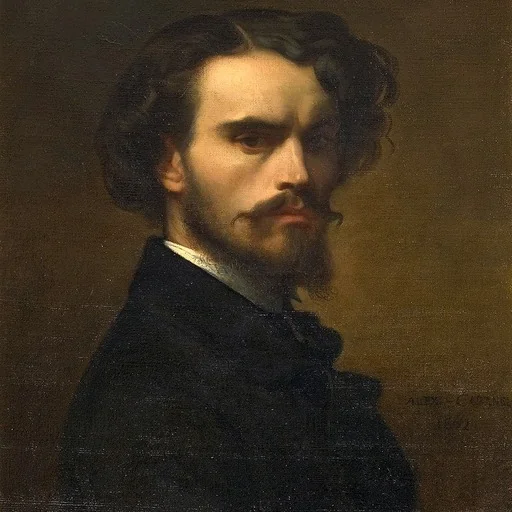
Alexandre Cabanel (French:; 28 September 1823 – 23 January 1889) was a French painter.