Artwork
The Good Samaritan
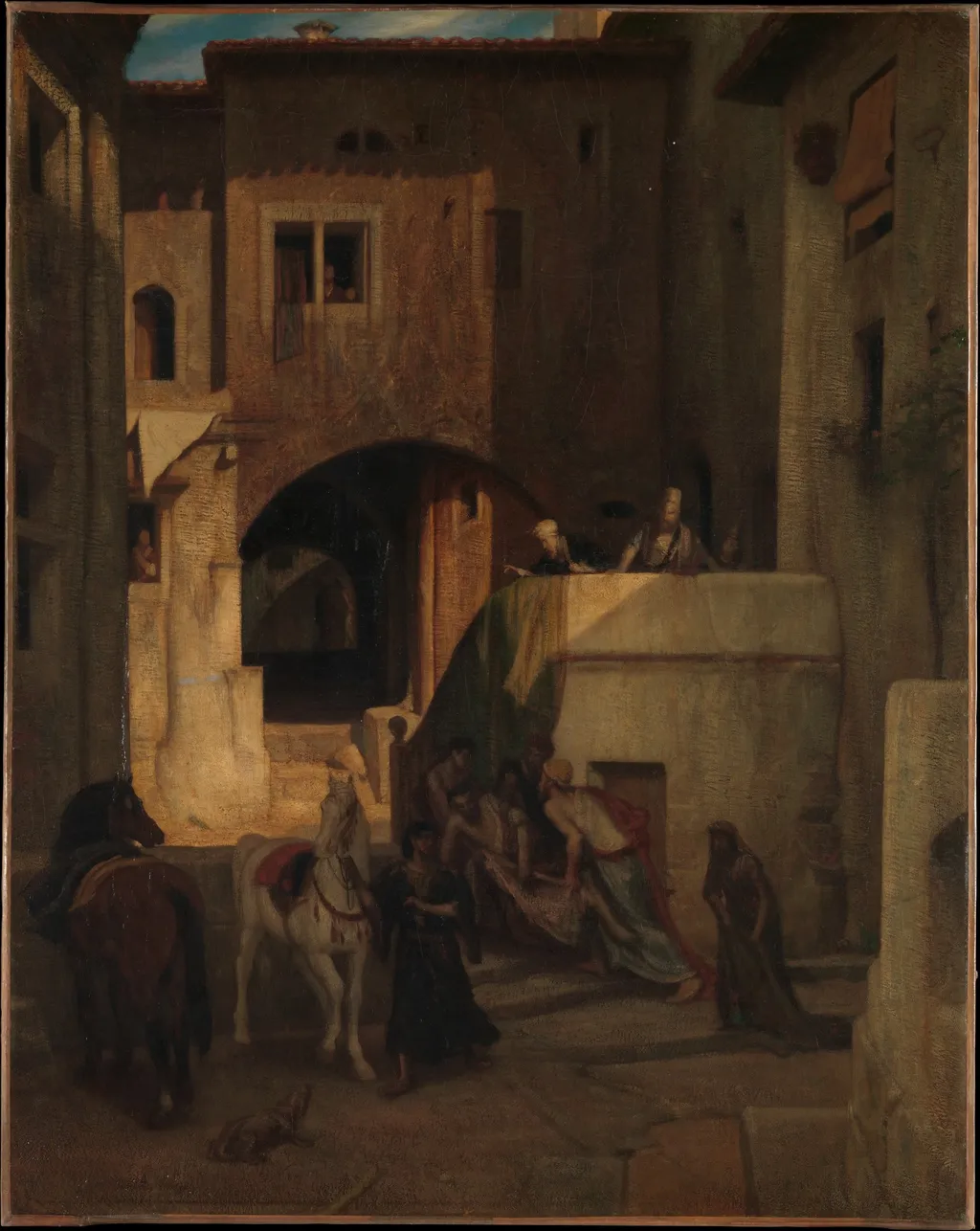
The Good Samaritan is an oil painting by Alexandre Gabriel Decamps. It dates from 1853 and is held in the collection of the Metropolitan Museum of Art.
About this work
Subject & Meaning
Decamps renders the scene with meticulous detail, emphasizing the Samaritan’s compassion and the vulnerability of the wounded figure.
The painting illustrates the biblical parable of the Good Samaritan, showing a traveler on horseback tending to an injured man beside a roadside inn, with a woman nearby and a town in the background. Decamps renders the scene with meticulous detail, emphasizing the Samaritan’s compassion and the vulnerability of the wounded figure. The horse, the road, and the distant town serve as visual cues for journey, assistance, and the broader community context.
As a religious work, the composition underscores themes of charity that transcends social and ethnic divisions, inviting viewers to contemplate moral responsibility toward strangers.
Technique & Style
The Good Samaritan is an oil painting on canvas created in 1853 by Alexandre‑Gabriel Decamps. The work measures 93 cm in height and 74 cm in width, characteristic dimensions for a mid‑19th‑century religious composition. Executed in oil paint, the surface reflects the academic technique of the period, employing layered brushwork to render figures and narrative detail.
The painting portrays the biblical parable of the Good Samaritan, showing a horse, a man, a woman, and a town within a cohesive spatial arrangement. It is housed in the Metropolitan Museum of Art, where it remains part of the institution’s collection.
History & Provenance
The Good Samaritan is an oil-on-canvas painting created by Alexandre-Gabriel Decamps in 1853. The work depicts the biblical parable of the Good Samaritan, featuring figures such as a man, a woman, a horse, and a town setting. Currently held in the collection of the Metropolitan Museum of Art, the piece measures 93 centimeters in height and 74 centimeters in width.
While the specific commissioning details and the full chain of ownership prior to its arrival at the museum are not detailed in the provided records, the work's creation date is firmly established as 1853. The painting remains categorized within the genre of religious art, reflecting Decamps's engagement with scriptural narratives during the mid-nineteenth century.
Alexandre-Gabriel Decamps's 1853 oil painting, The Good Samaritan, is held in the permanent collection of the Metropolitan Museum of Art. The work, executed on canvas, measures 93 centimeters in height and 74 centimeters in width. While the provided sources confirm the museum's custody and the artwork's physical dimensions, they do not specify a unique inventory or accession number for this piece.
Furthermore, the available documentation does not record any specific exhibition history, dates of display, or loan records for the painting. Consequently, the known provenance details are limited to its creation date, medium, dimensions, and current institutional location within the Metropolitan Museum of Art.
Overview
Alexandre Gabriel Decamps's 1853 oil painting, The Good Samaritan, captures a scene from the biblical parable. This work, rendered in oil, presents a bustling street within a town setting, drawing viewers into a moment of human interaction. Currently, the painting is part of the collection at The Metropolitan Museum of Art, where it represents Decamps's approach to religious narrative.
Own this work as a print
Artist & collection
Artist
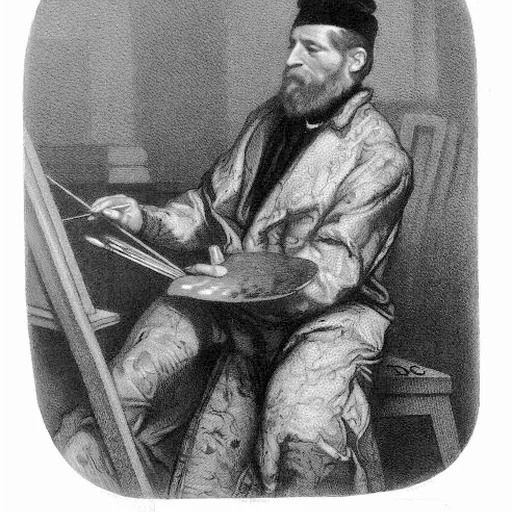
Alexandre-Gabriel Decamps was a French painter noted for his Orientalist works.

- The falconer's homecoming
 Christ Presented to the People
 Joseph Interpreting the Dreams of Pharaoh
 Gemüsemarkt
 Colour sketch for spirit fresco 'The Arts of Industry as Applied to War'
 View of a Dilapidated Building with a Fountain
 Joseph Selling Grain in Egypt
 Alexander and Bucephalus
 Processie in Verona
 Christ Blessing the Children
 Women of the Ouled Nayls
 Inn
Inn