Artwork
Madonna with two Angels Adoring the Christ Child in a landscape
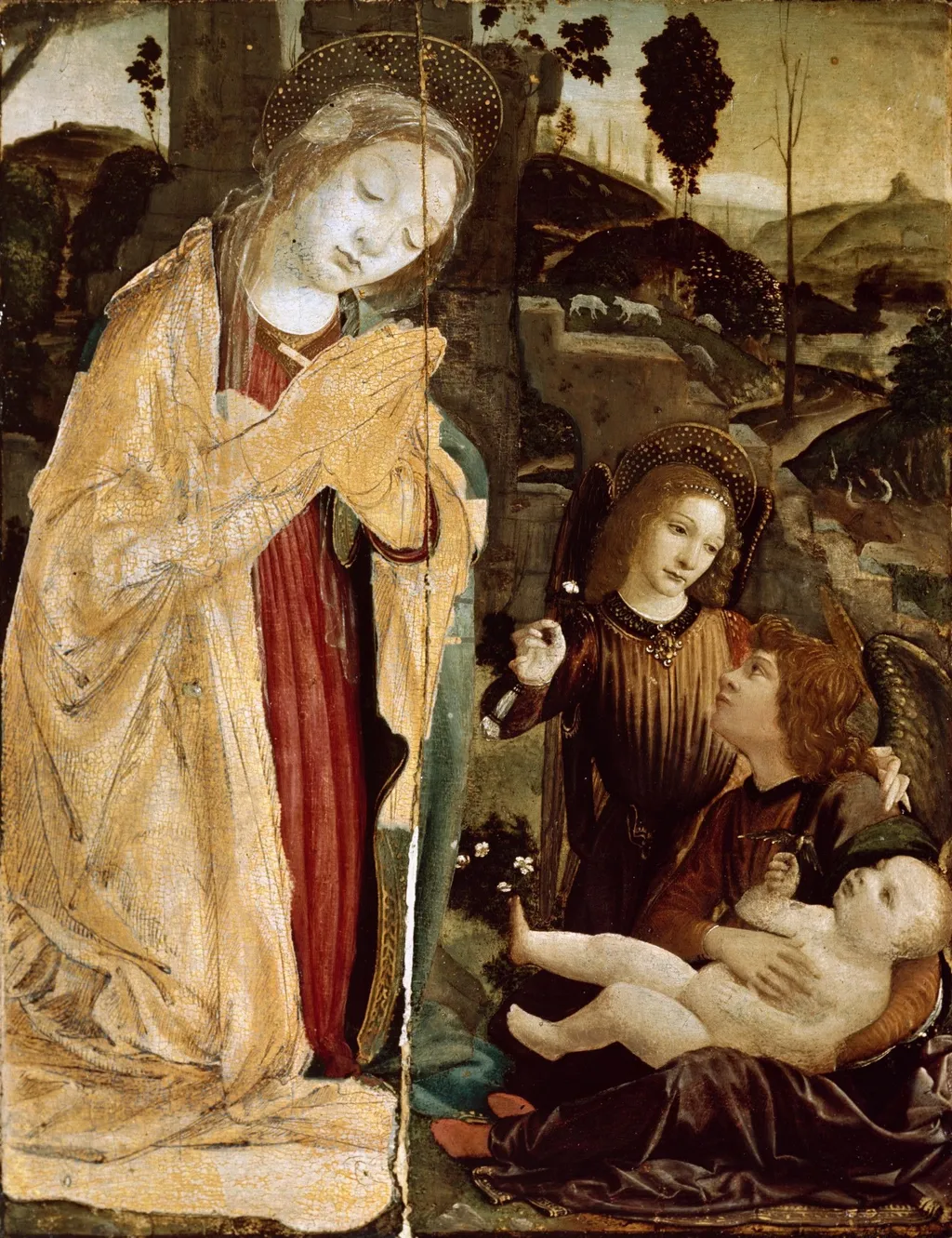
Madonna with two Angels Adoring the Christ Child in a landscape is a tempera painting by the Early Renaissance artist Andrea del Verrocchio. It dates from 1473 and is held in the collection of the Detroit Institute of Arts.
About this work
Subject & Meaning
The hilly, atmospheric landscape frames the scene and conveys a sense of contemplative stillness, characteristic of Florentine devotional imagery of the 1470s.
The painting depicts the Virgin Mary kneeling in adoration before the Christ Child, who is supported on the lap of a seated angel while a second angel kneels beside them. The Christ Child holds a bird, and the standing angel presents a flower, elements that underscore the sacred encounter and divine innocence.
The hilly, atmospheric landscape frames the scene and conveys a sense of contemplative stillness, characteristic of Florentine devotional imagery of the 1470s. The unfinished state of the Virgin’s figure has prompted debate about collaborative authorship, with some attributing portions to Leonardo da Vinci, yet the core subject remains a standard iconography of the Madonna and Child in an earthly setting.
History & Provenance
The work was created in 1473 by Andrea del Verrocchio in his workshop in Florence, likely as an altarpiece for a private devotional commission. It remained in a Florentine collection before passing by marriage into the possession of a Roman noble family in the 17th century. In 1957 Rudolf J. Heinemann and the New York dealer M Knoedler & Co acquired it from an Italian private collection, after which it entered the collection of the Detroit Institute of Arts.
Subsequent conservation revealed an earlier, fully painted layer of the Virgin beneath later overpainting, supporting the view that the panel was left unfinished and later worked on by assistants. Contemporary scholarship has debated the extent of Leonardo da Vinci’s involvement, with early 20th‑century proponents such as Wilhelm Suida and Kenneth Clark attributing parts of the composition to the young Leonardo, while later studies in the 1990s and early 2000s reconsidered authorship and dating, eventually placing the work within Leonardo’s circle but not as a wholly autonomous Leonardo painting.
The painting is held in the collection of the Detroit Institute of Arts in Detroit, Michigan. Its inventory/accession number is not specified in the sources. The work has been part of exhibitions at the Detroit Institute of Arts, including a 1957 acquisition that was publicized through the museum's publications and promotional materials.
It was acquired in 1957 from Rudolf Heinemann and the art dealership M. Knoedler & Co. for $250,000, following a fundraising effort that involved 28 donors. The painting was previously owned by Rudolf J. Heinemann and M. Knoedler & Co., and before that by an Italian private collection that passed through Roman aristocratic hands in the 17th century. The work has been referenced in scholarly literature and museum publications, including writings by Edgar P. Richardson, who documented its acquisition and history.
Context
The painting was regarded as an unfinished work from Verrocchio's circle that sparked extensive scholarly debate over its authorship and connection to Leonardo da Vinci. Early commentators such as Roberto Longhi, Stefano Bottari and Antonio Morassi argued for Leonardo's participation, a view supported by Wilhelm Suida and Wilhelm Reinhold Valentiner, while Kenneth Clark emphasized its value in illustrating workshop practices of the period. Subsequent attributions shifted from Leonardo's hand to various associates, including Ambrogio de Predis, Domenico Ghirlandaio and Bastiano Mainardi, before the consensus settled on classification as a work of Leonardo's school.
The Detroit Institute of Arts acquired the panel in 1957 for $250,000 after a fundraising campaign, and Edgar P. Richardson's 1957 publication framed the purchase as justification for Leonardo's involvement despite the work's unfinished condition.
Legacy
The attribution history of this painting reflects evolving scholarly interpretations of its authorship and influence. Early analyses by Longhi, Bottari, Morassi, Suida, and Valentiner suggested significant contributions from Leonardo da Vinci, particularly in the angelic figures and landscape, supporting theories of a youthful collaboration within Verrocchio's workshop. This view gained traction through Richardson's 1957 acquisitions advocacy, which framed the work as a key Leonardo-era piece justifying its $250,000 purchase.
Subsequent reattributions shifted focus: a 1994 proposal identifying it as entirely Verrocchio's hand was later superseded by de Predis' 1997 suggestion as the primary hand, with Mainardi and Ghirlandaio's circles also considered. By 2008, the Detroit Institute of Arts classified it as originating from Leonardo's school, though contemporary scholarship emphasizes its complex workshop origins without definitive singular authorship. The work's legacy lies in its role as a touchstone for debates on artistic collaboration, workshop practices, and the attribution of disputed Renaissance pieces, influencing conservation approaches and interdisciplinary studies of Verrocchio's studio.
Overview
This tempera painting, completed in 1473 by the Floreteenth-century artist Andrea del Verrocchio, presents a devotional scene set within a natural environment. Verrocchio maintained a significant workshop in Florence where he trained numerous artists, most notably Leonardo da Vinci. His practice encompassed sculpture, painting, and goldsmithing, with this work representing his contribution to early Renaissance panel painting.
Technique & Style
The artist employed tempera, a medium created by binding pigment with egg yolk, which produces a matte, precise surface. The paint application appears relatively flat, with visible age cracks across the panel. The figures occupy the foreground while a rocky hillside and trees recede into the distance, demonstrating the developing Renaissance interest in spatial depth and naturalistic settings. The subdued color palette and careful linear detail reflect Verrocchio's sculptural training.
Own this work as a print
Artist & collection
Artist
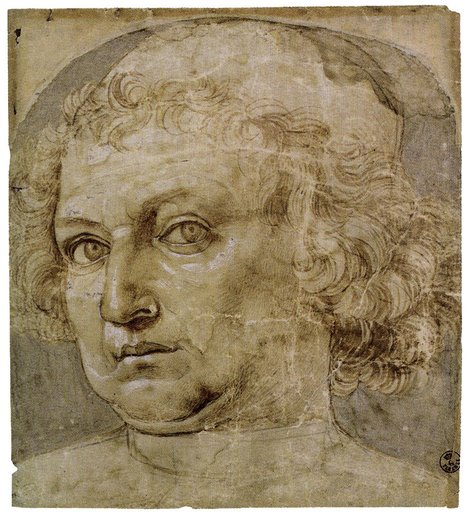
Andrea del Verrocchio was an Italian sculptor, painter and goldsmith who was a master of a workshop in Florence. He was the teacher of Leonardo da Vinci, who assisted in painting The Baptism of Christ.

 The Virgin and Child with two Angels
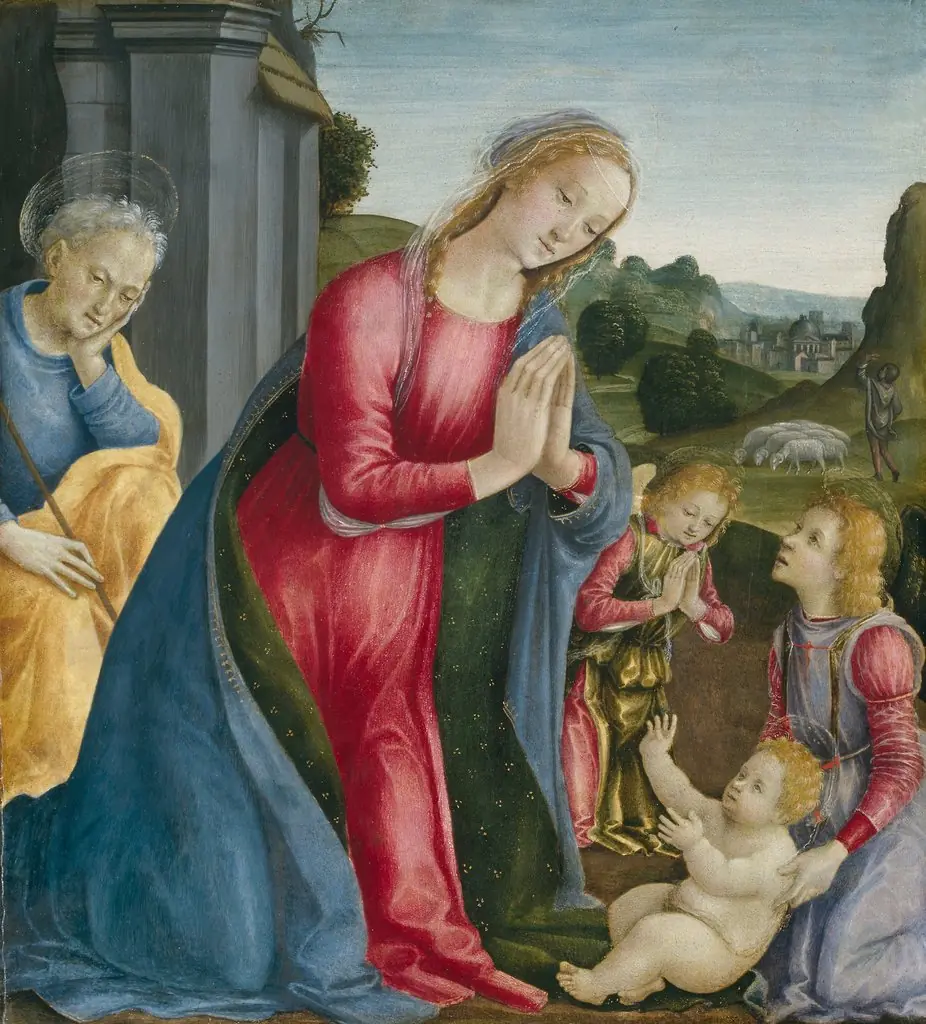 The Adoration of the Christ Child
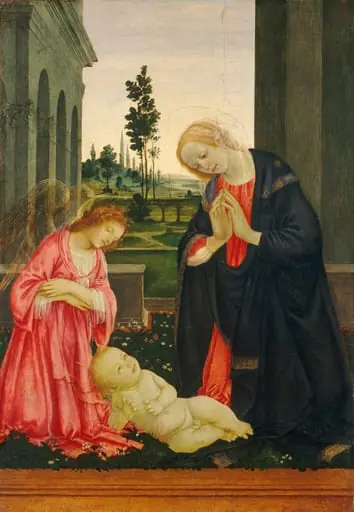 The Adoration of the Child
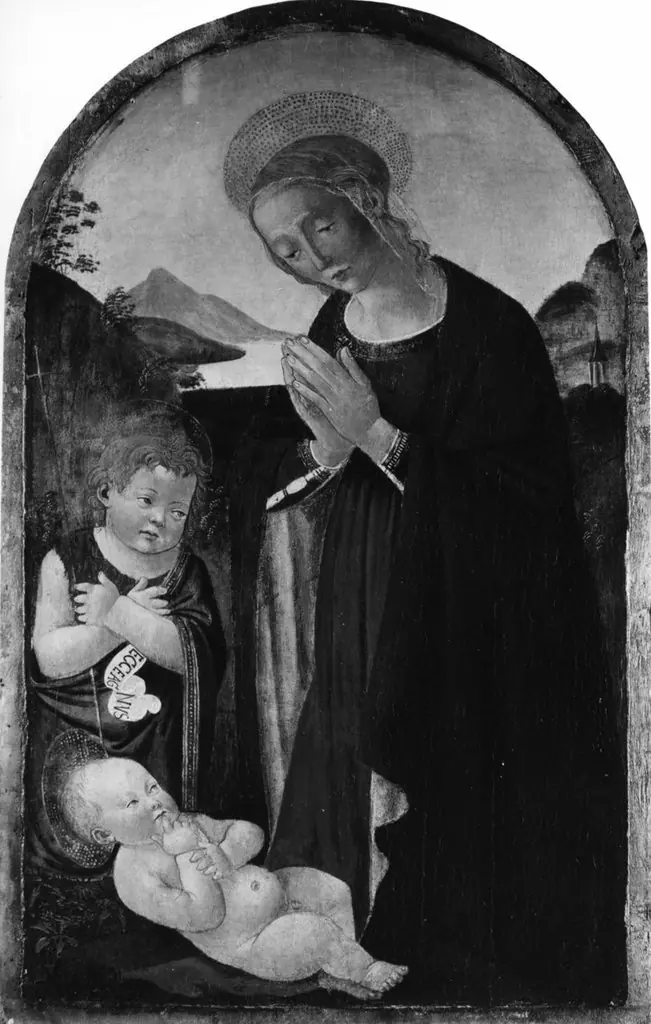 Mary, John and Christ as a Child
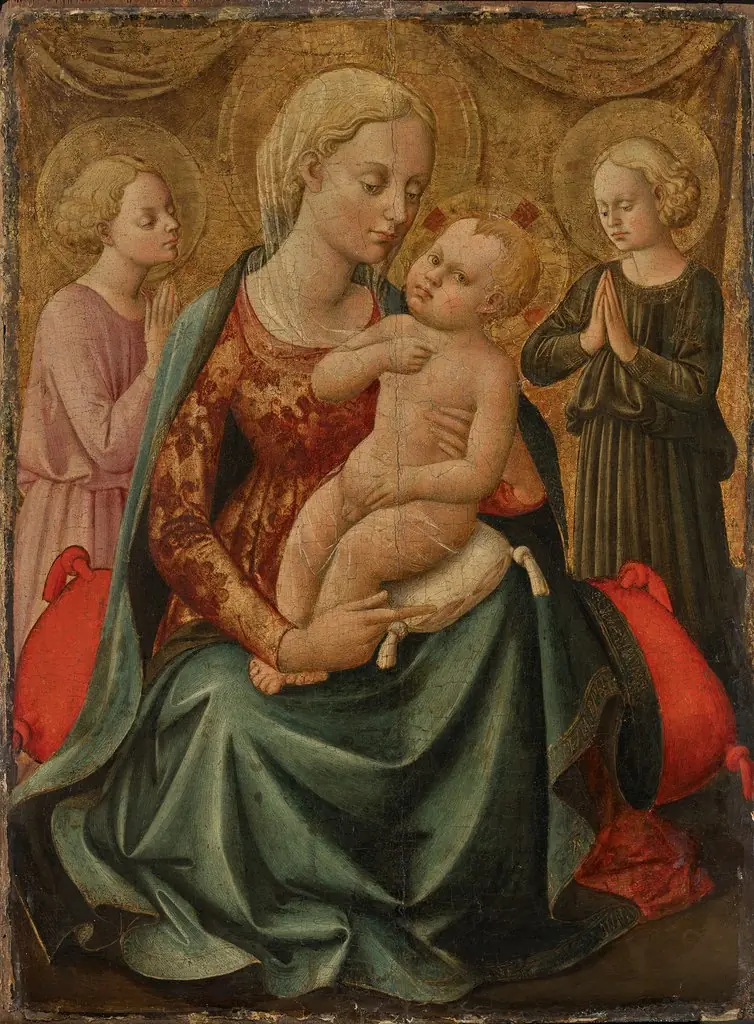 Madonna and Child
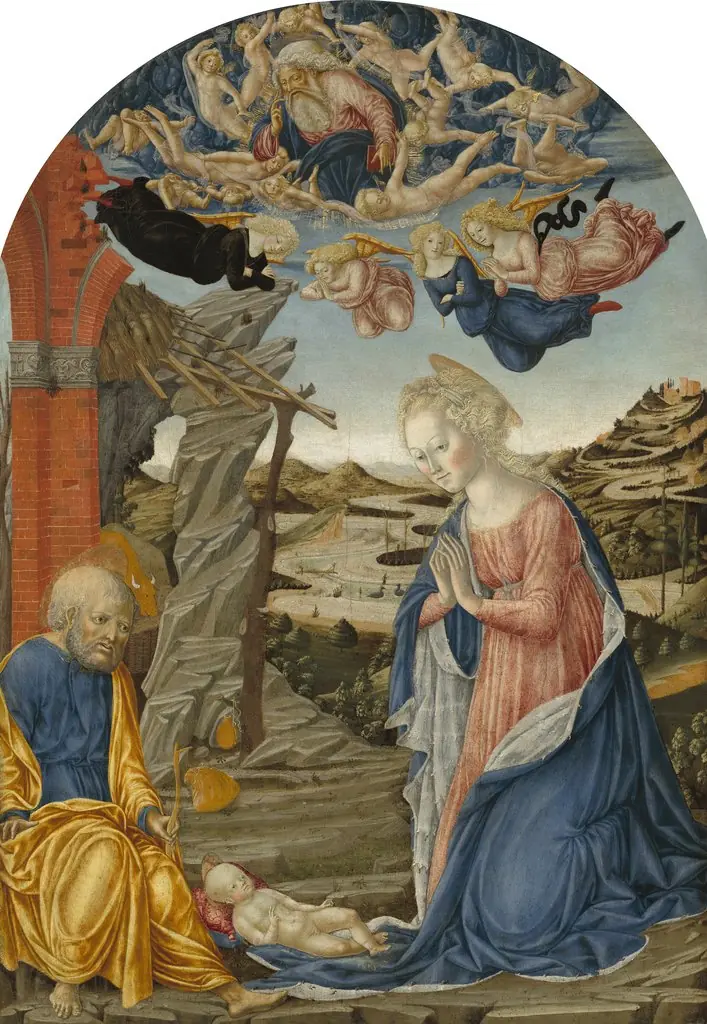 The Nativity
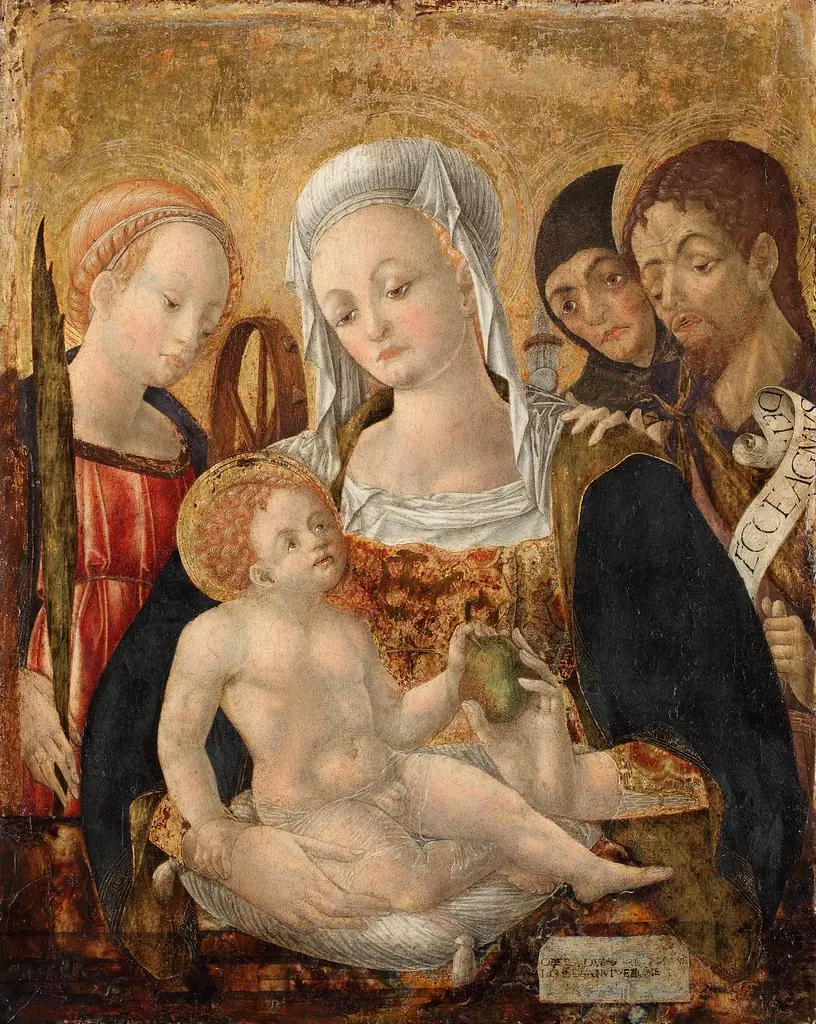 The Virgin and Child with Sts. Catherine of Alexandria, Clara and John the Baptist
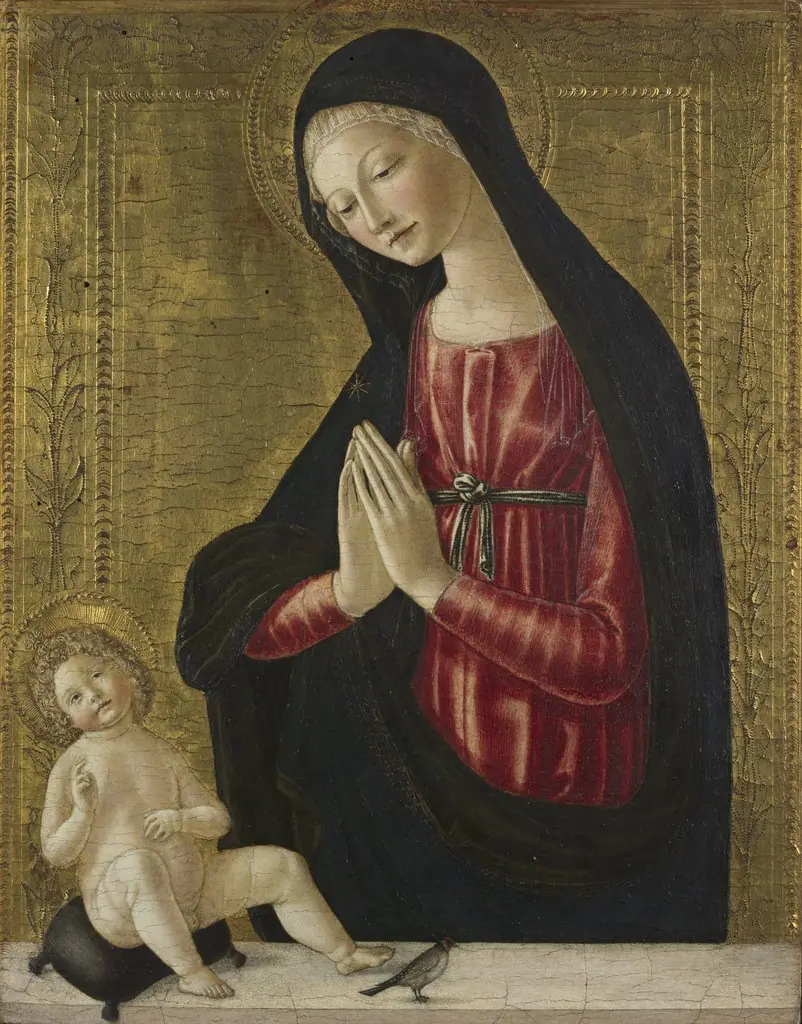 Virgin and Child with a Goldfinch
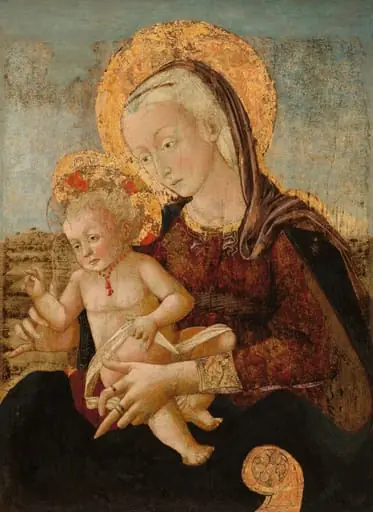 Madonna and Child
 The adoration of the Shepherds