Artwork
Race Horse and Trainer
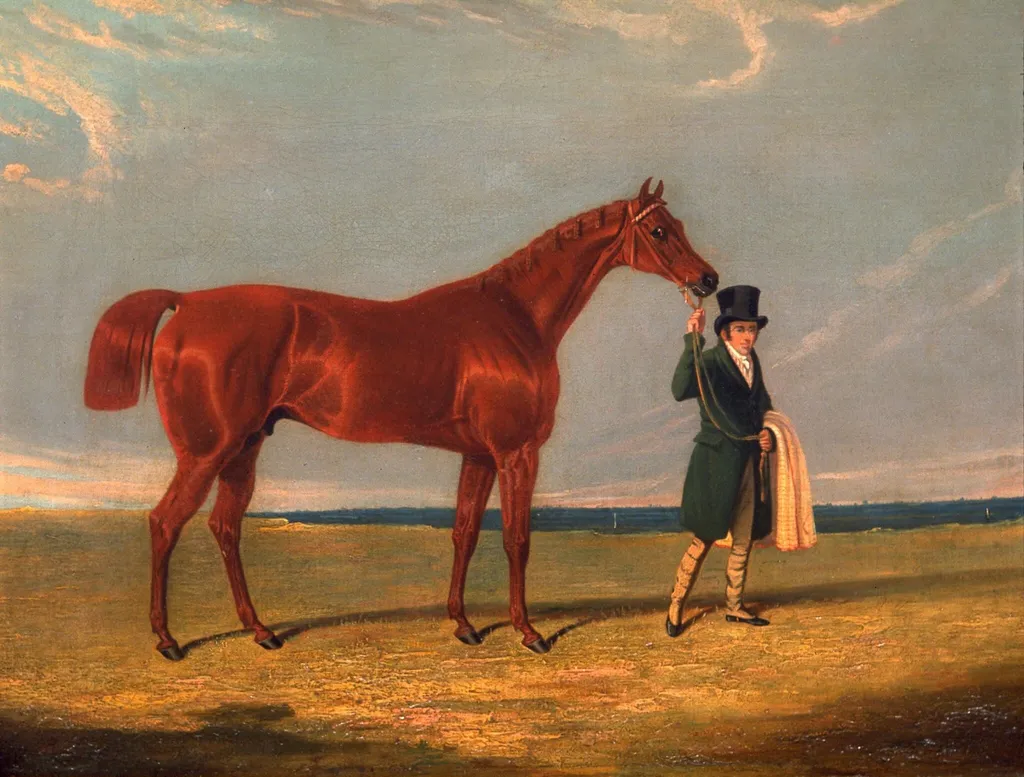
Race Horse and Trainer is an oil painting by the Romanticist artist Style of Benjamin Marshall. It dates from 1822 and is held in the collection of the National Gallery of Art.
About this work
Overview
Race Horse and Trainer is an oil-on-canvas painting dated circa 1820/1825, executed in the style of the British sporting artist Benjamin Marshall.
Race Horse and Trainer is an oil-on-canvas painting dated circa 1820/1825, executed in the style of the British sporting artist Benjamin Marshall. The work measures 33.3 by 43.5 cm and is held by the National Gallery of Art in Washington, D.C., where it entered in 1970 as part of the bequest of Ailsa Mellon Bruce. Though long associated with Marshall's circle, the painting is now classified by the National Gallery as by the "Style of Benjamin Marshall," reflecting scholarly uncertainty about its precise authorship. It represents a characteristic example of early nineteenth-century British sporting art, a genre devoted to the depiction of racehorses, hunters, and the culture of the turf.
Subject & Meaning
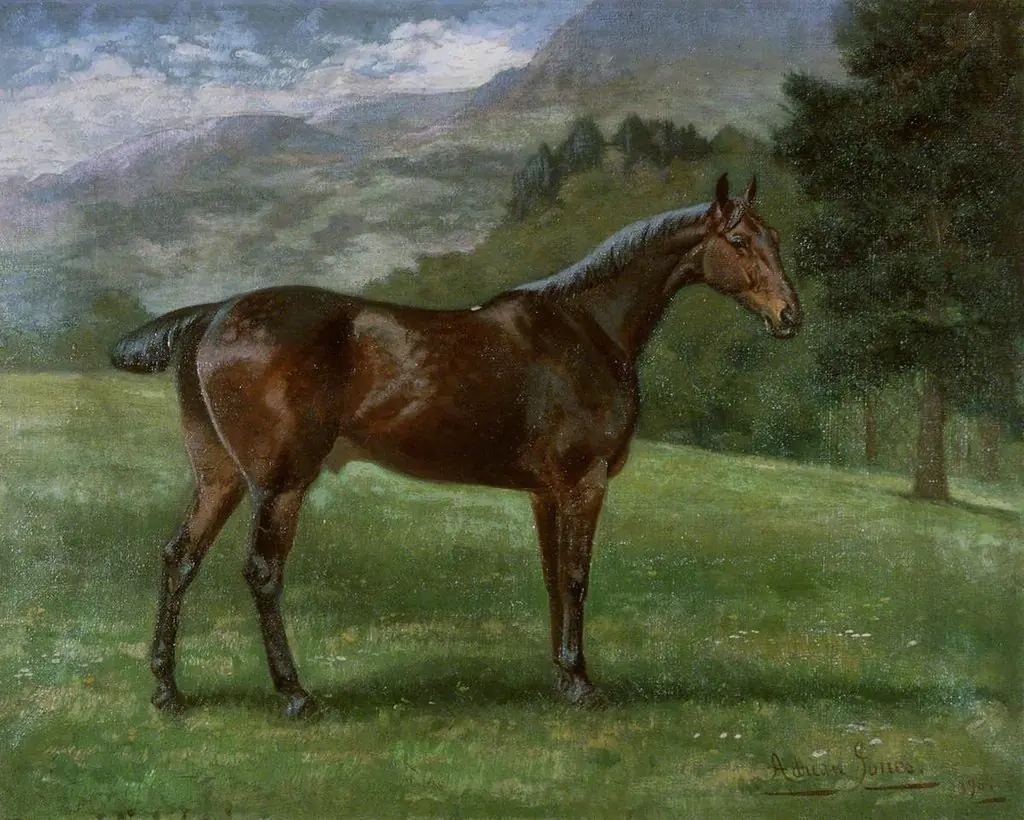
The painting presents a chestnut racehorse in profile, facing right, accompanied by a trainer or groom who stands to the horse's right holding its reins. The horse, which occupies the left two-thirds of the canvas, displays a glossy coat with dark mane and tail and wears a simple bridle. The human figure is dressed in the standard attire of a horseman of the period: a black top hat, dark green coat, light breeches, and tall boots, with a light-colored cloth draped over his left arm. The setting is flat, golden-brown grassland stretching to a low horizon beneath a pale blue sky with soft, wispy clouds tinged with pinkish light. The composition emphasizes the horse's physical power and breeding, central concerns of British sporting art, while the groom's deferential stance reinforces the social hierarchy of the racing world, where the animal's value exceeded that of its attendant.
Technique & Style
The work is painted in oil on canvas with relatively smooth brushwork and careful modeling of the horse's musculature, contrasted with more atmospheric handling of the sky and distant landscape. The paint surface shows fine craquelure throughout. Shadows fall to the right of both figures, indicating light from the left, a device that gives volume to the horse's form. The handling of the horse's anatomy reflects the influence of George Stubbs, whose scientific study of equine structure transformed British animal painting. The overall effect is one of controlled naturalism, with precise attention to the textures of coat, fabric, and flesh tempered by a conventionalized landscape setting typical of sporting portraits of the era.
History & Provenance
The painting's early history remains unknown. It was handled by M. Knoedler & Co. in London in 1929, then passed to Ailsa Mellon Bruce of New York, who bequeathed it to the National Gallery of Art in 1970. The accession number is 1970.17.125. The work has twice been placed on extended loan: to Blair House, Washington, D.C., from 1988 to 2004, and to the Vice President's House for use by Vice President and Mrs. Joseph Biden from 2009 to 2015. It has been catalogued variously as "Attributed to Marshall" in 1975 and subsequently as "Style of Benjamin Marshall." The painting is documented in John Hayes's 1992 systematic catalogue of British paintings at the National Gallery of Art.
Context
Benjamin Marshall (1768-1835) was a leading English sporting and animal painter, a follower of George Stubbs who began concentrating on horses at age twenty-six and exhibited thirteen pictures, chiefly portraits of racehorses and their owners, at the Royal Academy between 1801 and 1819. He contributed letters on horse racing to The Sporting Magazine from 1821 to 1833 under the pseudonym "The Observator." The attribution of works from his studio and circle has long challenged scholars. Walter Shaw Sparrow's 1929 monograph George Stubbs and Ben Marshall and Guy Paget's 1944 article in Apollo established the foundation for Marshall studies, while the 1967 Leicester Museums exhibition helped consolidate his oeuvre. The National Gallery's cautious attribution of Race Horse and Trainer reflects the broader difficulty of distinguishing Marshall's hand from that of assistants and imitators working in his manner during the 1820s.
Legacy
Race Horse and Trainer occupies a modest but representative place in the history of British sporting art and in the collections of the National Gallery of Art. Its classification as "Style of Benjamin Marshall" rather than a firm attribution illustrates the ongoing challenges of connoisseurship in a field where studio production, copies, and close imitations complicate authorship. The painting's two extended loans to official Washington residences, Blair House and the Vice President's House, indicate its suitability as a diplomatic and institutional representation of British cultural heritage. As a work that has moved from commercial gallery to private collection to public museum, and from tentative attribution to qualified classification, it exemplifies how scholarly understanding of sporting art continues to evolve through careful material and archival study.
Artist & collection
Artist