Artwork
Memorial card for Albert, The Prince Consort
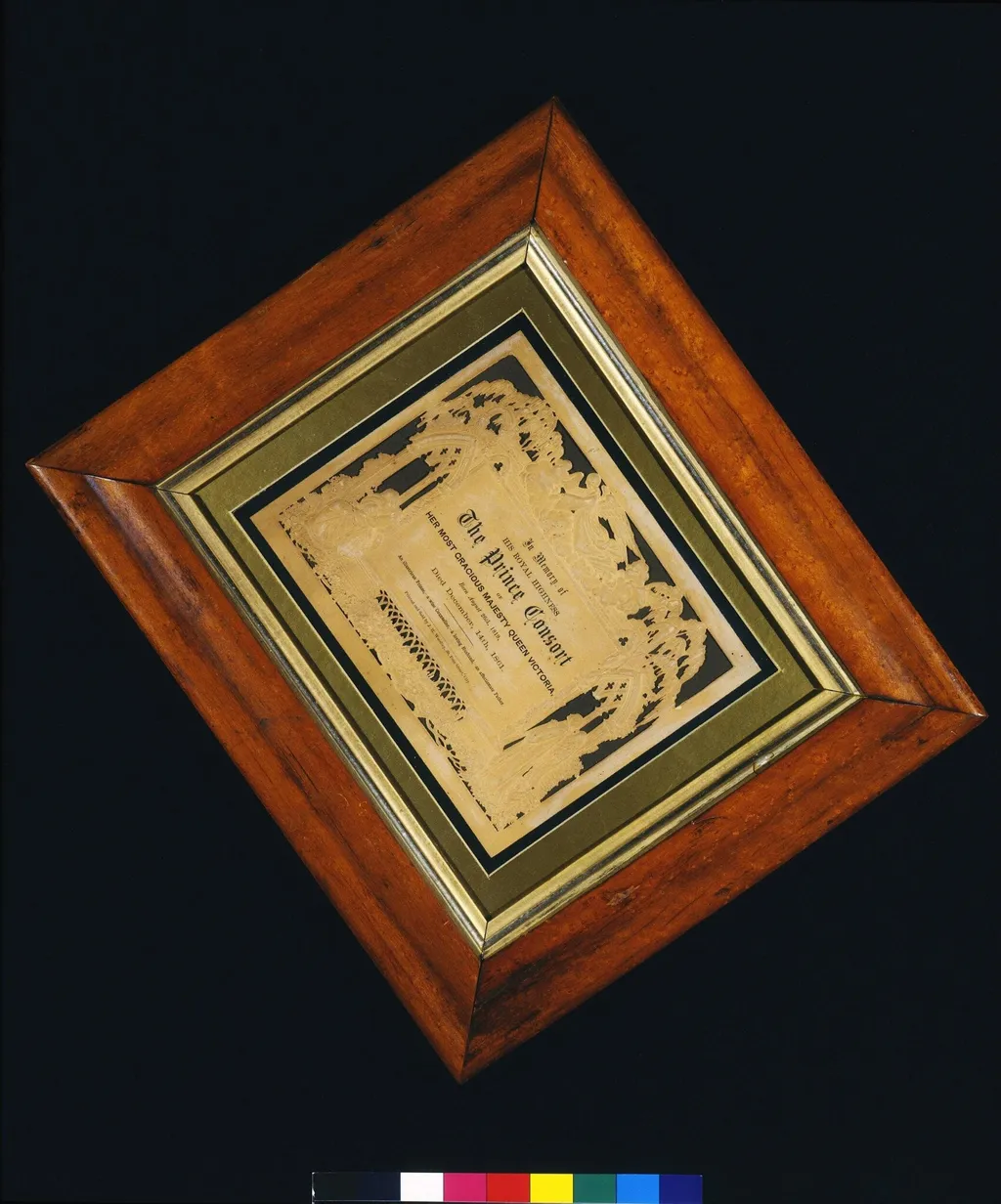
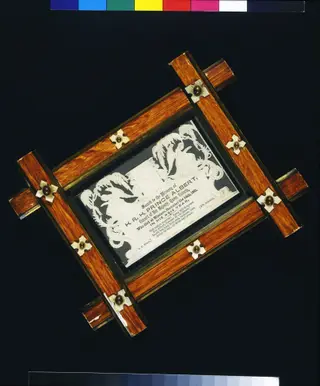
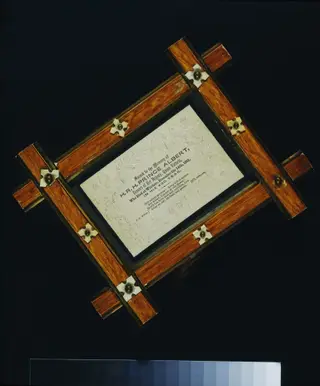
Memorial card for Albert, The Prince Consort is a print by the Romanticist artist BOXES ANONYMOUS. It dates from 1819 and is held in the collection of the Victoria and Albert Museum. A printed memorial card was issued in 1861 to honor Albert, Prince Consort, following his death that same year.
About this work
Overview
It bore the royal Windsor emblem in embossed relief and was distributed through Woodley’s business at 30 Fore Street, City.
A printed memorial card was issued in 1861 to honor Albert, Prince Consort, following his death that same year. Produced in Windsor and printed in London by J.H. Woodley, the card served as a formal token of mourning. It bore the royal Windsor emblem in embossed relief and was distributed through Woodley’s business at 30 Fore Street, City. The design combined typographic solemnity with ornamental detail, reflecting the era’s conventions for royal commemoration.
Subject & Meaning
The card’s central inscription, 'In Memory of His Royal Highness The Prince Consort,' framed Albert’s death as a national loss. Its formal tone and royal insignia reinforced his role as a stabilizing figure in the monarchy. The absence of imagery focused attention on the text, emphasizing duty, grief, and public reverence.
Such cards were circulated among subjects and institutions, functioning as both personal mementos and collective symbols of mourning.
Technique & Style
Produced via letterpress printing, the card featured sharp, legible typography in a formal serif font, typical of Victorian official printing. The Windsor crest was embossed, adding tactile dimension without color. Decorative elements included restrained geometric and floral borders, blending symmetry with subtle curvature.
The use of black paper or a black background, common in mourning stationery, heightened the contrast of white or gilt text, reinforcing solemnity through visual austerity.
History & Provenance
The card was printed shortly after Albert’s death in December 1861, during a period of widespread public mourning. It was distributed through J.H. Woodley’s London print shop, a known publisher of official and commemorative materials. The Victoria and Albert Museum acquired it as part of its collection of 19th-century design artifacts, preserving it as an example of how mass-produced objects mediated royal grief in the Victorian age.
Context
In mid-19th century Britain, memorial cards were standard for commemorating prominent figures, especially royalty. Queen Victoria’s prolonged mourning elevated the cultural significance of such items, turning them into objects of public participation. The card’s production in Windsor, near the royal residence, and its distribution via a commercial printer illustrate the intersection of state ritual and emerging print culture in shaping collective memory.
Legacy
This card exemplifies how Victorian mourning practices merged personal grief with institutional formality. Its preservation in the Victoria and Albert Museum underscores its value as a material artifact of royal commemoration and design history. Similar cards were widely circulated, but few survive with documented provenance.
This one remains a quiet testament to the era’s rituals of loss and the role of print in sustaining public remembrance.
Artist & collection
Artist
Boxes Anonymous left us with a simple trick: they made mourning feel like a work of art.

 Turcoaice
 Flori - cavaleri
 Peisaj cu flori galbene
 Semn al înfloririi
 Case pe mal
 Mitropolitul Veniamin
 Din deltă
 Portret
 Cap de bărbat
 Icoana reprezintă Nașterea Mântuitorului Iisus Hristos. Icoana este împărțită patru secvențe: Nașterea Mântuitorului este în centrul icoanei. Pruncul Iisus Hristos, înfășat în scutece este ținut în legănuț de Maica Domnului și de Dreptul Iosif, logodnicul Fecioarei Maria. În registrul superior este ilustrată venirea magilor după steaua cea călăuzitoare. În colțul drept, este un înger îmbrăcat în cămașă roz, aplecându-se din Ceruri, pentru a privi și a mângâia bucuria Nașterii Pruncului. În registrul inferior este ilustrată îmbăierea Pruncului de către câteva tinere fecioare. Alături este Dreptul Iosif care se arată nedumerit de Taina minunată a Nașterii Domnului și de păstrarea Fecioriei Maicii Domnului și după Naștere. În centrul icoanei este steaua cea călăuzitoare cu un mănunchi de raze luminoase, aducătoare de vestea cea bună. Urcând spre dreapta, întâlnim un ciobănel păstor cu oile. Elementele de arhitectură sunt foarte minuțios realizate, creându-se atmosfera Nazareth-ului. Este o alternanță cromatică luminoasă și vie de roșu zmeuriu, roz, albstru turcoaz-smarald, galben chihlimbar, gri și brun. Cerurile sunt deschise. Icoana este foarte bogată în narațiune. Registrele se întrepătrund armonios. Inscripția din româno-chirilică se traduce Nașterea ICXC Iisus Hristos.
 Memorial card for Albert
- Memorial card for Albert