Artwork
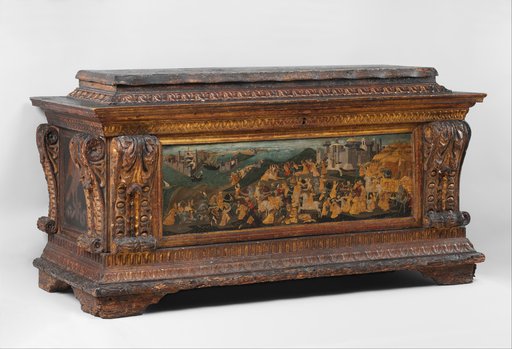
Cassone with painted front panel depicting the Conquest of Trebizond
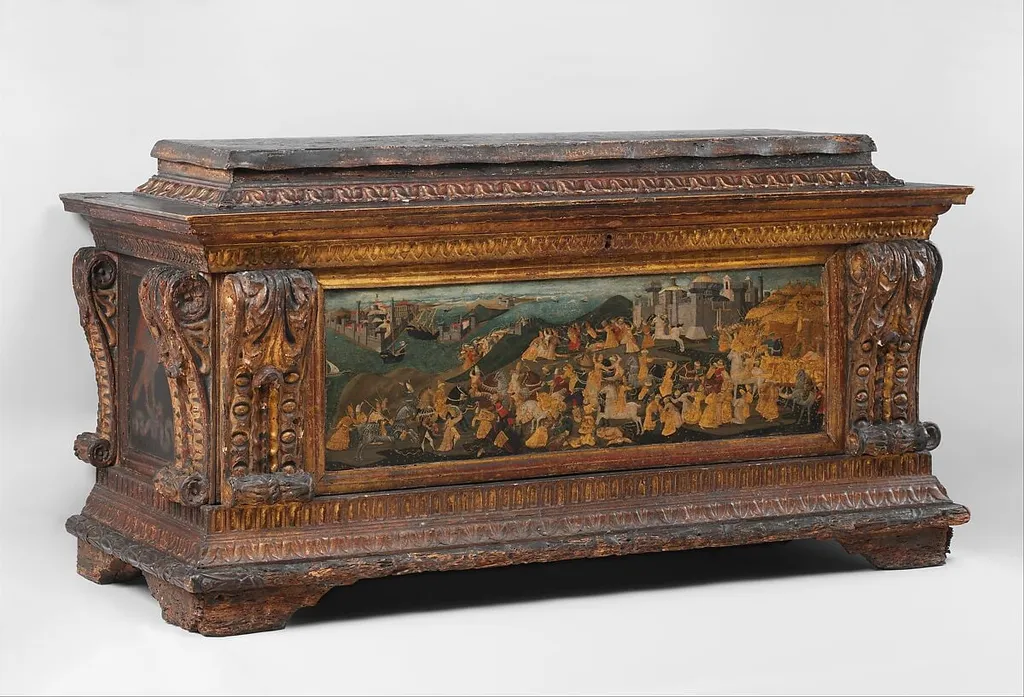
Cassone with painted front panel depicting the Conquest of Trebizond is a tempera painting by the Early Renaissance artist Apollonio di Giovanni di Tomaso. It dates from 1461 and is held in the collection of the Metropolitan Museum of Art. This Florentine cassone, or marriage chest, features a painted front panel depicting a military triumph.
- Accession no.
- 14.39
- Credit line
- John Stewart Kennedy Fund, 1914
About this work
Before the walls of Trebizond, a turbaned commander in a triumphal chariot receives captives while Janissaries retreat in disarray.
Before the walls of Trebizond, a turbaned commander in a triumphal chariot receives captives while Janissaries retreat in disarray. Painted in the Florentine workshop shared by Apollonio di Giovanni and Marco del Buono after 1461, this marriage-chest panel doubles as a comment on Ottoman expansion. Infrared study shows the victor is Tamerlane, not Mehmed II, celebrating his 1402 win at Ankara against the city that fell in 1461.
Subject & Meaning
The cassone depicts the Siege of Trebizond in 1461, a historical event marking the Ottoman conquest of the last Byzantine successor state, the Empire of Trebizond. Iconographic elements include representations of Trabzon and Constantinople alongside references to both the Byzantine and Ottoman Empires. As a history painting on a domestic object, the scene likely served to convey contemporary narratives of triumph or political commentary, though explicit symbolism is not documented in the sources.
Technique & Style
The cassone is constructed from poplar wood with a linen covering, over which a gesso ground has been applied and gilded. The painted front panel is executed in tempera with gold highlights, a technique typical of fifteenth-century Florentine cassoni. The painting depicts the Conquest of Trebizond in a narrative, history-painting style, showcasing detailed figural scenes and architectural elements. The gilded gesso and polychromy lend a rich, decorative surface appropriate for a wedding chest.
History & Provenance
The cassone is held at the Metropolitan Museum of Art in New York, where it is cataloged under the accession number 14.39, reflecting a 1914 acquisition. No exhibition history is provided in the available sources.
Overview
This Florentine cassone, or marriage chest, features a painted front panel depicting a military triumph. Crafted from poplar wood with polychromed and gilded gesso, the panel itself is executed in tempera and gold. While the chest originally served a domestic function, the elaborate scene transforms it into a political statement.
The panel, attributed to the workshop of Apollonio di Giovanni and Marco del Buono, presents an anachronistic narrative that comments on contemporary events through historical allegory.
Context
The panel's anachronistic depiction of Tamerlane's victory over the Ottomans, set against the recently fallen city of Trebizond, reflects Florentine political and commercial anxieties. Following Trebizond's capitulation to Mehmed II in 1461, the panel's message would have resonated with Florentine interests. An accord in December 1460 had established a Florentine presence in the region, making the prospect of Ottoman expansion a direct concern. The artwork thus serves as a visual expression of hope for a check on Ottoman dominance.
Artist & collection
Artist
Apollonio di Giovanni di Tomaso
Italian, Florence ca. 1416–1465 Florence|Italian, Florence 1402–1489 Florence

 Rajput Box with Various Scenes
 Rajput Box with Various Scenes
 The Baptism of Christ (casket lid, front); Saint Peter, Saint John the Evangelist, Saint Matthew and Two Unknown Saints (casket, front)
 Snuffbox
 Manuscript Cover Interior with Mahasiddhas, Bodhisattvas, and Protectors
 Excavations, 1869, Plan and View of a part of the Circus Maximus of the time of the Trajan, on the curve
 The Calling of James and John
 kaappi
 Deksel van een klavecimbel