Artwork
The Tiber River with the Ponte Molle at Sunset
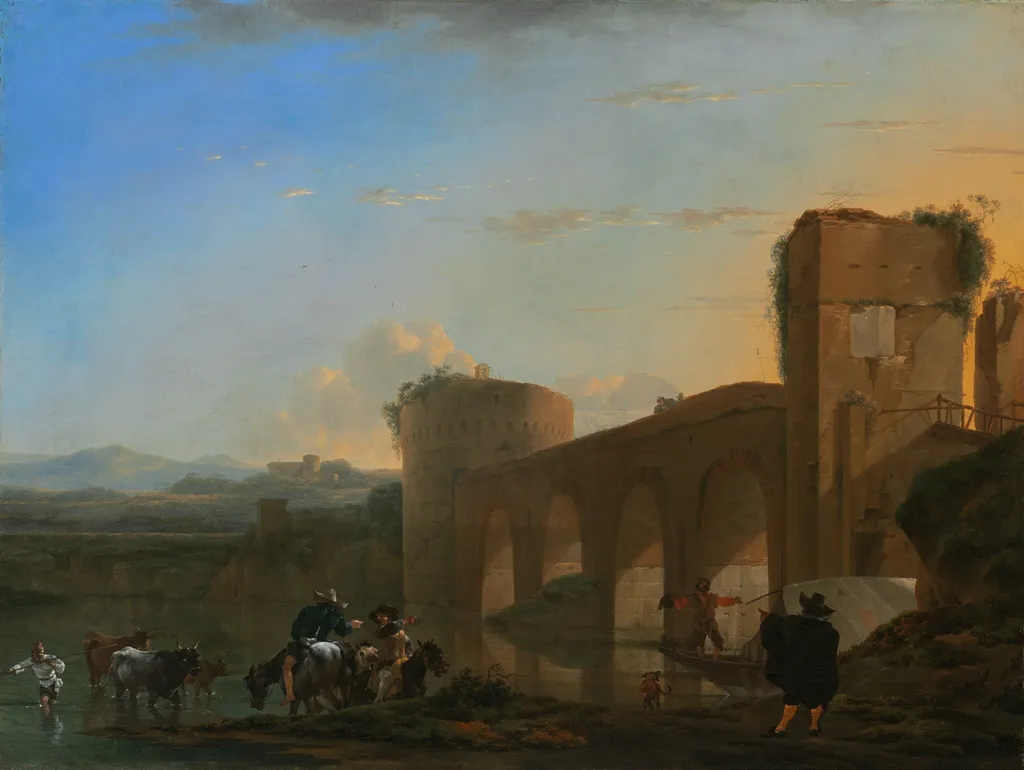
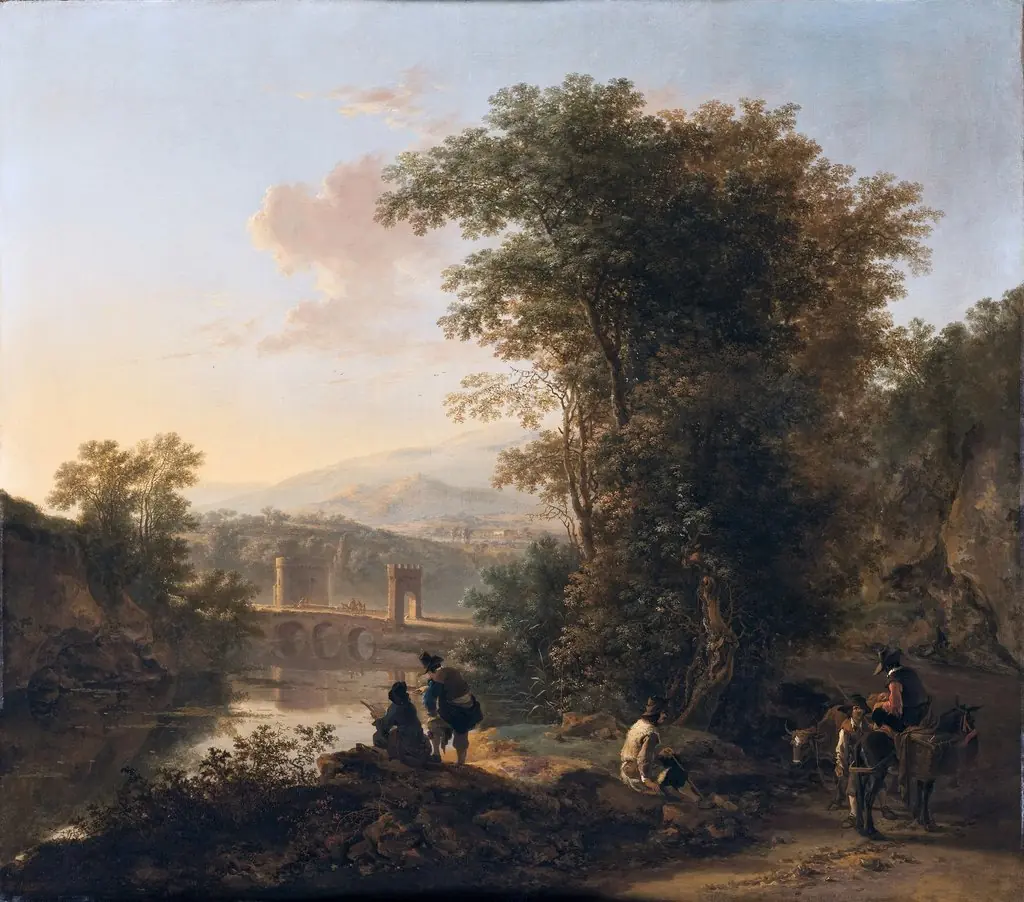
The Tiber River with the Ponte Molle at Sunset is an oil painting by the Baroque artist Jan Asselijn. It dates from 1650 and is held in the collection of the National Gallery of Art.
- Inscription
- Inscribed:lower right, in monogram: JA
About this work
Subject & Meaning
The sunset functions as both a temporal marker and an atmospheric device, casting the landscape in characteristic golden light.
The painting depicts the Ponte Molle (Ponte Milvio) spanning the Tiber River at sunset. The bridge, an ancient Roman structure north of Rome, appears as the central architectural element within a landscape setting, with the river flowing beneath it and the warm light of the setting sun illuminating the scene. The sunset functions as both a temporal marker and an atmospheric device, casting the landscape in characteristic golden light.
As a Dutch Italianate landscape, the work belongs to a genre in which Northern European artists depicted Mediterranean scenes, often imbuing them with a sense of classical antiquity and pastoral serenity. The choice of the Tiber and this particular bridge evokes Rome's imperial past and the enduring presence of ancient Roman engineering, while the sunset may suggest the passage of time and the romanticized decay of classical civilization.
Technique & Style
The work is executed in oil on canvas, a medium consistent with Jan Asselijn's landscape practice, and is classified as a painting in the landscape genre. Its modest dimensions, 41.2 cm in height by 54 cm in width, indicate a small-scale cabinet picture rather than a large decorative commission. The composition depicts the Ponte Milvio spanning the Tiber at sunset, a subject that allowed Asselijn to exploit the tonal and atmospheric possibilities of oil paint, from the warm light of the setting sun to the cooler reflections on the river's surface.
The provenance record, which traces the canvas through successive private collections from Amsterdam and The Hague to Leipzig and ultimately the National Gallery of Art in Washington, suggests the panel has survived in relatively stable condition, though no specific conservation or restoration history is documented in the available sources.
History & Provenance
Jan Asselijn painted this landscape in 1650. Its documented ownership begins with David Ietswaart in Amsterdam, from whom it passed to Willem Lormier of The Hague by 1682. Lormier's collection, catalogued in 1752 with 376 paintings, included this work; his annotated copies survive at the Netherlands Institute for Art History.
Following Lormier's estate sale in The Hague on 4 July 1763 (lot 64), Gottfried Winkler acquired it by 1768 for his Leipzig collection. The painting appeared at auction in Amsterdam on 23 February 1904, where dealer Frederik Müller purchased it. Joanna Maria Tydeman-VerLoren van Themaat of Ginneken owned it by 1938, when she lent it to an Eindhoven exhibition, and it descended through her family until the National Gallery of Art acquired it on 7 November 2012 through Rachel Kaminsky Fine Art, New York.
The Tiber River with the Ponte Molle at Sunset has been held by the National Gallery of Art in Washington, D.C., since 7 November 2012, when it was purchased through Rachel Kaminsky Fine Art in New York. Its recorded provenance before that acquisition traces through David Ietswaart in Amsterdam, the dealer Willem Lormier in The Hague (whose estate sale in 1763 dispersed the work to Gottfried Winkler in Leipzig by 1768), an anonymous Amsterdam sale in 1904, and subsequent ownership by Joanna Maria Tydeman-VerLoren van Themaat and her descendants in Ginneken. The painting was lent by Tydeman-VerLoren van Themaat to a 1938 exhibition in Eindhoven, as noted in the dealer's prospectus held in NGA curatorial files.
Overview
Jan Asselijn's "The Tiber River with the Ponte Molle at Sunset" is an oil on canvas painting that captures a serene evening scene in the Roman countryside. This work exemplifies the Dutch artist's deep engagement with Italian landscapes, a common theme in his oeuvre despite his origins in the Netherlands. The painting showcases a specific Roman landmark, known today as Ponte Milvio, bathed in the warm, fading light of day, reflecting Asselijn's ability to render atmospheric conditions.
Context
Although a Dutch painter, Jan Asselijn spent a significant period of his career working in Rome, where he developed a strong affinity for Italian scenery. His relocation to Amsterdam later in life did not diminish his focus on these southern European vistas. This painting is a testament to the enduring influence of his Roman years and can be found in the collection of the National Gallery of Art in Washington.
Own this work as a print
Artist & collection