Artwork
Italian landscape with the Ponte Molle
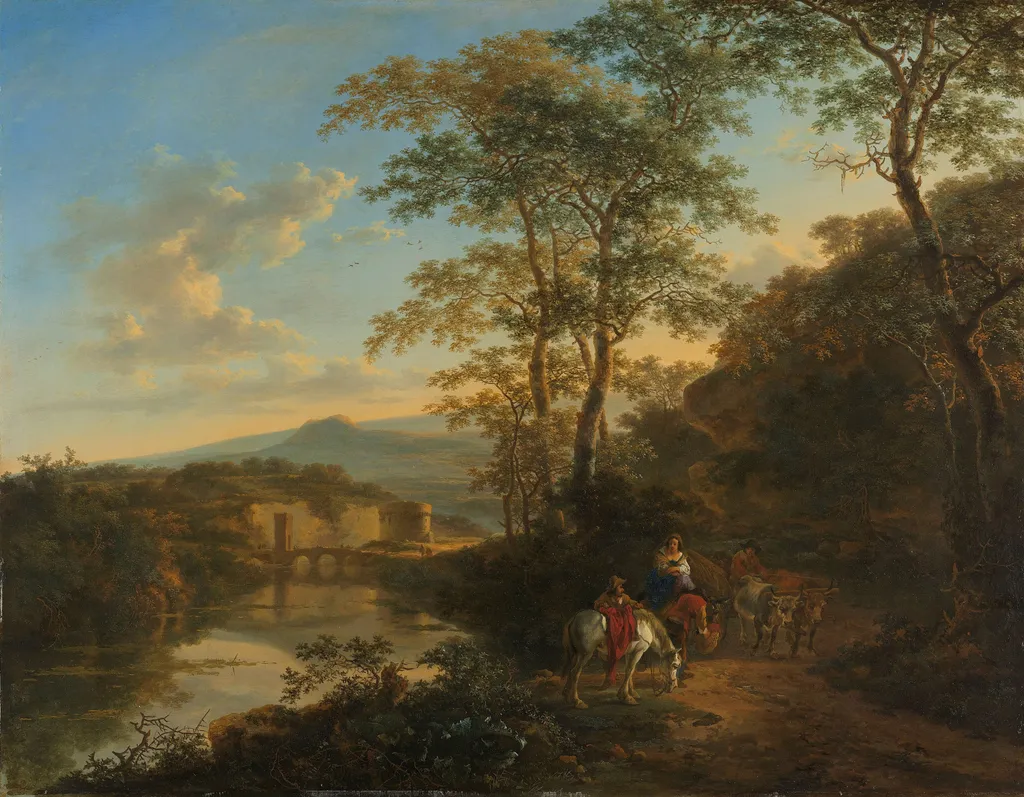
Italian landscape with the Ponte Molle is an oil painting by the Dutch Golden Age artist Jan Both. It dates from 1650 and is held in the collection of the Rijksmuseum.
About this work
Subject & Meaning
Current scholarship instead identifies the structure as the Ponte Molle, better known as the Ponte Milvio, a subject Both also treated in an etching.
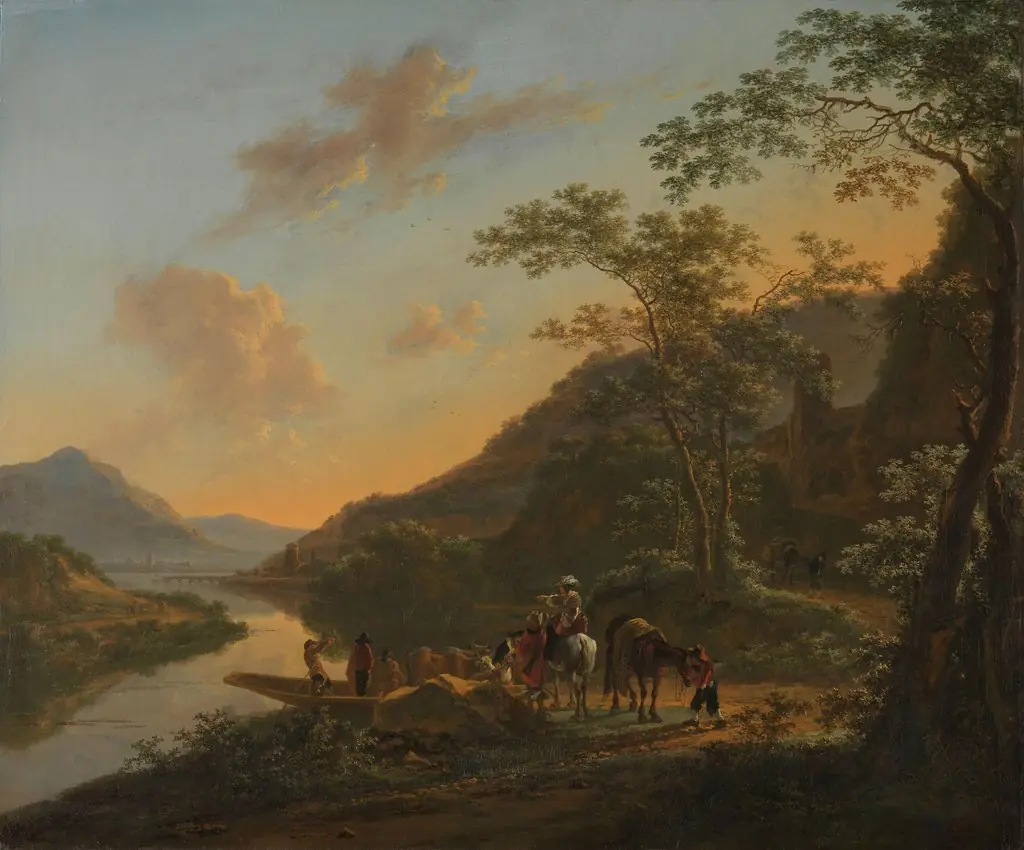
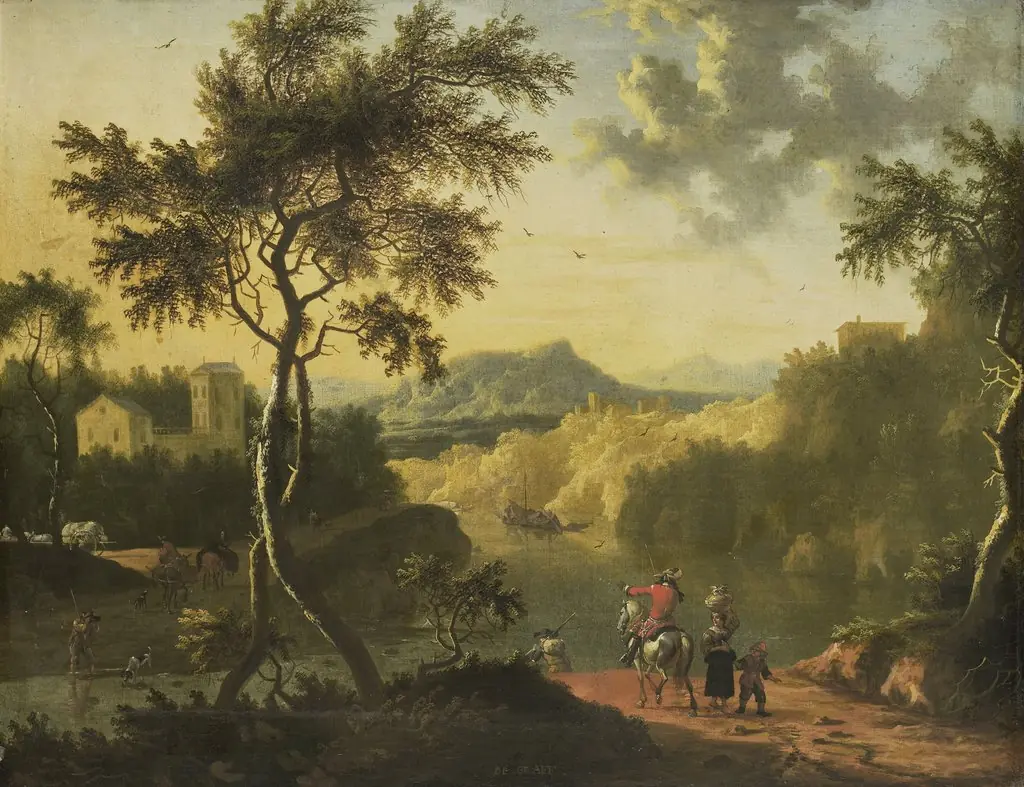
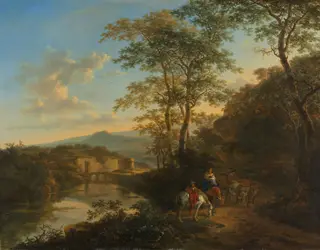
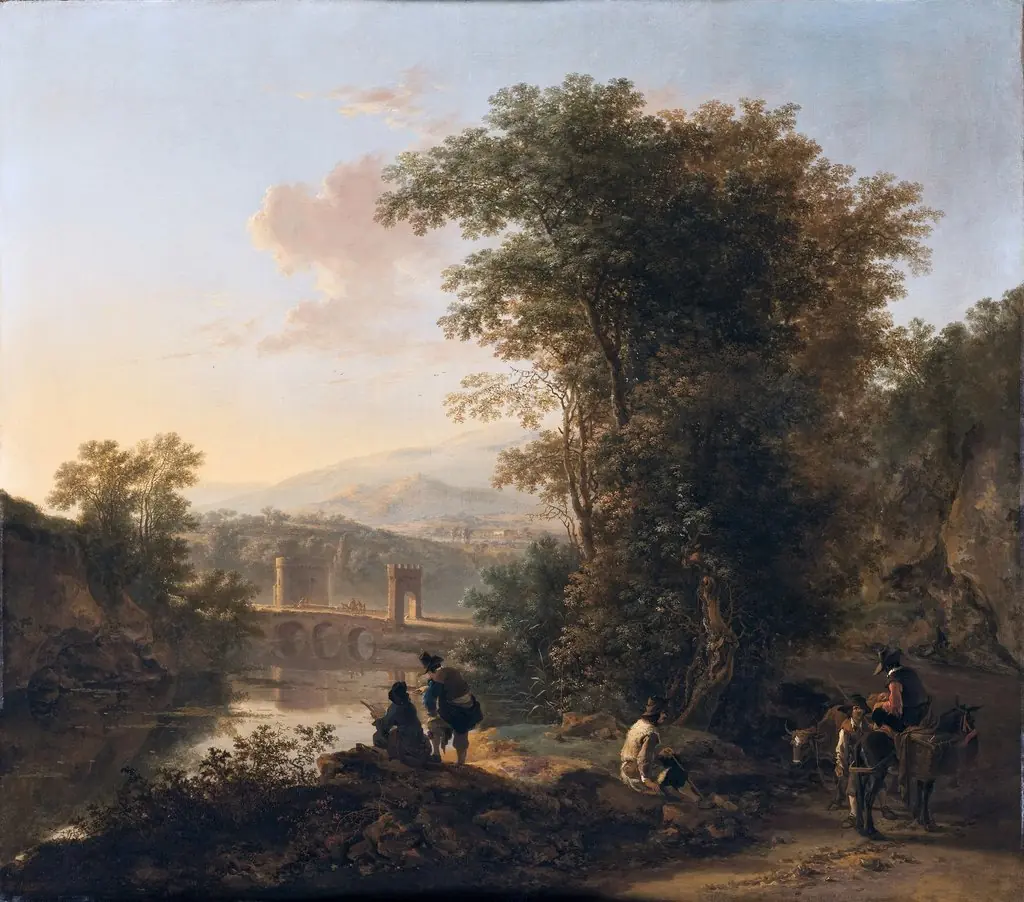
Italian landscape with the Ponte Molle presents a sunlit Italian countryside at sunset, centered on a stone bridge with a square tower that links the two banks of a river. The bridge was once identified in older scholarship, including Cornelis Hofstede de Groot, as the Ponte Lucano over the Aniene near Tivoli, with the adjacent round tower read as the Mausoleum of the Plautii. Current scholarship instead identifies the structure as the Ponte Molle, better known as the Ponte Milvio, a subject Both also treated in an etching.
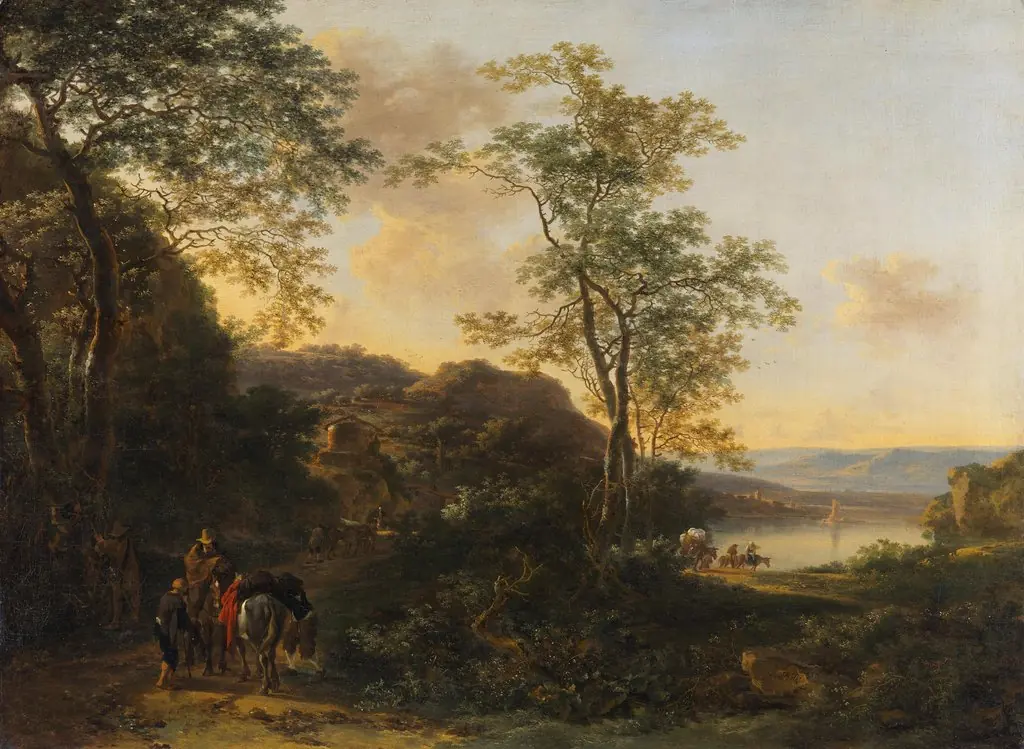
The foreground stages a roadside scene: a man stands behind a white horse draped with a red cloak, a woman rides a brown mule being fed by a man in a red jerkin, and an ox-drawn cart approaches along the path. Tall oaks rise at the center, with a rugged, rocky landscape on the right and shrub-covered banks on the left, framing the bridge as the compositional and symbolic anchor of the scene.
The painting reflects the Dutch Italianate tradition of celebrating the warm, golden light and classical ruins of the Roman Campagna, using the historic bridge as a recognizable emblem of the Italian setting.
Technique & Style
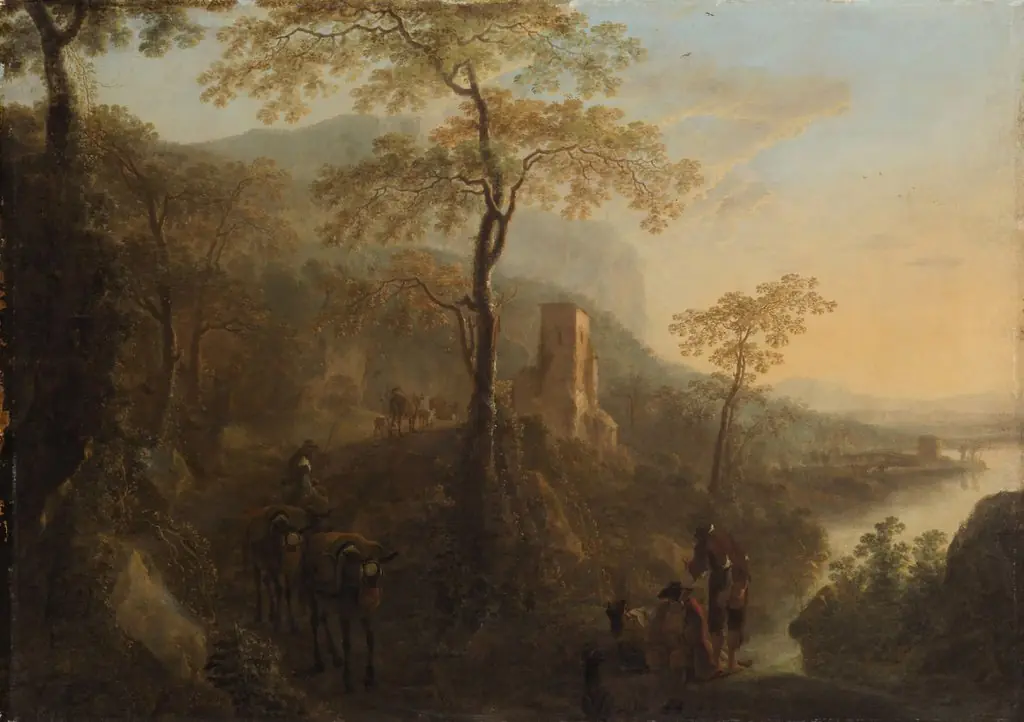
Executed in oil paint on a copper support, this 1650 landscape demonstrates Jan Both's characteristic handling of light and texture. The composition features a rugged, rocky terrain on the right contrasted with a shrub-covered riverbank on the left, unified by high oak trees in the center. Both employs a warm palette to depict a setting sun, casting specific illumination on figures including a man with a white horse and a woman on a mule.
A stone bridge with a square tower and a distant round tower anchor the background architecture. The artist signed the work 'JBoth' on a rock block in the lower left area. The painting's surface details, such as the red mantle on the horse and the feeding of the mule, are rendered with precise attention to narrative elements within the Italianate style.
History & Provenance
The painting is signed ‘JBoth’ and dates stylistically to after Jan Both’s Roman sojourn (1638–1641).
Its earliest recorded appearance is on 19 April 1775 at the posthumous sale of Johanna Ghys, widow of Pieter Anthony Bonenfant, in Zoeterwoude, where Nicolaas Nieuhoff purchased it. At Nieuhoff’s sale in Amsterdam on 14 April 1777, the work was bought by Adriaan Leonard van Heteren. Upon Van Heteren’s death, it passed to his son, Adriaan Leonard van Heteren Gevers, who consigned it, together with 134 other paintings, on 8 June 1809 to the Rijksmuseum as the Kabinet Van Heteren Gevers.
Since 1952 the painting has been managed by the Dutch national heritage agency now known as the Rijksdienst voor het Cultureel Erfgoed.
The painting is held in the Rijksmuseum, Amsterdam, accessioned as part of the Kabinet van Heteren Gevers. It was first recorded at the posthumous sale of Johanna Ghys in Zoeterwoude on 19 April 1775, purchased by Nicolaas Nieuhoff, and later sold at his sale in Amsterdam on 14 April 1777 to Adriaan Leonard van Heteren. After his death it passed to his son Adriaan Leonard van Heteren Gevers, who sold it with 134 other works as the Kabinet Van Heteren Gevers to the Rijksmuseum on 8 June 1809.
The painting was included in the exhibition The Bentvueghels. A Notorious Art Society in Rome.
Context
Italian landscape with the Ponte Molle belongs to Jan Both's Italianate output produced after his Roman sojourn of 1638 to 1641, and it has been discussed in the older literature by Cornelis Hofstede de Groot, who identified the depicted bridge as the Ponte Lucano over the Aniene near Tivoli, with the round tower read as the Mausoleum of the Plautii. Current scholarship instead identifies the bridge as the Ponte Molle (Ponte Milvio), a structure Both also treated in a print. The painting was included in the exhibition The Bentvueghels.
A Notorious Art Society in Rome, situating Both within the circle of Northern Netherlandish artists active in Rome whose work shaped the Dutch Italianate landscape tradition. Its successive ownership by Nicolaas Nieuhoff and the Van Heteren Gevers family, culminating in the 1809 sale of the Kabinet van Heteren Gevers to the Rijksmuseum, reflects the collecting history typical of seventeenth-century Dutch Italianate landscapes entering Dutch public collections in the early nineteenth century.
Legacy
The painting influenced later artists through its depiction of the Milvische Brug, also known as Ponte Molle, which became a subject of an etching by Jan Both himself and inspired subsequent representations of the bridge in art. Its legacy is tied to its presence in the Rijksmuseum collection and its historical journey from private collections to public ownership, reflecting its significance in the development of landscape painting.
The work's reputation grew through scholarly attention, including identification of the depicted bridge as Ponte Molle rather than Ponte Lucano in older literature, and its inclusion in exhibitions such as The Bentvueghels. A Notorious Art Society in Rome.
Overview
Created around 1650, this copper landscape by Jan Both portrays a tranquil Italian countryside centered on the historic Ponte Lucano, also known as Ponte Molle. The work is part of the Rijksmuseum’s collection and exemplifies Both’s interest in combining Northern realism with the luminous atmosphere of the Italianate tradition.
Own this work as a print
Artist & collection

Artist
Jan Dirksz Both was a Dutch painter, draughtsman, and etcher, who made an important contribution to the development of Dutch Italianate landscape painting.