Artwork
The Threatened Swan
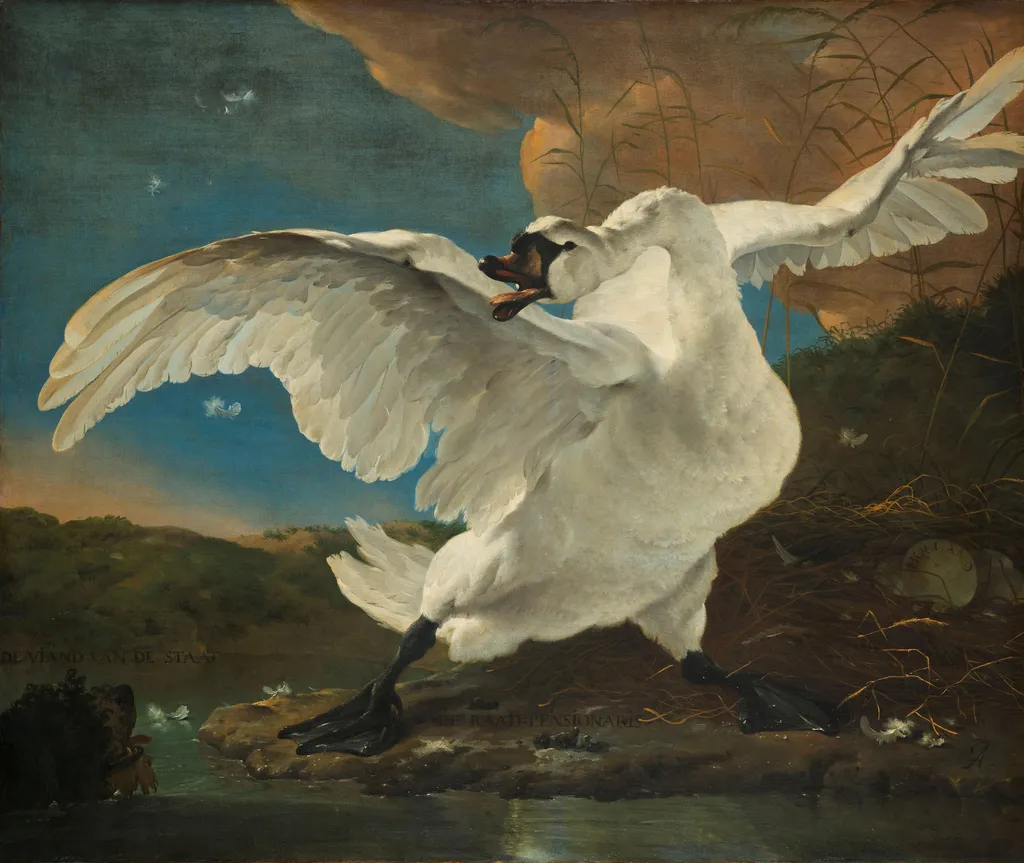
The Threatened Swan is an oil painting by the Dutch Golden Age artist Jan Asselijn. It dates from 1650 and is held in the collection of the Rijksmuseum.
About this work
Subject & Meaning
The swan, associated with purity and vigilance, is identified with Johan de Witt, the Grand Pensionary of Holland, while the dog symbolizes the state's enemies.
The Threatened Swan depicts a life-size mute swan defending its nest and eggs against an approaching dog, a scene later interpreted as a political allegory. The swan, associated with purity and vigilance, is identified with Johan de Witt, the Grand Pensionary of Holland, while the dog symbolizes the state's enemies. The added inscriptions, “de raad-pensionaris” beneath the swan, “de viand van de staat” above the dog, and “Holland” on an egg, explicitly link the composition to de Witt's defense of the Dutch Republic.
Art historical consensus places the inscriptions in the mid-eighteenth century, during the Witten-Oorlog, a pamphlet war over the 1672 execution of the De Witt brothers, rather than in Asselijn's lifetime. The allegory thus frames the swan's protective stance as a metaphor for de Witt shielding the province of Holland from political threats.
Technique & Style
Jan Asselijn executed The Threatened Swan around 1650 using oil paint on a canvas support measuring 144 by 171 centimetres. The composition features a life-size mute swan depicted from a low, frog-eye perspective to enhance its threatening posture. Asselijn employs a limited palette of white, yellow, gray, and blue tones for the bird, using backlighting where sunlight catches the upper wing to define the breast and create tension.
The artist demonstrates mastery in rendering textures, particularly the translucent edges of downy feathers and the golden straw of the nest, which reflects Italian influences. The sky consists of two blue shades, likely smalt and ultramarine, transitioning from gray at the top to clear below. The painting also includes realistic details such as the swan's excrement, rendered with subtle reddish-brown variations. Later, three white inscriptions were added to the surface, after the original artist's death.
History & Provenance
Painted by Jan Asselijn around 1650, this oil on canvas work bears his monogram "A" in the lower right corner. The artist died in 1652, predating the later political interpretations added to the piece. The painting first appeared in 1784 during the auction of Jean Deutz's collection in Amsterdam.
By the 1790s it was held by Jan Gildemeester Jansz., though it was absent from Adriaan de Lelie's 1794 depiction of Gildemeester's gallery. It was catalogued for Gildemeester's 1800 estate sale as an allegory of Grand Pensionary Johan de Witt. On 11 June 1800, the art dealer Cornelis Sebille Roos purchased the work for 100 guilders on behalf of the Nationale Konst-Gallery in The Hague, marking that institution's first acquisition.
The painting was subsequently housed in Huis ten Bosch, the Prince William V Gallery, the Royal Palace of Amsterdam, and the Trippenhuis before entering the Rijksmuseum in 1885. In 1968 it was included in the exhibition "The Age of Rembrandt: Dutch Paintings and Drawings of the 17th Century" at the National Museum of Western Art in Tokyo, and in 2016 it was selected for the Europeana 280 project.
Context
Critical discourse on The Threatened Swan has long centered on its political allegory, which emerged decades after Jan Asselijn's death in 1652. By 1800 the painting was widely read as a coded tribute to Johan de Witt, Grand Pensionary of Holland, defending the Republic against its enemies; this interpretation was cemented by added inscriptions, “de Raad-pensionaris,” “de viand van de staat,” and “Holland”, first recorded in the 1790s and plausibly linked to the mid-eighteenth-century Witten-Oorlog pamphlet wars. Scholars debate whether Asselijn intended such a reading or whether later viewers retrofitted the image to a posthumous political myth.
Within Dutch Golden Age studies, the work is often situated alongside Asselijn's Italianate animalier practice, yet its later canonical status stems from its adoption into national narratives: purchased in 1800 for the Nationale Konst-Gallery, it became a founding acquisition of what would become the Rijksmuseum and has since been exhibited as a key emblem of Dutch resilience, notably featured in Europeana 280's 2016 selection of the Netherlands' ten most important artworks.
Legacy
The Threatened Swan's later reputation rests on its transformation into a political allegory of Johan de Witt defending the Dutch Republic. By 1800, the painting was interpreted as an emblem of the grand pensionary's resistance to enemies of the state, with added inscriptions, ‘de Raad-pensionaris,’ ‘de viand van de staat,’ and ‘Holland’, linking the swan to de Witt and Holland to the nest. Though these texts likely date to the mid-eighteenth-century Witten-Oorlog pamphlet wars, they cemented the work's legacy as a symbol of Dutch resilience, securing its place among the Nationale Konst-Gallery's inaugural acquisitions in 1800.
In 2016 the painting was selected by the Europeana 280 project as one of the Netherlands' ten most important artworks, underscoring its enduring cultural significance. Contemporary references, including its appearance in the Netflix series Ares, further attest to its modern resonance.
Overview
Jan Asselijn's oil painting, The Threatened Swan, created around 1650, depicts a life-size mute swan fiercely defending its nest. This sizable work, measuring 144 by 171 centimeters, is a notable example from the Dutch Golden Age. It is currently housed in the Rijksmuseum in Amsterdam, where it remains a significant piece in the national collection. The artist's monogram "A" is visible in the lower right corner.
Own this work as a print
Artist & collection