Artwork
Osprey and Weakfish
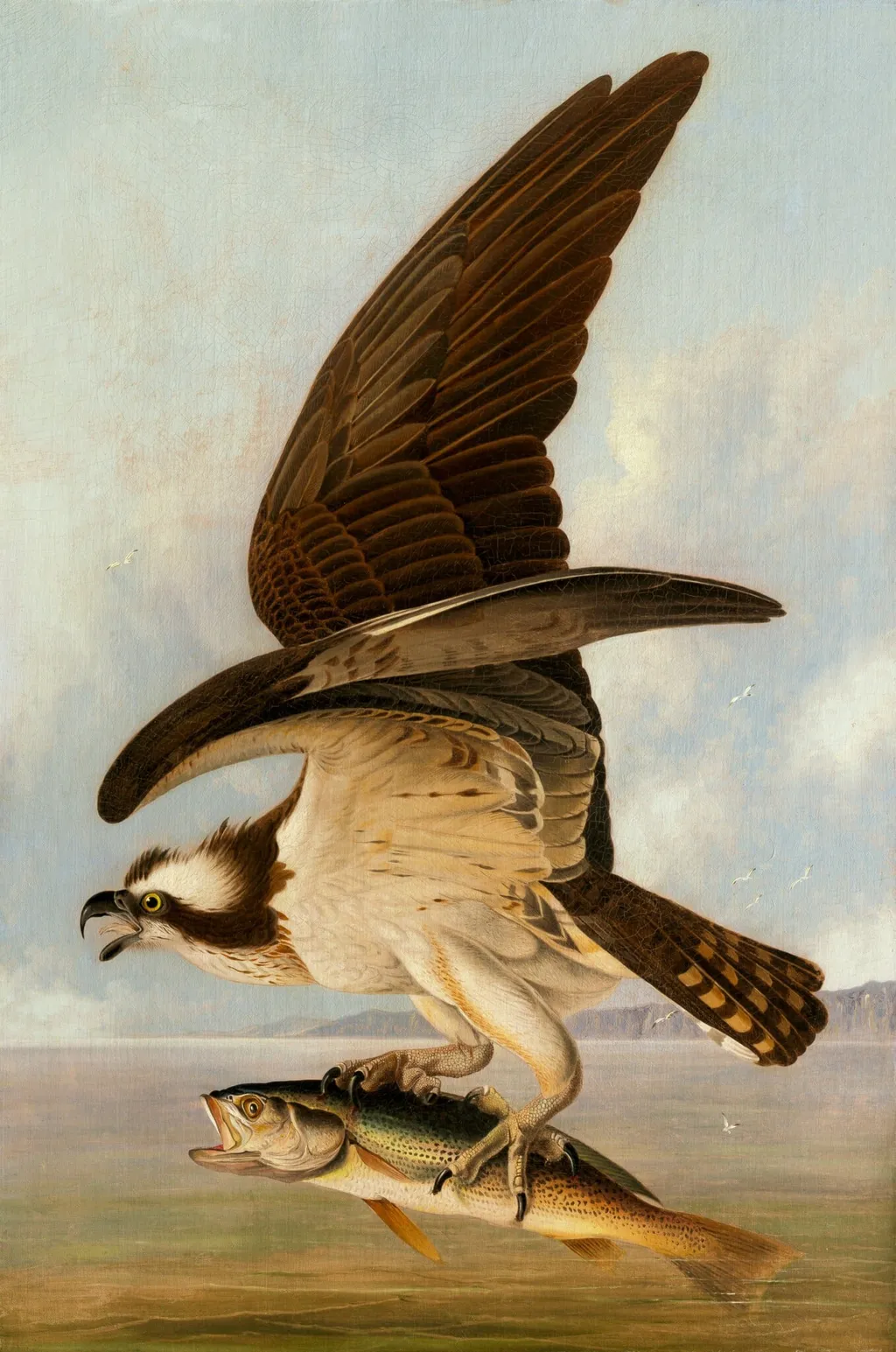
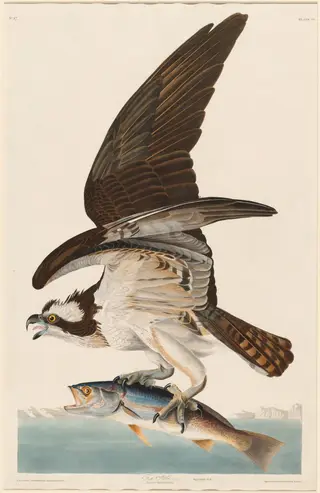
Osprey and Weakfish is an oil painting by the Romanticist artist John James Audubon. It dates from 1829 and is held in the collection of the National Gallery of Art. Created in 1829, this oil painting on canvas affixed to hardboard portrays a raptor in the act of seizing a fish.
About this work
Technique & Style
It portrays a bird in mid‑flight, rendered with Audubon’s characteristic attention to anatomical detail and naturalistic composition.
The work is an oil painting executed on canvas stretched over hardboard, measuring 101.6 cm by 66.7 cm. It portrays a bird in mid‑flight, rendered with Audubon’s characteristic attention to anatomical detail and naturalistic composition. The brushwork combines precise delineation of plumage with looser atmospheric effects that suggest movement, while the palette emphasizes muted earth tones punctuated by vivid highlights to accentuate the osprey’s plumage against the water‑borne weakfish. The surface retains its original varnish with minimal craquelure, indicating stable handling throughout its provenance.
History & Provenance
Created by John James Audubon in 1829, the oil painting Osprey and Weakfish remained in the artist's possession until his death in 1851, when it was bequeathed to his widow, Lucy Bakewell Audubon. The work was sold in 1863 to Mary D. Bates of Ipswich, Massachusetts, who retained ownership at least until 1894. It subsequently entered the collection of the New England Museum of Natural History in Boston before being deposited at the Museum of Comparative Zoology at Harvard University on July 24, 1942.
Following a bequest to Julia Adelaide Barbour in 1946, the painting was sold in 1973 through Vose Galleries to Dr. William J. Hlavin. After passing through Apollo-Pierce Galleries in 2005, it was acquired by Richard Mellon Scaife, who gifted the work to the National Gallery of Art later that same year.
Currently held by the National Gallery of Art, Washington, D.C., where it entered the collection in 2005 as a gift from Richard Mellon Scaife.
The work is accessioned as 2005.59.1, and its dimensions are 101.6 × 66.7 cm. The painting’s exhibition history includes a deposit at Harvard University’s Museum of Comparative Zoology beginning in 1942, following a bequest to Dr. Thomas Barbour and later sale in 1973.
Legacy
The painting's provenance and subsequent movements contributed to its scholarly recognition, particularly through its presence in major institutional collections and documented transfers between private and public holders. Its inclusion in the National Gallery of Art's collection solidified its standing within American art historical discourse, reflecting broader patterns of Audubon's legacy in naturalist illustration. The work's journey from Audubon's bequest to holdings at the Museum of Science in Boston and later at the Museum of Comparative Zoology, Harvard, underscores its enduring relevance in both art and scientific contexts.
Its sale history, including transactions through notable galleries and private collections, highlights its continued resonance in the art market and institutional acquisition practices.
The painting's legacy is further evidenced by its exhibition history and scholarly attention, including its display at the Museum of Fine Arts, Boston, during the late 19th century. Such visibility, combined with its documentation in curatorial records and institutional archives, supports its recognition as a significant example of Audubon's technical and observational contributions to 19th-century American art.
The work remains accessible to the public at the National Gallery of Art in Washington, D.C., where it is part of the permanent collection, ensuring ongoing engagement with Audubon's artistic and scientific legacy.
Overview
Created in 1829, this oil painting on canvas affixed to hardboard portrays a raptor in the act of seizing a fish. The composition centers on an osprey grasping a silvery weakfish, whose tail is caught mid‑flop. The work belongs to the early phase of John James Audubon’s extensive effort to illustrate North American avifauna, a project that later culminated in the monumental publication The Birds of America.
Subject & Meaning
The image captures a moment of predation, emphasizing the interaction between predator and prey. The osprey’s keen gaze and outstretched talons convey both the bird’s hunting prowess and the vulnerability of the weakfish, whose shimmering scales contrast with the bird’s darker plumage. The scene reflects Audubon’s interest in natural behavior as well as his desire to document species in realistic, dynamic poses.
Context
At the time of its execution, Audubon was engaged in a lifelong survey of the continent’s birdlife, a venture that would produce the celebrated multi‑volume Birds of America between 1827 and 1838. This painting exemplifies his early methodological approach, combining field observation with studio rendering, to produce scientifically valuable yet artistically compelling images for a growing American audience.
Own this work as a print
Artist & collection
Artist
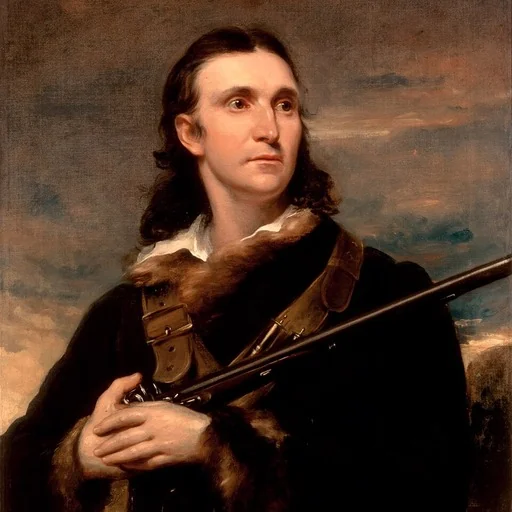
John James Audubon (born Jean-Jacques Rabin, April 26, 1785 – January 27, 1851) was a French-American artist, entrepreneur, naturalist, explorer, and ornithologist.