Artwork
The Temptation of Christ
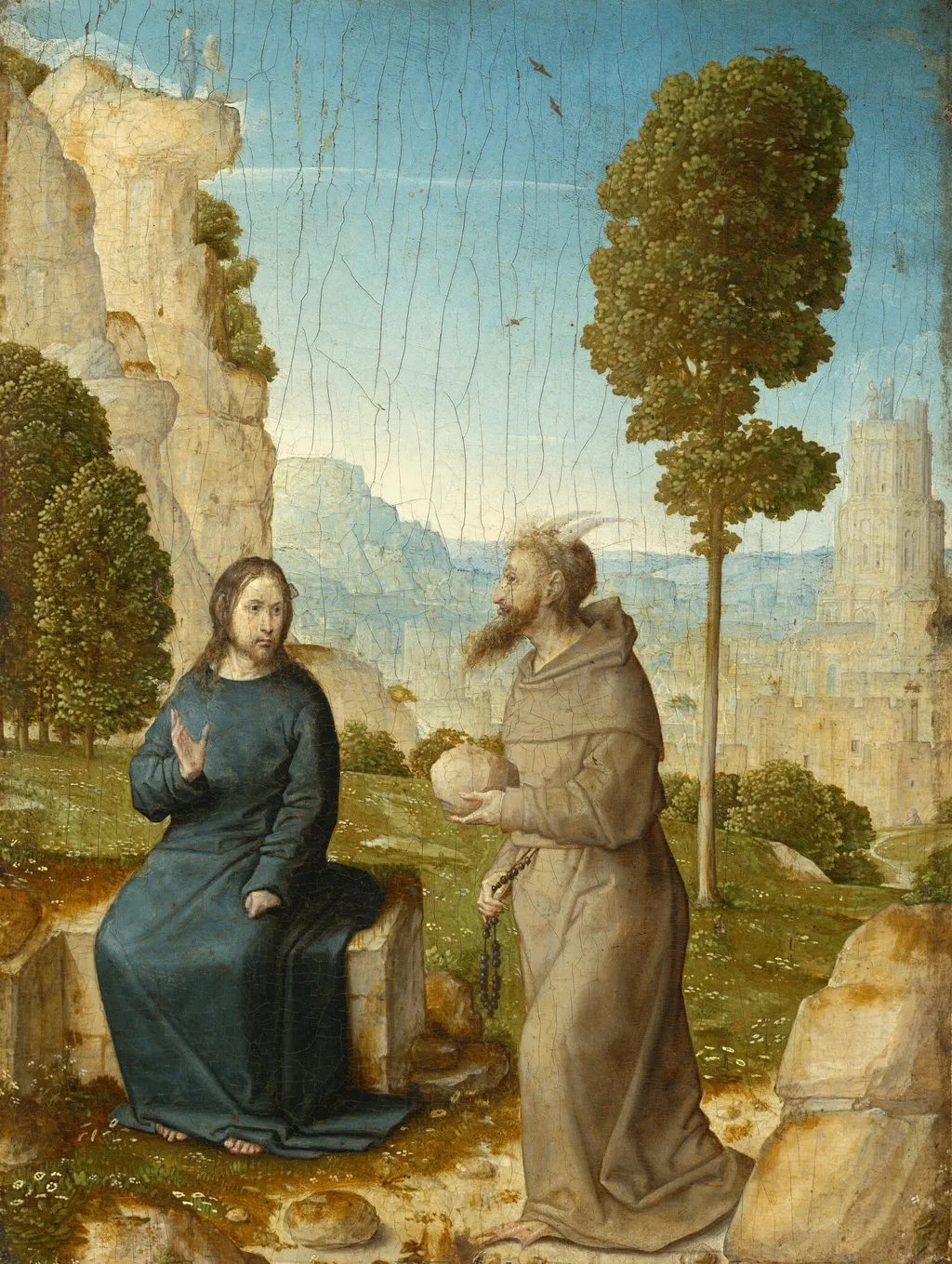
The Temptation of Christ is an oil painting by the Early Renaissance artist Juan de Flandes. It dates from 1502 and is held in the collection of the National Gallery of Art.
About this work
In a stony wilderness, a horned devil in clerical garb offers bread to Christ after forty days of fasting. Juan de Flandes painted the panel, barely twenty-one centimetres tall, around 1500 for the private polyptych of Queen Isabella I of Castile. After her death it passed to Margaret of Austria, moved through Habsburg hands in Madrid, and reached the National Gallery of Art in 1967.
Technique & Style
The painting is executed in oil on panel, measuring 21 by 16 cm. It originally belonged to a larger retable made for Queen Isabel of Castile, indicating its function within a polyptych. No specific information on brushwork, condition, or other formal stylistic qualities beyond the medium and support is provided in the sources.
History & Provenance
It subsequently passed to her nephew, Emperor Charles V, who gave it to his wife Isabel of Portugal; their son, King Philip II of Spain, inherited it.
The painting was created by Juan de Flandes in 1502, likely as part of a retable commissioned by Queen Isabel of Castile. After Isabel's death in 1504, the panel entered the collection of Diego Flores, possibly acting as agent for Margaret of Austria, and was inventoried in Margaret's collections in Mechelen in 1516 and 1524. It subsequently passed to her nephew, Emperor Charles V, who gave it to his wife Isabel of Portugal; their son, King Philip II of Spain, inherited it.
The panel later appeared in Naples with Oderisio de Sangro, Prince of Fondi, and was sold in Rome in 1895. It was acquired by Stefano Bardini of Florence, then by Vernon James Watney of Cornbury Park, Oxfordshire, from 1899, descending to his son Oliver Vernon Watney. Following the latter's estate sale at Christie's in London in 1967, it was purchased by Thos. Agnew & Sons, Ltd., and acquired by the National Gallery of Art in 1967.
Overview
Juan de Flandes's The Temptation of Christ, painted in oil on a small panel around 1500–1504, depicts a pivotal moment from the Gospels. This intimate work, measuring only 21.3 by 16 centimeters, was originally part of a larger altarpiece created for Queen Isabella I of Castile's personal devotion. It illustrates the devil's attempt to sway Christ in the wilderness after his forty-day fast.
Subject & Meaning
The panel illustrates the biblical account of Christ's forty-day fast in the desert, where he is confronted by the devil. The tempter appears disguised in clerical attire, possibly a Franciscan monk, and offers bread to the famished Christ. His horns subtly reference the Vulgate's description of Moses, while the rosary beads he holds may allude to contemporary religious practices, adding layers of symbolic meaning to the encounter.
Own this work as a print
Artist & collection


![The Papacy Offered to Saint Gregory the Great [?], by Fra Angelico](https://artifactworldgallery.com/img/fra-angelico--the-papacy-offered-to-saint-gregory-the-great--6c28505dc47c9093-w320.webp)