Artwork
The Equatorial Jungle
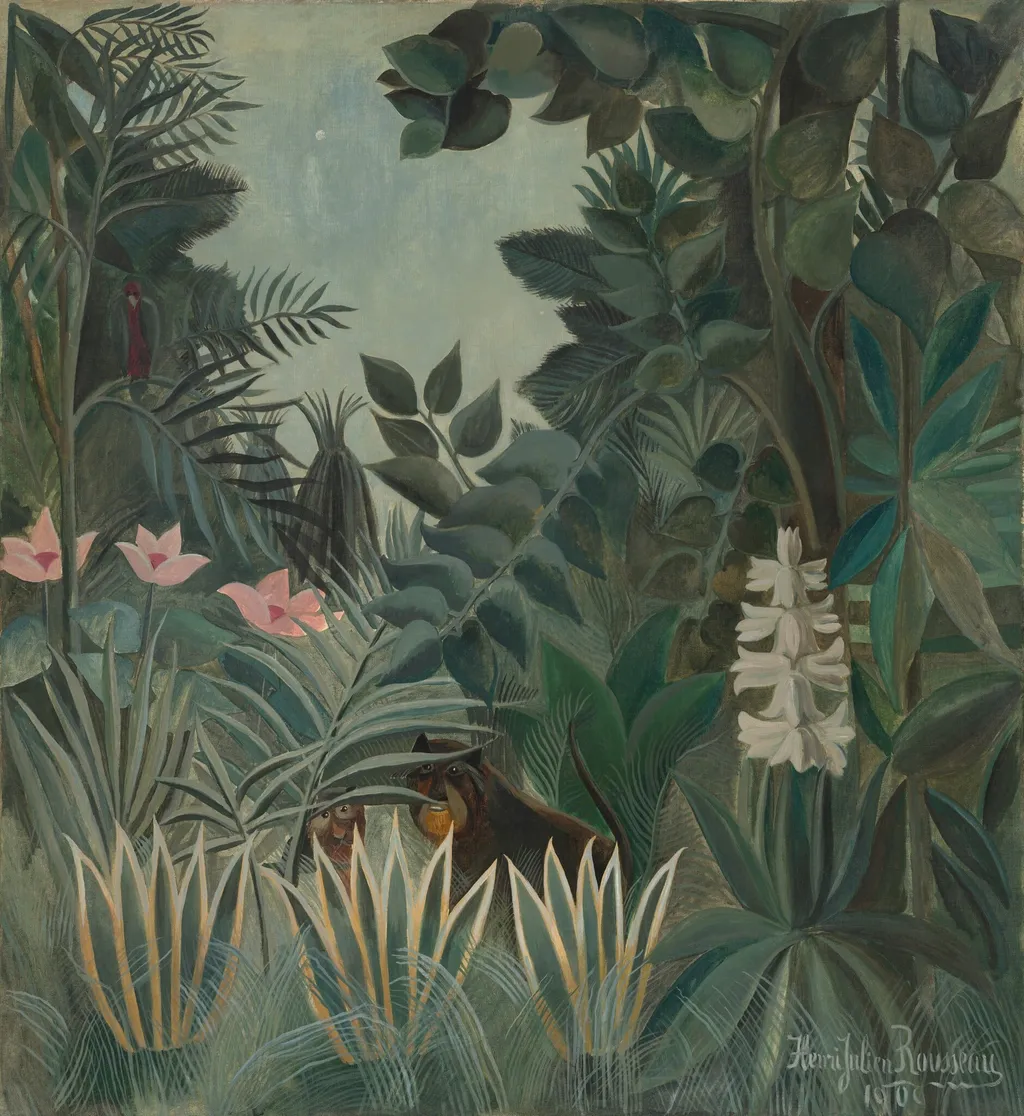
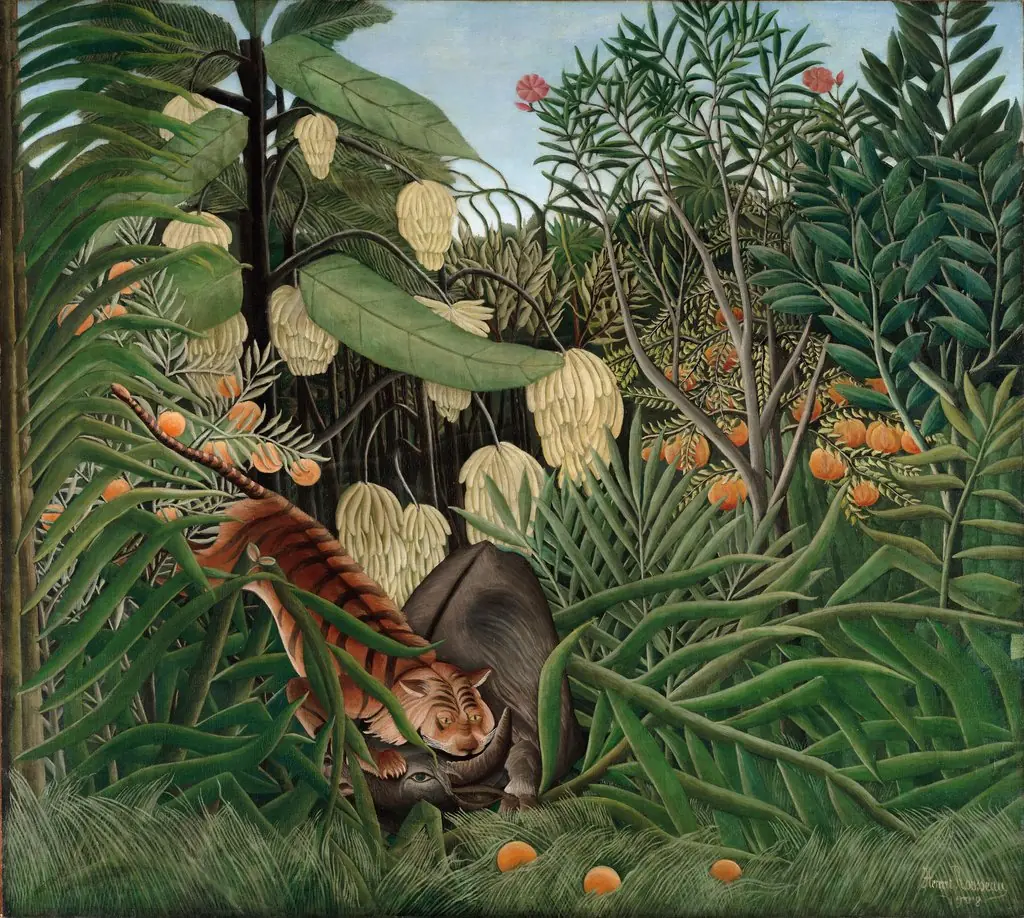
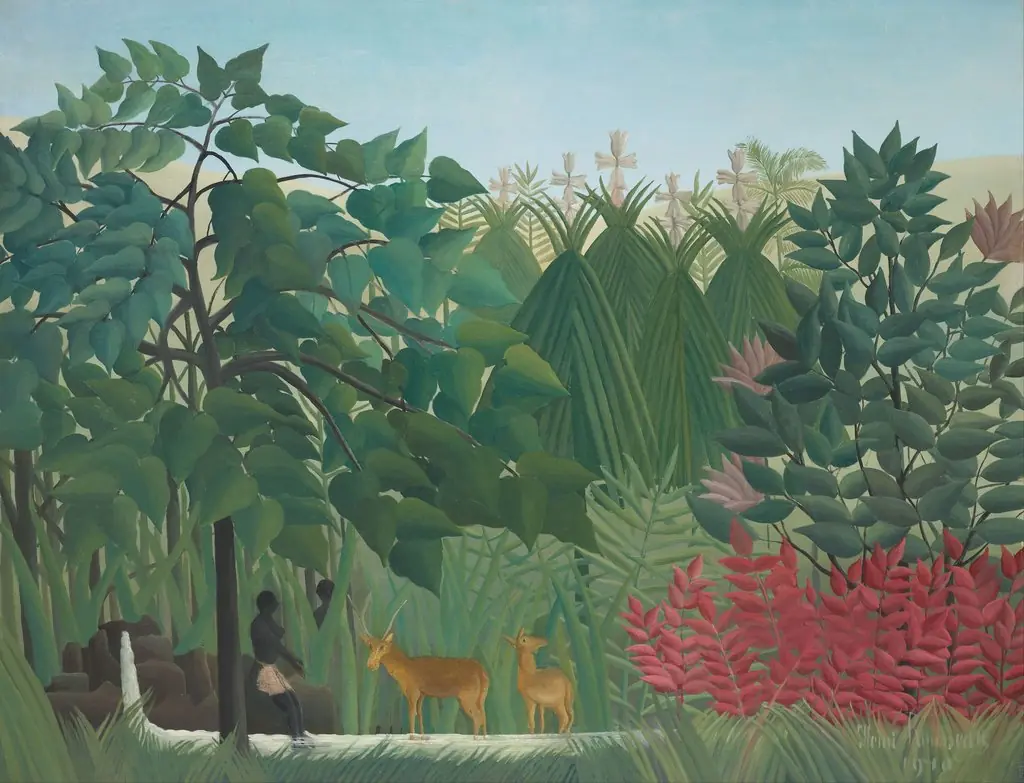
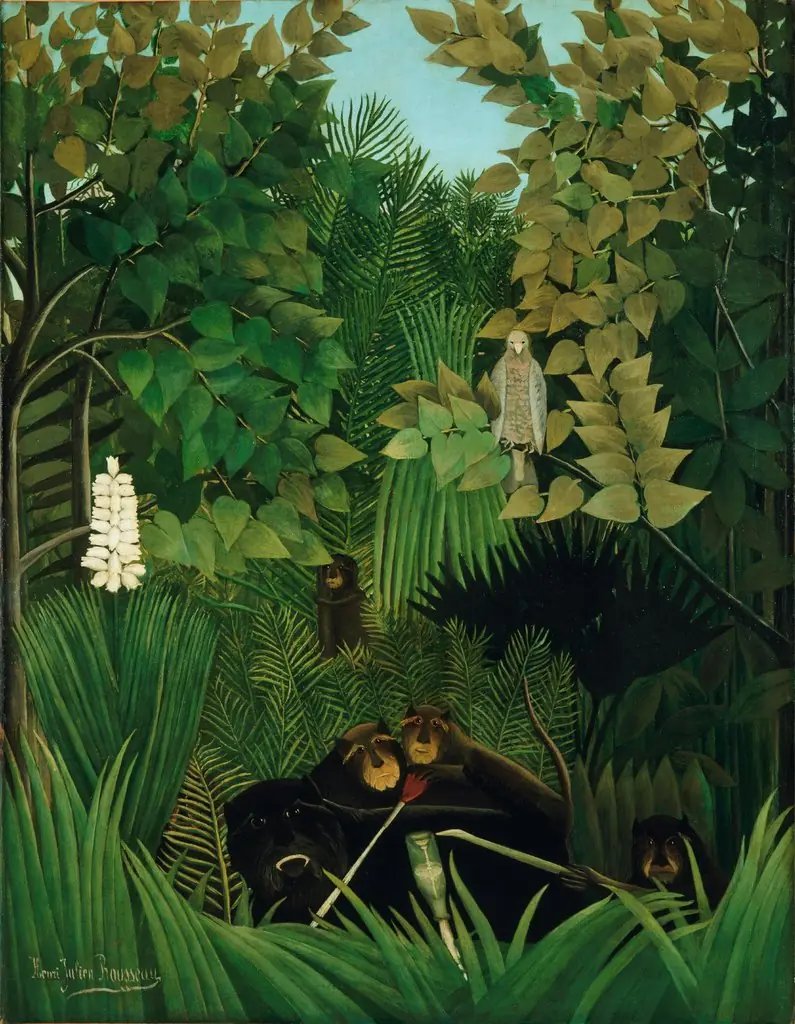
The Equatorial Jungle is an oil painting by the Naïve art artist Henri Rousseau. It dates from 1909 and is held in the collection of the National Gallery of Art.
- Inscription
- Inscribed:lower right: Henri Julien Rousseau / 1909
About this work
Two animals peer from behind oversized leaves and fuchsia flowers in Henri Rousseau's 1909 canvas, a dense wall of sage and olive greens that crowds out the sky. The self-taught French customs officer signed it and gave it to Robert Delaunay in Paris. It now hangs in the National Gallery of Art's Chester Dale Collection.
Technique & Style
Flowers are rendered with stylized, decorative precision, large pink centers and pale petals contrast with the deep green foliage.
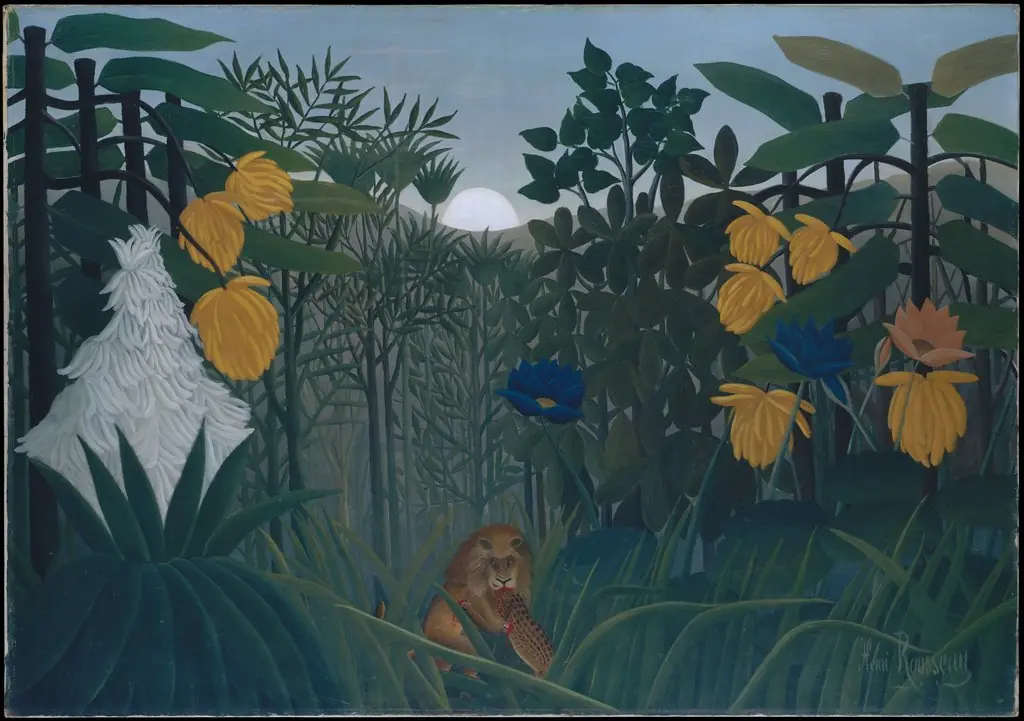
This work, executed in 1909, is an oil on canvas (140.6 × 129.5 cm) belonging to Henri Rousseau's series of jungle paintings. The technique exemplifies his naïve style: broad, flat areas of salvia, olive, and moss green are applied to create a dense, nearly impenetrable wall of vegetation. Small monkeys and a red bird are discreetly integrated into the leafy tapestry.
Flowers are rendered with stylized, decorative precision, large pink centers and pale petals contrast with the deep green foliage. There is little attempt at atmospheric perspective or realistic modeling; instead, the composition emphasizes pattern and surface, characteristic of Rousseau's self-taught approach. The handling is meticulous yet retains a flat, two-dimensional quality that heightens the dreamlike effect.
History & Provenance
Henri Rousseau painted The Equatorial Jungle in 1909. The painting's provenance begins with the artist, passing to Robert Delaunay, then possibly Paul Guillaume, before reaching Ambroise Vollard. In 1925 Vollard sold it to Juliana Force, who returned it the same year.
It was then with Galerie Étienne Bignou, and in 1928 sold to Chester Dale. Dale bequeathed the painting to the National Gallery of Art, Washington, D.C., in 1963. No commission is recorded.
Overview
Henri Rousseau's The Equatorial Jungle, an oil on canvas from 1909, exemplifies the artist's distinctive approach to landscape painting. This large-scale work, measuring 140.6 by 129.5 centimeters, presents a dense, verdant scene populated by exotic flora and fauna. Completed the year before his death, it showcases the self-taught artist's characteristic flat, detailed style.
The painting is now housed in the National Gallery of Art, Washington, D.C., as part of the Chester Dale Collection.
Subject & Meaning
The canvas depicts a lush, impenetrable jungle, dominated by broad leaves in shades of green and accented by vibrant pink and white flowers. From the lower center, two small, dark animals, an adult and a partially concealed juvenile, peer out, almost lost amidst the overwhelming vegetation. A slender, brick-red bird perches discreetly on a branch.
Rousseau, who never traveled to the tropics, synthesized these imagined landscapes from observations at Parisian botanical gardens, museum dioramas, and illustrated books, creating his unique "naïve" interpretations of the exotic.
Legacy
Rousseau's distinctive jungle scenes, often described by contemporaries as "primitive," have since been recognized for their significant contribution to modern art. The Equatorial Jungle was featured in the influential 2005-2006 exhibition "Henri Rousseau: Jungles in Paris," which traveled to major institutions including the Tate Modern and the National Gallery of Art. This exhibition underscored Rousseau's role as a pivotal precursor to modernism, whose direct and unconventional style influenced avant-garde artists such as Picasso, Braque, and the Fauves.
Own this work as a print
Artist & collection

Artist
Henri Julien Félix Rousseau (French: ; 21 May 1844 – 2 September 1910) was a French post-Impressionist painter in the Naïve or Primitive manner.