Artwork
Paris Almanac, 1897: Back Cover
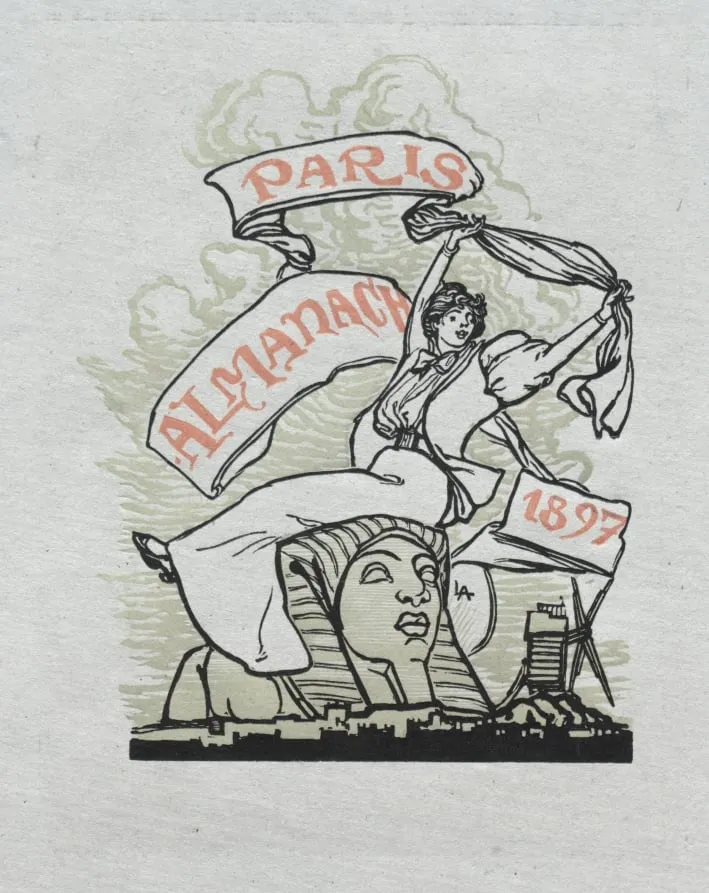
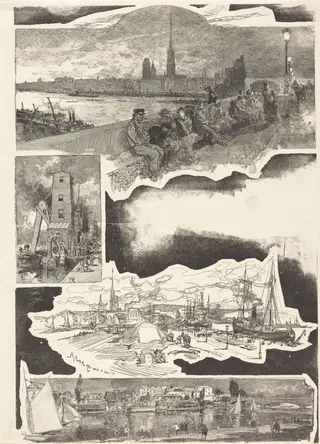
Paris Almanac, 1897: Back Cover is a print by the Impressionist artist Auguste Louis Lepère. It dates from 1897 and is held in the collection of the Cleveland Museum of Art.
- Accession no.
- 1953.553
- Credit line
- Gift of M. Knoedler and Company
About this work
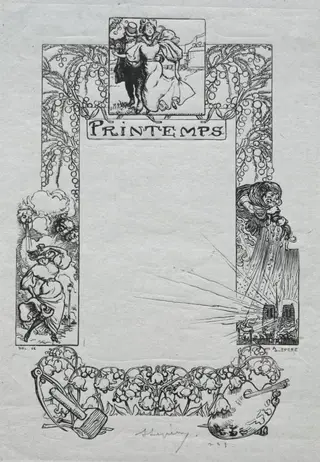
" The scene looks chaotic, with smoke in the background and a building in the distance.
This image shows a woman’s face crushed under a pile of people. One person holds a banner that says "Paris Almanac 1897." The scene looks chaotic, with smoke in the background and a building in the distance.
The crushed woman’s face is exaggerated, almost like a symbol. The year "1897" suggests this might be about a specific event or publication.
If you like bold political art, check out Realism for more examples of this style.
Overview
Auguste Louis Lepère produced the back cover of the 1897 Paris Almanac as a wood engraving, reflecting his role in the revival of traditional printmaking techniques in late 19th-century Europe. The work is held in the collection of The Cleveland Museum of Art. Unlike decorative illustrations of the period, this piece employs stark graphic contrasts and symbolic composition to convey social tension, aligning with Lepère’s broader commitment to print as a medium of artistic and critical expression.
Subject & Meaning
The image depicts a woman’s face partially obscured beneath a crowd of figures, one of whom holds a banner inscribed with the almanac’s title. The compressed form and distorted features suggest oppression or erasure, possibly commenting on the anonymity of individuals within urban mass culture. Smoke and distant architecture imply a city in flux, while the year 1897 anchors the scene in a specific cultural moment, perhaps reflecting anxieties around media, public spectacle, or social hierarchy in Paris at the time.
Technique & Style
Lepère used wood engraving to achieve sharp tonal contrasts and intricate linework, emphasizing texture and volume through precise carving. The composition relies on dramatic chiaroscuro and exaggerated scale to heighten emotional impact. Rather than naturalistic representation, the figures are stylized, their forms compressed into a dense, almost claustrophobic mass.
This approach prioritizes symbolic resonance over literal narrative, characteristic of Lepère’s engagement with graphic innovation over mere illustration.
History & Provenance
Created as the rear cover of the 1897 Paris Almanac, the print was likely distributed as part of an annual publication aimed at urban readers. Its inclusion in The Cleveland Museum of Art’s collection indicates early recognition of its artistic merit beyond its commercial function. While the almanac itself is now obscure, Lepère’s contribution survives as a rare example of fine printmaking integrated into popular media during a period when such boundaries were being redefined by artists seeking autonomy from academic traditions.
Context
In the 1890s, European artists increasingly turned to printmaking as a means of challenging industrialized reproduction and reclaiming artisanal value. Lepère’s work emerged alongside movements like the Société des Aquafortistes and the British Arts and Crafts movement, which valued handcrafted imagery. The chaotic, symbolic nature of this image reflects broader cultural unease with modernity, urban crowds, mass media, and the loss of individual identity in rapidly changing cities like Paris.
Legacy
Lepère’s wood engraving for the Paris Almanac stands as a testament to the potential of print as a vehicle for social commentary. Though not widely exhibited during his lifetime, his technical rigor and willingness to embed critique within commercial formats influenced later generations of printmakers. The work remains a quiet but potent example of how graphic art could engage with urban life’s complexities without relying on overt political rhetoric.
Artist & collection

Artist
Louis-Auguste Lepère (30 November 1849 – 20 November 1918) was a French painter and etcher. Lepère is also considered a leader in the creative revival of wood engraving in Europe.