Artwork
Washerwomen
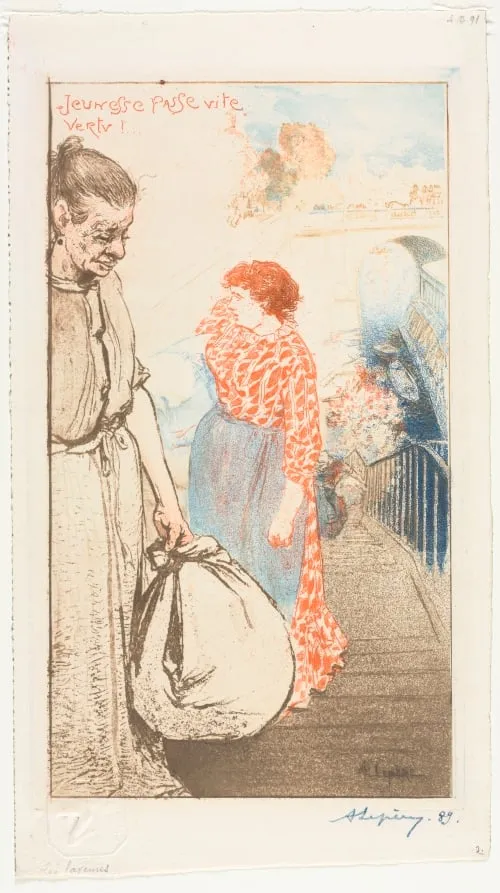
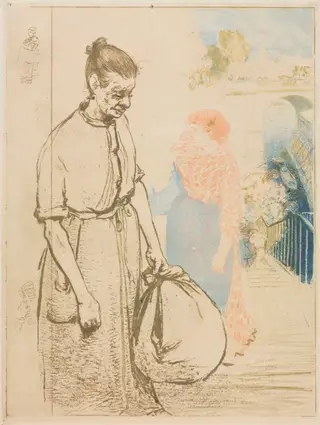
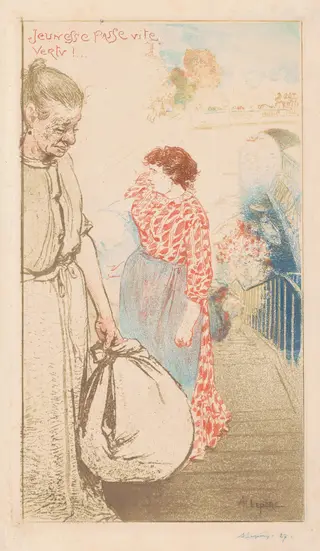
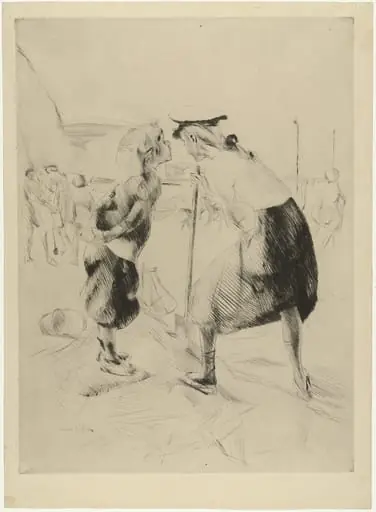
Washerwomen is a print by the Impressionist artist Auguste Louis Lepère. It dates from 1893 and is held in the collection of the Cleveland Museum of Art.
- Accession no.
- 1955.451
- Credit line
- Mr. and Mrs. Charles G. Prasse Collection
About this work
Overview
Auguste Lepère's 'Washerwomen' depicts two laundresses ascending steps from a Seine River wash boat, highlighting their laborious work amidst an unsanitary environment.
Subject & Meaning
The piece contrasts a youthful and a seasoned laundress, juxtaposing their mirrored poses and bold vs. muted tones to illustrate the passage of time and the hardships of their profession, underscored by the caption 'Youth passes quickly. Virtue!'.
Technique & Style
The artwork employs chiaroscuro, utilizing strong contrasts of light and dark to emphasize the subjects' emotional and physical states, drawing attention to their labor and the environment.
Context
Set against the backdrop of 19th-century Paris, the work reflects concerns over the Seine's pollution and the challenging conditions faced by laundry workers, who relied on the river despite its unsanitary state.
History & Provenance
No specific historical ownership or exhibition records are provided for 'Washerwomen', focusing attention on its thematic and artistic elements rather than its provenance.
Legacy
While 'Washerwomen' may not be widely recognized as a seminal work, it contributes to the broader discourse on late 19th-century social commentary through art, particularly in depicting the plight of working-class women.
Artist & collection

Artist
Louis-Auguste Lepère (30 November 1849 – 20 November 1918) was a French painter and etcher. Lepère is also considered a leader in the creative revival of wood engraving in Europe.

![[Peasants by a Dock, Paris], by Auguste Louis Lepère](https://artifactworldgallery.com/img/auguste-louis-lepere--peasants-by-a-dock-paris--be27cb4200b9108b-w320.webp)