Artwork
Uranio and Carino
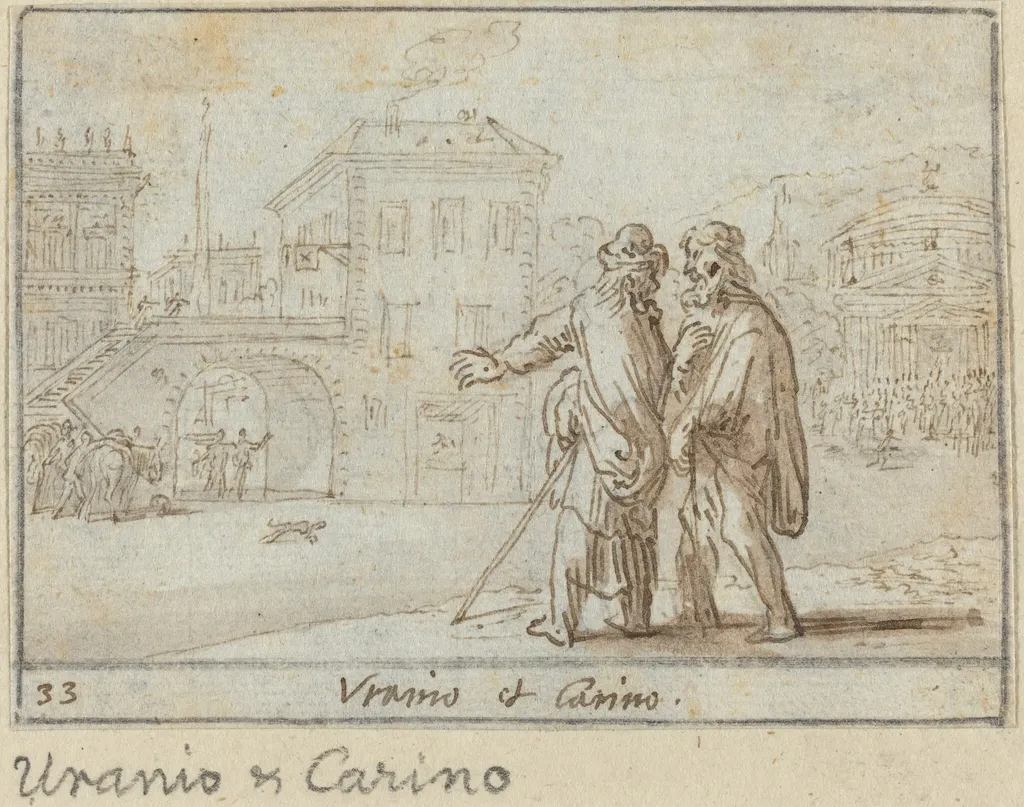
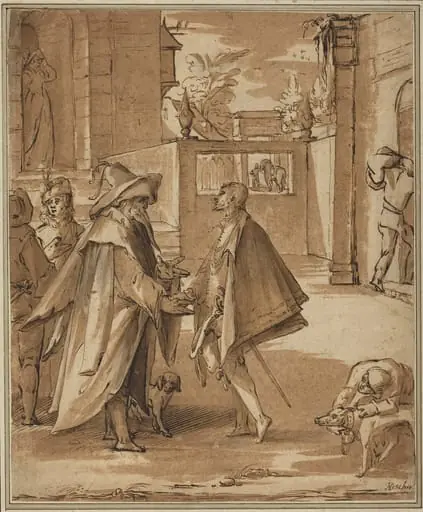
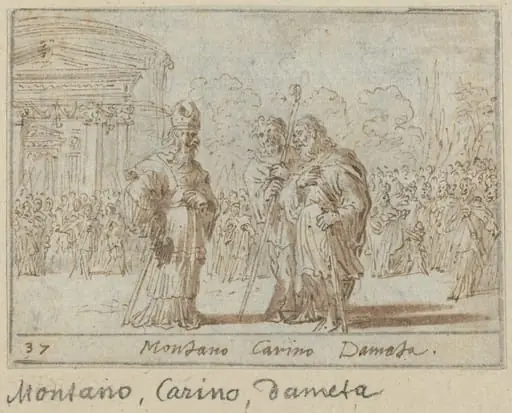
Uranio and Carino is an ink drawing by the Baroque artist Johann Wilhelm Baur. It dates from 1640 and is held in the collection of the National Gallery of Art.
- Inscription
- Inscribed:across bottom in brown ink: 33 Vranio [et] Carino.
About this work
Overview
Uranio and Carino is a small drawing from 1640 by the German Baroque artist Johann Wilhelm Baur, executed in pen and brown ink with brown wash on laid paper.
Uranio and Carino is a small drawing from 1640 by the German Baroque artist Johann Wilhelm Baur, executed in pen and brown ink with brown wash on laid paper. Measuring only 6.5 by 9 cm, it is part of a series illustrating Giovanni Battista Guarini's pastoral tragicomedy Il pastor fido. The work is held in the collection of the National Gallery of Art in Washington, D.C., where it entered in 1952 with the accession number 1952.8.34. Despite its modest scale, the drawing exemplifies Baur's refined draftsmanship and his engagement with Italianate literary subjects, representing a significant example of mid-seventeenth-century German drawing practice informed by the artist's extended sojourn in Italy.
Subject & Meaning
The drawing depicts two bearded male figures, Uranio and Carino, characters from Guarini's Il pastor fido. The figure on the left, presumably Uranio, gestures with his extended right hand while holding a staff in his left; the companion faces him with right hand raised toward his own chest. Both wear long draped garments with voluminous sleeves, with leggings visible beneath. The staff carried by the left figure carries conventional associations with old age and, in Renaissance iconography, with pilgrimage and the journey of life. The open gestures of the protagonists suggest classical oratorical and theatrical expression, conveying emotional intensity appropriate to the dramatic source. The background presents an architectural setting that combines classical and Renaissance elements: a multi-story building with pitched roof and smoking chimney, a monumental structure with stairs and colonnade leading to an arched passageway with smaller figures, and at the far right a domed building with columns before which a crowd gathers. This architectural backdrop situates the human drama within an idealized classical world, establishing psychological continuity with antiquity. The inscriptions below the image read "33" at left, followed by "Uranio et Carino" and "Uranio & Carino," identifying the scene and its place within the illustrated series.
Technique & Style
Baur executed the drawing with a restricted palette of brown ink and wash with gray tonalities on aged cream paper. The technique combines precise linear penwork in the foreground figures with looser, sketchier strokes in the background architecture and distant figures. A dark border line frames the composition. Shadows beneath the two main figures ground them on a flat plane that recedes toward the architectural backdrop. This combination of meticulous figure drawing with more freely handled background elements is characteristic of Baur's draftsmanship and reflects his training in miniature painting under Friedrich Brentel in Strasbourg, as well as his exposure to Italian draftsmanship during his years in Rome. The paper shows slight foxing and discoloration consistent with its age. The diminutive scale of the work, 6.5 by 9 cm, suggests it was conceived as part of a closely coordinated series of illustrations rather than as an independent composition.
History & Provenance
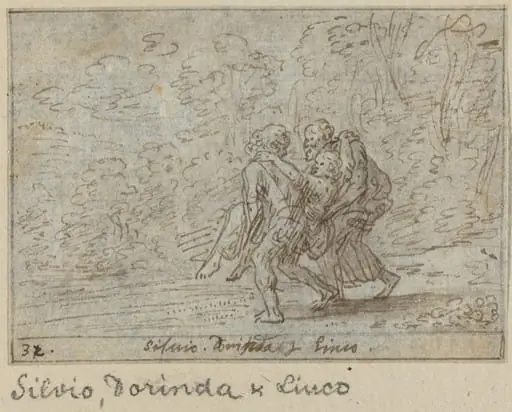
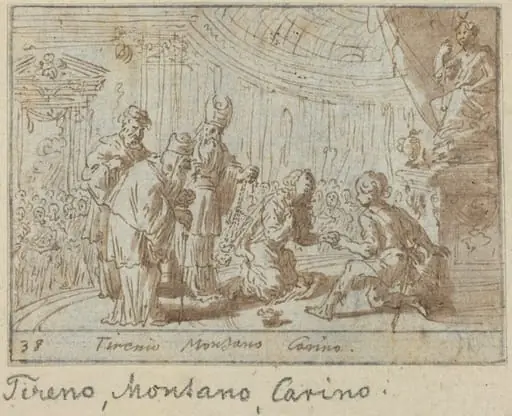
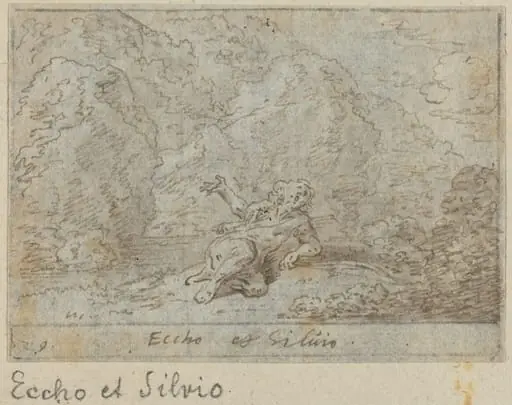
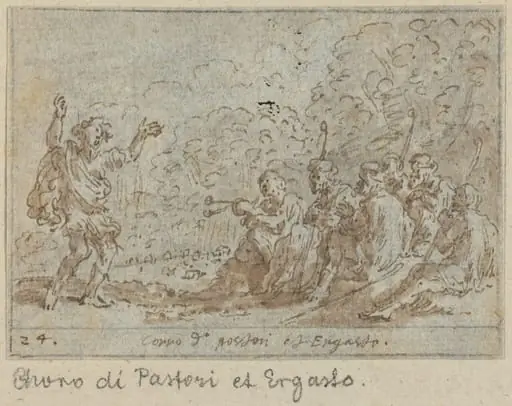
The drawing was created in 1640, the final year of Baur's life, during his employment as court painter in Vienna. It belongs to a series of illustrations for Giovanni Battista Guarini's Il pastor fido, a pastoral tragicomedy first published in 1590 that enjoyed enormous popularity throughout Europe in the seventeenth century. The series was subsequently engraved by Melchior Küsel of Augsburg, a frequent collaborator who reproduced many of Baur's designs. A related print after Baur's design, inscribed "Vranio et Carino" with the number "33" and the opening lines of the relevant passage, is documented in the collection of the Herzog Anton Ulrich-Museum in Braunschweig, confirming the drawing's function as a preparatory design for the print series. The drawing entered the National Gallery of Art in 1952 with accession number 1952.8.34. It has been cited in scholarly literature, including Thomas DaCosta Kaufmann's 1985 census of drawings from the Holy Roman Empire in North American collections.
Context
Johann Wilhelm Baur (1607-1640) was a German engraver, etcher, and miniature painter active during the Baroque period. Born in Strasbourg, he trained with the miniaturist Friedrich Brentel before undertaking a Grand Tour to Italy, where he worked in Rome from 1631 to 1637 and painted for patrons including the Duke of Bracciano. During his Italian sojourn he associated with Karel Škréta and likely joined the Bentvueghels, the society of Dutch and Flemish artists in Rome. He specialized in watercolors of architectural subjects and perspective views, skills that informed his illustrations of literary texts. In his final years he served as court painter in Vienna, where he died suddenly in January 1640 while working on a commission for Ferdinand III, Holy Roman Emperor. Baur's work as printmaker drew inspiration from Jaques Callot and Stefano della Bella. His drawings and prints are held in major collections including the Louvre, the Akademie der bildenden Künste in Vienna, and the Grafikkabinett in Strasbourg. The Uranio and Carino drawing exemplifies his engagement with Italian literary culture and his ability to translate dramatic narrative into compact, visually compelling images.
Legacy
The Uranio and Carino drawing survives as a tangible record of Baur's late style and his contribution to the visual culture of Guarini's Il pastor fido, one of the most widely disseminated literary works of the seventeenth century. The related print series engraved by Melchior Küsel ensured the broader circulation of Baur's designs among European audiences. The drawing's presence in the National Gallery of Art, documented in Kaufmann's 1985 census, has secured its place in the study of Central European draftsmanship and the international exchange of artistic ideas during the Baroque period. Baur's illustrations for Ovid's Metamorphoses remain his most celebrated graphic achievement, yet the Il pastor fido series demonstrates comparable sophistication in adapting theatrical narrative to the intimate scale of the drawn image. His sudden death at age thirty-two cut short a career that had already produced significant work across multiple media and subject types.
Own this work as a print
Artist & collection
Artist
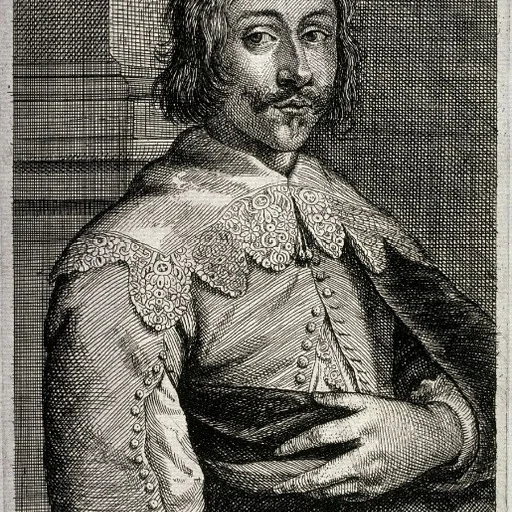
Johann Wilhelm Baur, Joan Guiliam Bouwer, or Bauer (Strasbourg, 31 May 1607 - Vienna, 1 January 1640) was a German engraver, etcher and miniature painter. He is famous for a series of illustrations of Ovid's Metamorphoses.