Artwork
Saint Anthony Abbot and Saint Bernardino of Siena
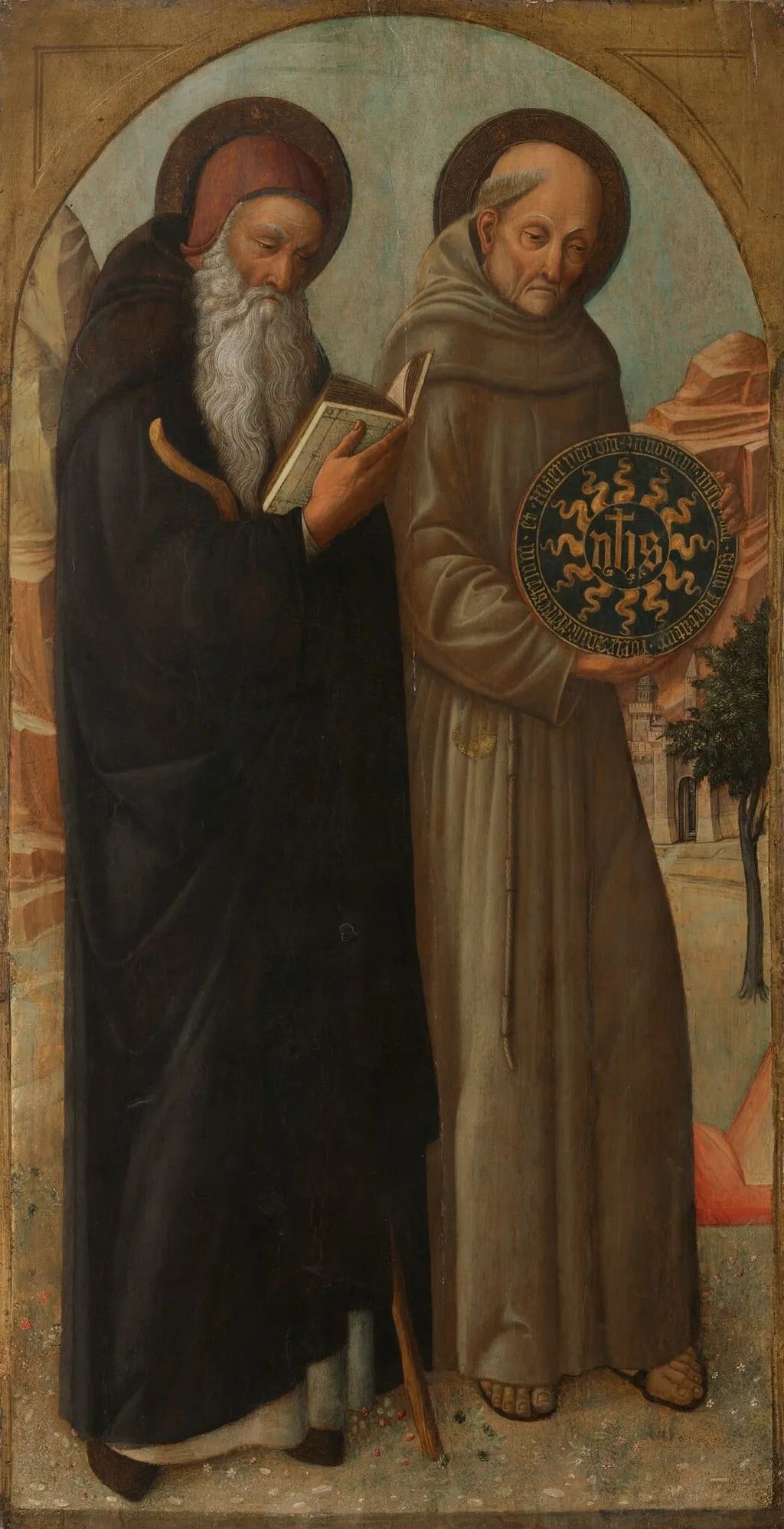
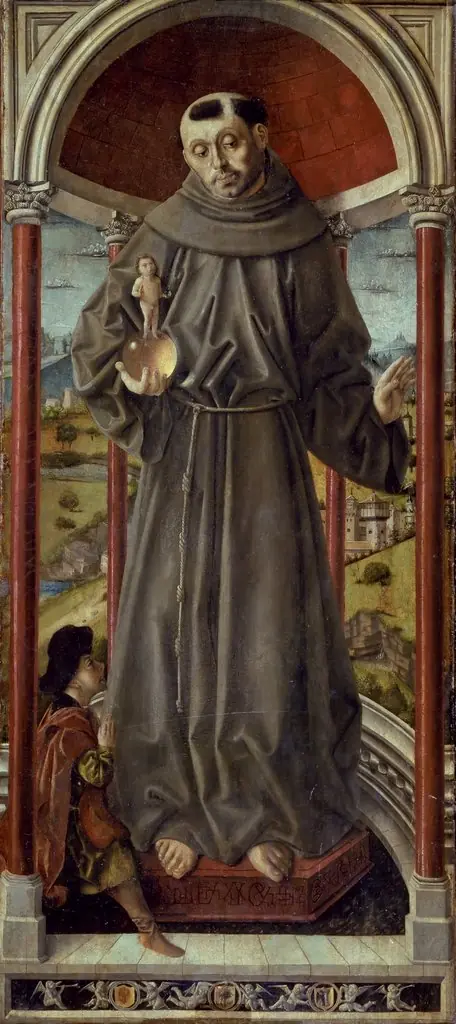
Saint Anthony Abbot and Saint Bernardino of Siena is a tempera painting by the Early Renaissance artist Jacopo Bellini. It dates from 1459 and is held in the collection of the National Gallery of Art.
- Inscription
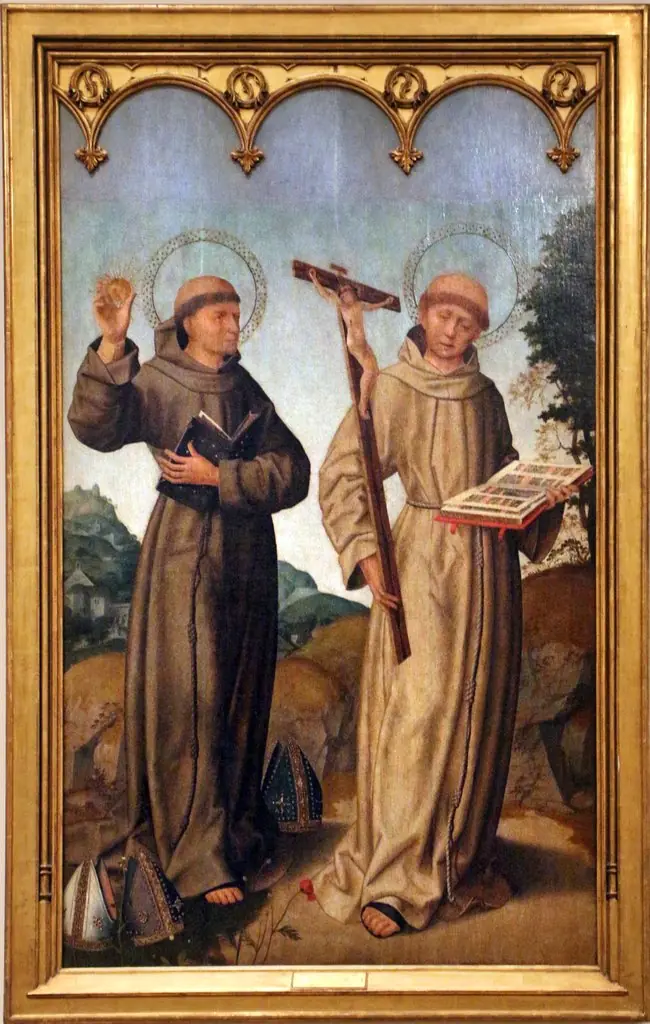
- Inscribed:around circumference of the disk held by Saint Bernardino: innomine.chri[sti omne] genuflectatur.coelestium.terrestriu.et.infernorum. (Philippians 2:10); center of the disk: YHS
About this work
Two saints stand on a wooden platform: one in red clutching a lily, the other in brown with a book and a tau staff, their gold-leaf halos glowing. This is Jacopo Bellini's only surviving panel, from 1459. The flat halos mark early Renaissance work, before full perspective took hold.
Subject & Meaning
Both are identified in the sources as the subjects of the painting, reflecting their prominence in contemporary devotional practice.
The work portrays the two saints, Saint Anthony Abbot and Saint Bernardino of Siena, as the central figures. Both are identified in the sources as the subjects of the painting, reflecting their prominence in contemporary devotional practice. Their inclusion together underscores a shared cultic significance and allows the viewer to invoke their protection and intercession.
The composition follows traditional iconographic conventions for these saints, presenting them in a dignified, frontal manner that emphasizes their spiritual authority. Created in 1459 by Jacopo Bellini, the tempera panel functions as a devotional image within a religious genre, meant to inspire contemplation of the saints’ virtues.
Technique & Style
The panel is executed in tempera on a poplar support, measuring 110 × 57 cm, with the figures presented in a vertical format typical of mid-fifteenth-century Venetian devotional painting. Handling shows precise linear draftsmanship beneath thin, translucent layers of pigment, characteristic of Jacopo Bellini’s early maturity. The linear contours define the saints’ physiognomies and drapery, while restrained hatching modulates volume, avoiding the richer chiaroscuro later associated with his son Gentile.
The faces exhibit a restrained, almost schematic modeling, consistent with tempera’s limited tonal range and the panel’s probable liturgical function in a chapel context.
History & Provenance
The panel Saint Anthony Abbot and Saint Bernardino of Siena is dated 1459 and attributed to Jacopo Bellini. Its early provenance is conjectural: it has been linked hypothetically to the Gattamelata chapel in the Basilica del Santo, Padua, dismantled in 1651 during the chapel’s transformation into the Sacrament chapel. The work later passed through a private collection in the Netherlands before appearing at Sotheby’s, London, on 8 April 1981, catalogued as by Carlo Crivelli.
It was subsequently acquired by Piero Corsini, New York, and entered a private collection in New York by 1984. In 1989, P. & D. Colnaghi & Co. sold the painting to another private collection, which in 1990 gifted a partial and promised interest to the National Gallery of Art, Washington, D.C.; the gift was completed in 2018.
The painting is held in the collection of the National Gallery of Art in Washington, D.C. Its modern provenance includes a sale at Sotheby's in London on April 8, 1981, where it was attributed to Carlo Crivelli. The work subsequently passed through the hands of dealer Piero Corsini in New York and was recorded in a private New York collection by 1984. It was later handled by P. & D. Colnaghi & Co. before being sold to a private collector in 1989.
In 1990, the owner made a partial and promised gift of the panel to the National Gallery of Art, with the transfer of ownership completed in 2018. An earlier, hypothetical provenance suggests the work may have originally belonged to the Gattamelata chapel in the Basilica del Santo, Padua, prior to that chapel's dismantling in 1651.
Context
The mid‑15th‑century panel of Saint Anthony Abbot and Saint Bernardino of Siena, attributed to Jacopo Bellini and possibly executed with input from Gentile Bellini, exemplifies early Venetian religious painting. Dated 1459 and executed in tempera on poplar (110 × 57 cm), it was likely originally linked to the Gattamelata chapel in Padua before entering private collections in the Netherlands and New York, and was gifted partially in 1990 with full acquisition completed in 2018 by the National Gallery of Art. Scholarship, including Peter Humfrey’s survey of Gothic‑to‑Renaissance transition and Colin Eisler’s attribution discussion, situates the work within the Bellini workshop’s evolution and the broader shift toward Renaissance naturalism.
Overview
This painting, titled Saint Anthony Abbot and Saint Bernardino of Siena, is rendered in tempera on a poplar panel. Created by Jacopo Bellini in 1459, it depicts two prominent saints standing together on a wooden base. The work is notable as the artist's sole surviving panel from that specific year, offering insight into his practice during the early Renaissance.
Artist & collection

Artist
Jacopo Bellini (c. 1400 – c. 1470) was one of the founders of the Renaissance style of painting in Venice and northern Italy. His sons Gentile and Giovanni Bellini, and his son-in-law Andrea Mantegna, were also famous…