Artwork
Saint Anthony of Padua
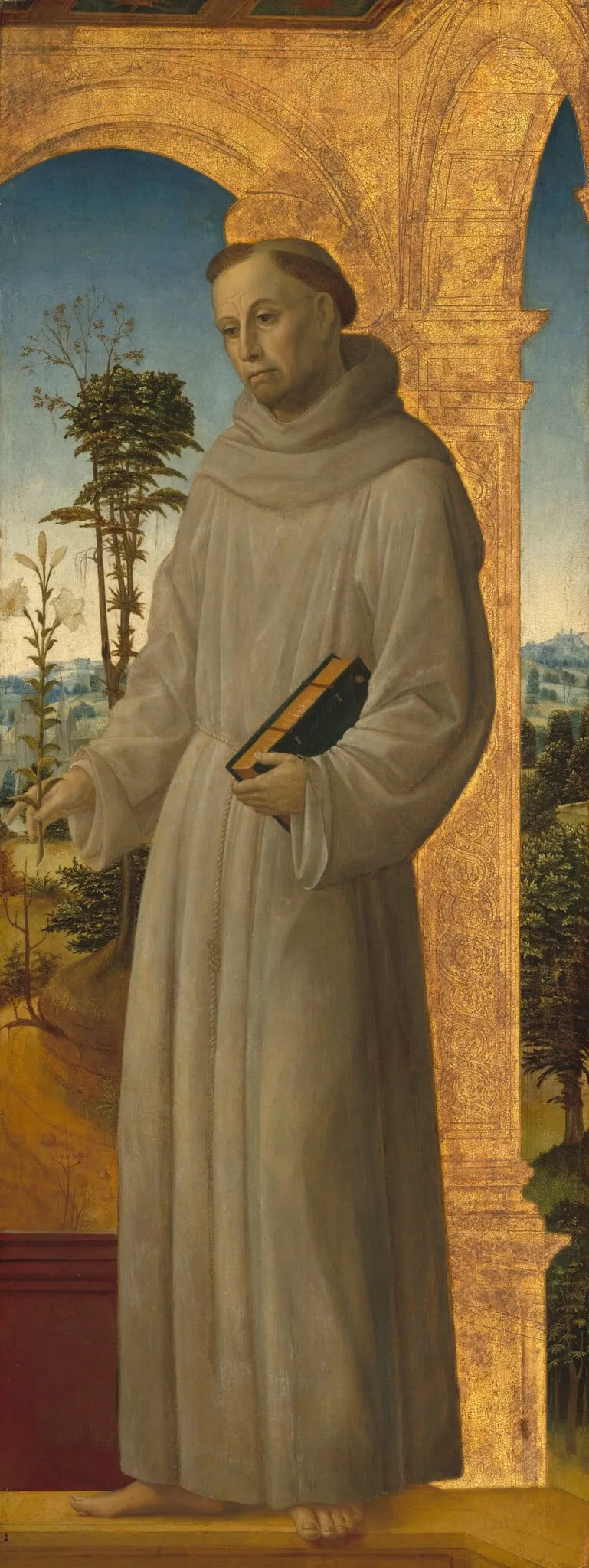
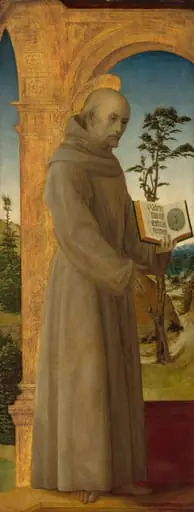
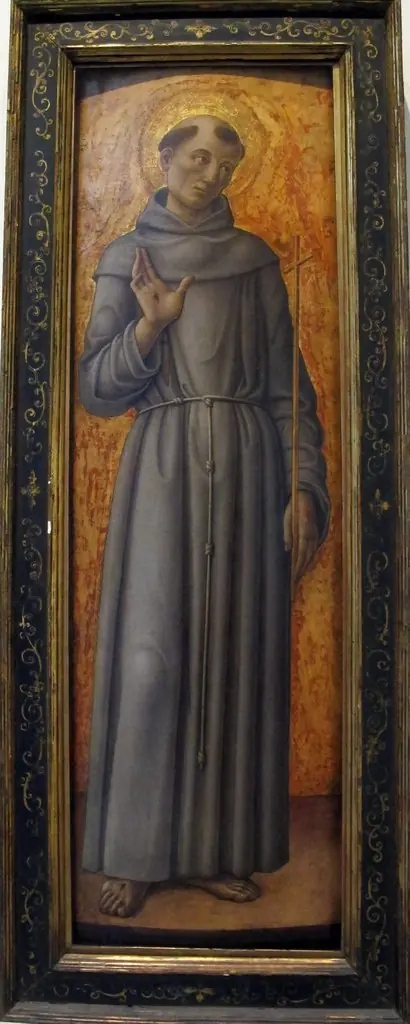
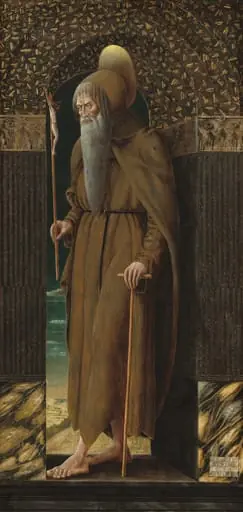
Saint Anthony of Padua is an oil painting by the Early Renaissance artist Vincenzo Foppa. It dates from 1498 and is held in the collection of the National Gallery of Art.
About this work
Subject & Meaning
The work's narrow dimensions suggest it formed part of a complex devotional structure rather than standing as an independent portrait.
Executed in 1498 by Vincenzo Foppa, this panel painting depicts Anthony of Padua as its sole principal subject. Classified as a work of religious art, the image focuses entirely on the Franciscan saint and likely originally functioned as a wing for a larger, now-lost altarpiece, possibly intended for the church of San Francesco Grande in Milan. The work's narrow dimensions suggest it formed part of a complex devotional structure rather than standing as an independent portrait.
The piece serves as a formal representation of the saint within a liturgical context, in keeping with the late fifteenth-century tradition of integrating holy figures into multi-panel sacred ensembles.
Technique & Style
The work is executed in oil on a wooden panel, a support typical of late-15th-century Italian devotional painting. Its dimensions are about 149 cm in height and 56.5 cm in width, and it belongs to the religious genre, depicting Saint Anthony of Padua. The medium is oil paint applied to the panel surface, reflecting the technique Vincenzo Foppa used for altar images of the period. The formal composition follows the conventional iconography of the saint within a devotional context.
History & Provenance
Saint Anthony of Padua, an oil-on-panel painting by Vincenzo Foppa dated 1498, may originally have been executed for San Francesco Grande in Milan, where it is thought to have formed part of the wings of a lost altarpiece. By around 1900 the panel was in a private collection in Romagna. It entered the collection of Sir Frederick Lucas Cook, 2nd Baronet, at Doughty House, Richmond, by 1903, passing by inheritance to his son Sir Herbert Frederick Cook, 3rd Baronet, and then to Sir Francis Ferdinand Maurice Cook, 4th Baronet, who kept it at Cothay Manor, Somerset.
In 1947 it was sold through Gualtiero Volterra in London to Count Alessandro Contini Bonacossi in Florence, who in July 1948 sold it to the Samuel H. Kress Foundation in New York. The Foundation gave it to the National Gallery of Art in 1952, where it remains as part of the Samuel H. Kress Collection.
Overview
Vincenzo Foppa, a significant painter of the Early Lombard Renaissance, created Saint Anthony of Padua around 1498. This oil on panel work portrays the revered Franciscan friar, Saint Anthony, and represents a late-career creation for Foppa, completed after his return to his native Brescia. The painting reflects the artistic developments of its era, showcasing the artist's engagement with the medium.
Context
Vincenzo Foppa was a leading figure of the Early Lombard School, active across Lombardy and Liguria, including service to the influential Sforza family in Pavia. Despite a relatively small number of his works surviving today, Foppa was highly regarded during his lifetime. This painting, created late in his career, reflects his continued artistic output in Brescia.
Artist & collection
Artist
Vincenzo Foppa (Brescia, c. 1427–1430 – Brescia, c. 1515–1516) was an Italian painter from the Renaissance period. While few of his works survive, he was an esteemed and influential painter during his time and is…