Artwork
Saint Bernardino of Siena
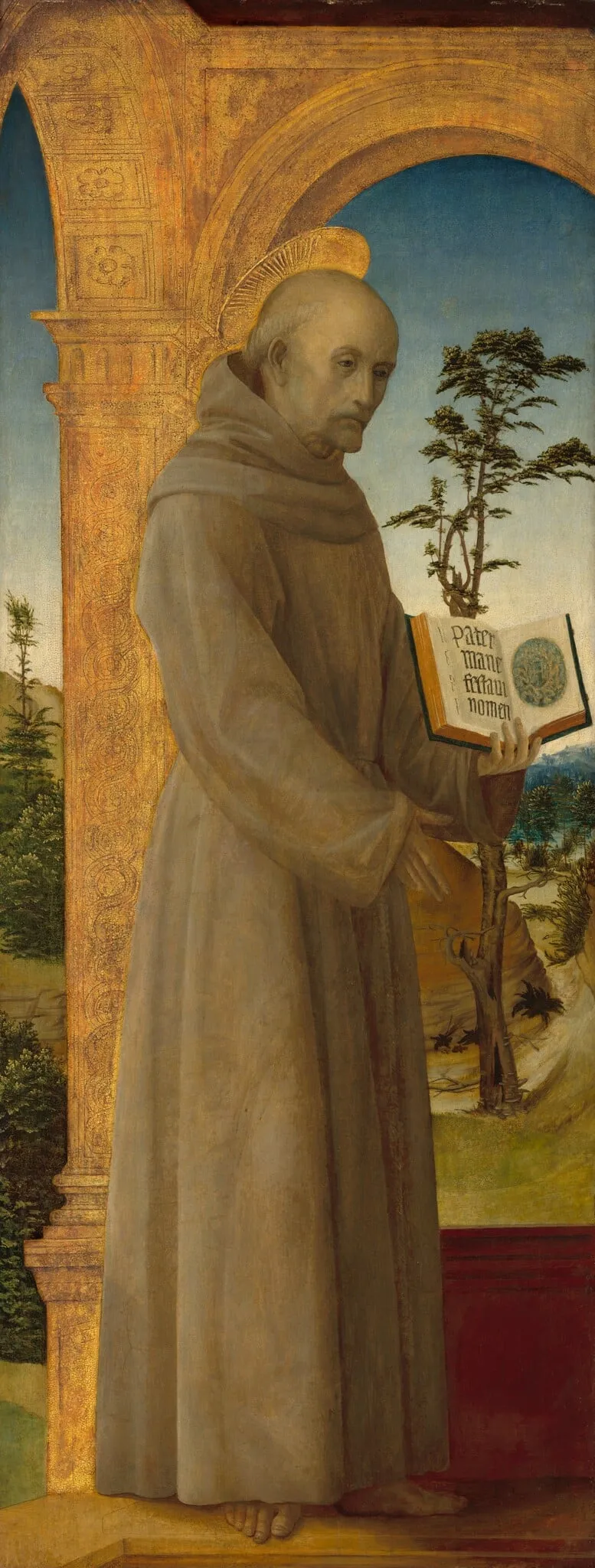
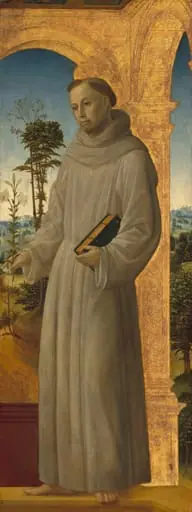
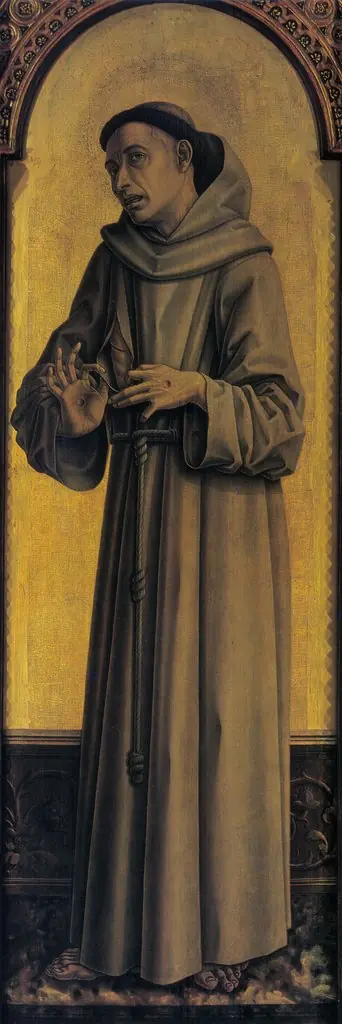
Saint Bernardino of Siena is an oil painting by the Early Renaissance artist Vincenzo Foppa. It dates from 1498 and is held in the collection of the National Gallery of Art.
- Inscription
- Inscribed:center right on open book: Pater manefestavi nomen (Father, I have manifested [Thy] name; from John 17:5,6, words that form the antiphon of the first Vespers of Ascension, recited by Saint Bernardino while he was dying); on facing page of book, in monogram: IHS
About this work
History & Provenance
By circa 1900 the present work surfaced in a private collection in Romagna before entering the UK with Sir Frederick Lucas Cook at Doughty House by 1903.
The panel is generally dated to 1495 and may have been commissioned for San Francesco Grande, Milan, as part of a larger altarpiece whose wings, an Angel Gabriel and a Virgin Annunciate, are now in the Borromeo collection at Isola Bella, having been in that family at least since the mid-nineteenth century. After the suppression of monastic houses at the century’s start, their provenance remains undocumented until their Borromeo ownership. By circa 1900 the present work surfaced in a private collection in Romagna before entering the UK with Sir Frederick Lucas Cook at Doughty House by 1903.
It descended through his heirs, Sir Herbert Frederick Cook and then Sir Francis Ferdinand Maurice Cook, until sold in June or July 1947 to Gualtiero Volterra for Count Alessandro Contini Bonacossi. The Contini Bonacossi sale to the Samuel H. Kress Foundation followed in July 1948, and the work was given to the National Gallery of Art, Washington, in 1952.
The painting is currently held by the National Gallery of Art in Washington, D.C., as part of the Samuel H. Kress Collection, having been gifted to the institution in 1952. Prior to this, the work passed through the Cook family collection, residing at Doughty House in Richmond, Surrey, under Sir Frederick Lucas Cook and his successors until its sale in 1947. Following a brief period with Count Alessandro Contini Bonacossi in Florence, the Samuel H. Kress Foundation acquired the panel in July 1948.
While specific exhibition records are not detailed in the provided texts, the work's provenance traces its movement from a possible original location at San Francesco Grande in Milan to private holdings in Romagna and England before entering the American public trust.
Overview
Vincenzo Foppa, a significant painter of the early Renaissance in northern Italy, created Saint Bernardino of Siena around 1498. This oil (?) on panel work exemplifies his contribution to the Lombard School, where he was a leading figure. The painting presents its subject, a venerated Franciscan friar, with a quiet dignity, reflecting the artistic conventions prevalent during the period of its creation.
Subject & Meaning
The painting features Bernardino of Siena, a Franciscan friar who was later canonized. He is portrayed standing in a serene, uncluttered setting, his expression composed. The artist's approach emphasizes a direct and unadorned representation of the saint, conveying a sense of honesty and simplicity.
This straightforward depiction aligns with the religious and artistic sensibilities of the early Renaissance, focusing on the figure's spiritual presence.
Technique & Style
Foppa's artistic method in this work demonstrates a careful attention to detail, particularly evident in the rendering of the saint's robes. The precise depiction of fabric folds suggests a meticulous hand, contributing to the painting's overall sense of realism. The restrained palette and smooth transitions, possibly achieved through glazing techniques, underscore the artwork's quiet solemnity and the artist's command of his medium.
Context
Vincenzo Foppa was a pivotal figure in the development of Renaissance painting in northern Italy, particularly within the Early Lombard School. Born in Brescia, he was active across Lombardy and Liguria, even serving the influential Sforza family in Milan. Saint Bernardino of Siena stands as a testament to Foppa's impact as a key exponent of the Renaissance style in this region, shaping its artistic trajectory.
Artist & collection
Artist
Vincenzo Foppa (Brescia, c. 1427–1430 – Brescia, c. 1515–1516) was an Italian painter from the Renaissance period. While few of his works survive, he was an esteemed and influential painter during his time and is…