Artwork
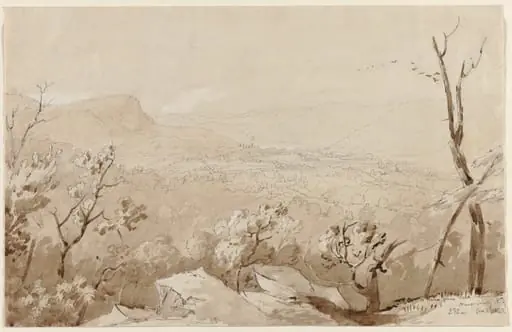
Mount Cairo from across the Melfa River
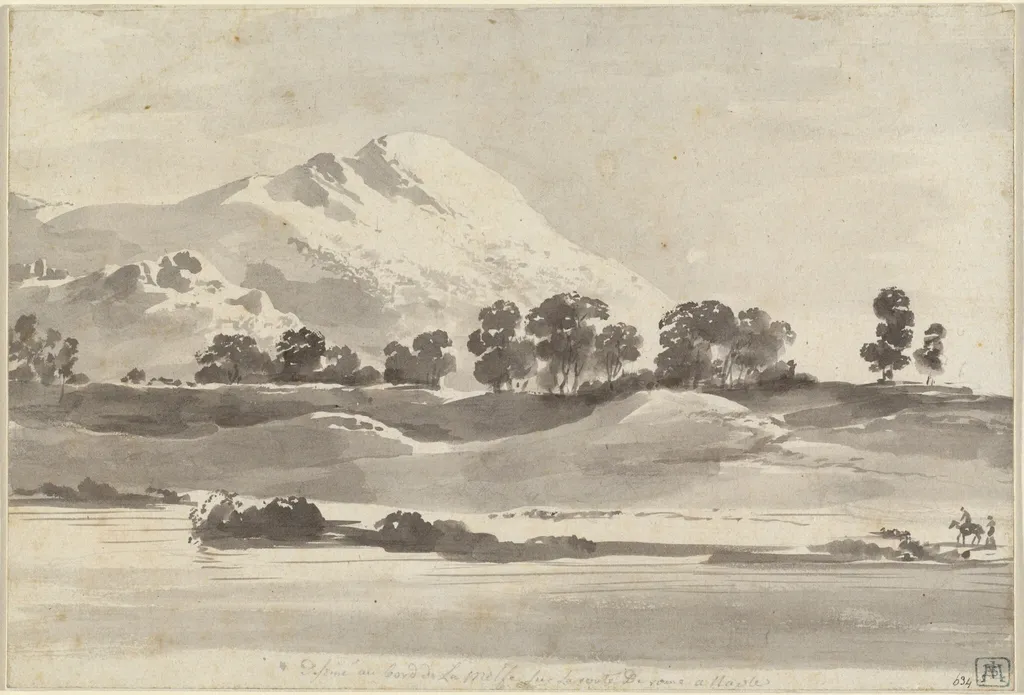
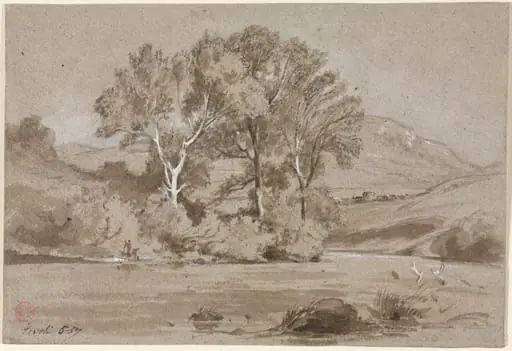
Mount Cairo from across the Melfa River is a drawing by the Romanticist artist Jean-Jacques de Boissieu. It dates from 1766 and is held in the collection of the National Gallery of Art.
- Inscription
- Inscribed:lower center in graphite: D[?] au bord de la Melfa sur la route De rome a Naple; by later hand lower right in pen and ink: 634
About this work
Overview
Created around 1766 by Jean-Jacques de Boissieu, this drawing depicts Mount Cairo as seen from the opposite bank of the Melfa River. Executed in brush and gray wash on laid paper, the work is mounted on a backing sheet. Its quiet composition and restrained tonality reflect a topographical interest common among 18th-century French draftsmen, blending observation with subtle atmospheric effect.
Subject & Meaning
The scene presents a distant mountain rising above rolling hills and a winding river, with sparse vegetation framing the view.
The scene presents a distant mountain rising above rolling hills and a winding river, with sparse vegetation framing the view. There is no human presence, emphasizing nature’s stillness. The subject is not symbolic but grounded in direct observation, suggesting an early interest in landscape as a subject worthy of contemplation, anticipating later Romantic sensibilities without overt emotional dramatization.
Technique & Style
Boissieu employed diluted gray washes to model form and suggest depth, allowing the texture of the laid paper to contribute to the sense of atmosphere. Delicate brushwork defines distant trees and the mountain’s contours, while the washes soften transitions between land and sky. The medium’s transparency lends a muted, ethereal quality, aligning with the restrained aesthetic of French draftsmanship of the period.
History & Provenance
The drawing is part of Boissieu’s broader body of topographical studies, likely made during his travels in Italy. It was later mounted on a support sheet, a common conservation practice of the time. While specific early ownership records are sparse, its preservation in institutional collections indicates recognition of its technical refinement and historical value within 18th-century French drawing.
Context
In the mid-18th century, French artists increasingly turned to landscape as a subject independent of narrative or myth. Boissieu’s work reflects this shift, influenced by Italian scenery and the growing appreciation for naturalism. Though not yet Romantic in the 19th-century sense, his attention to light and mood foreshadows the movement’s later emphasis on emotional resonance through nature.
Legacy
Boissieu’s drawings, including this one, contributed to the development of landscape as a serious artistic genre in France. His precise yet lyrical handling of wash influenced later generations of draftsmen who sought to capture nature’s subtleties. Though less widely known than his contemporaries, his work remains a quiet testament to the evolving perception of landscape in pre-Romantic Europe.
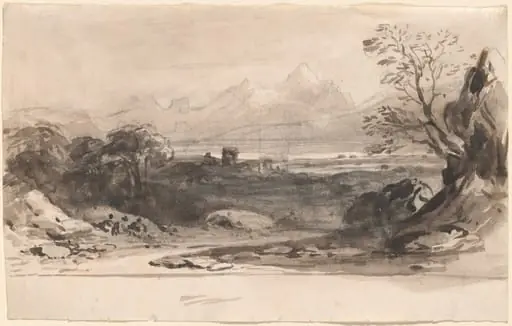
Own this work as a print
Artist & collection

- Landscape with Ruins
 View Near Tivoli (Vue prise à Tivoli)
 A Mountainous Landscape
 Appuldurcombe, Isle of Wight
 Untitled
 A Mountain Valley with a Waterfall
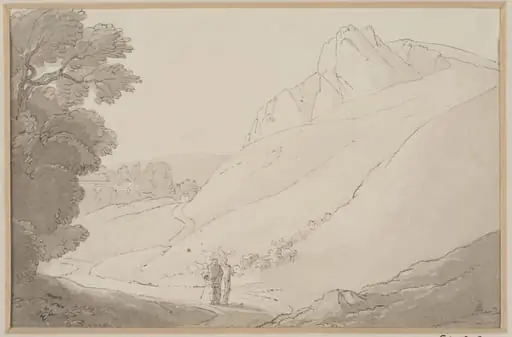 Untitled
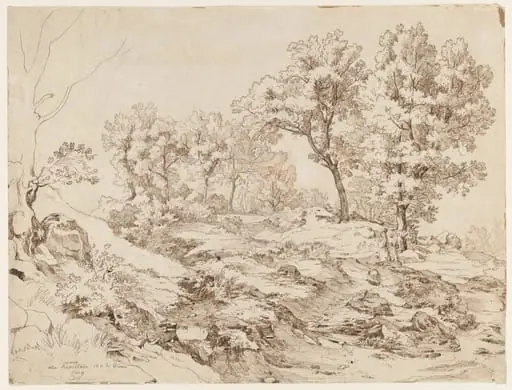 La Serpentara near Olevano
 A Landscape with Farm Buildings among Trees
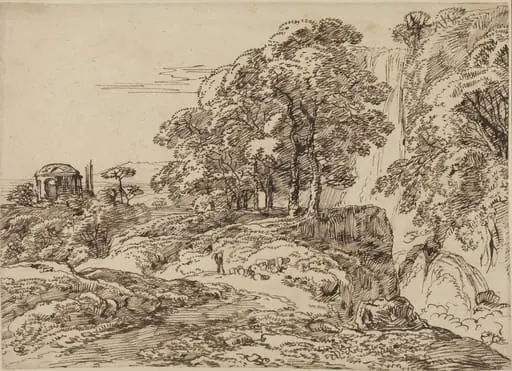 Pastoral Landscape with a Waterfall and a Temple
 A View from Bald Mountain, Orange County, N.Y.
 Study for "The Mountain Ford"