Artwork
Washerwoman near Trouville
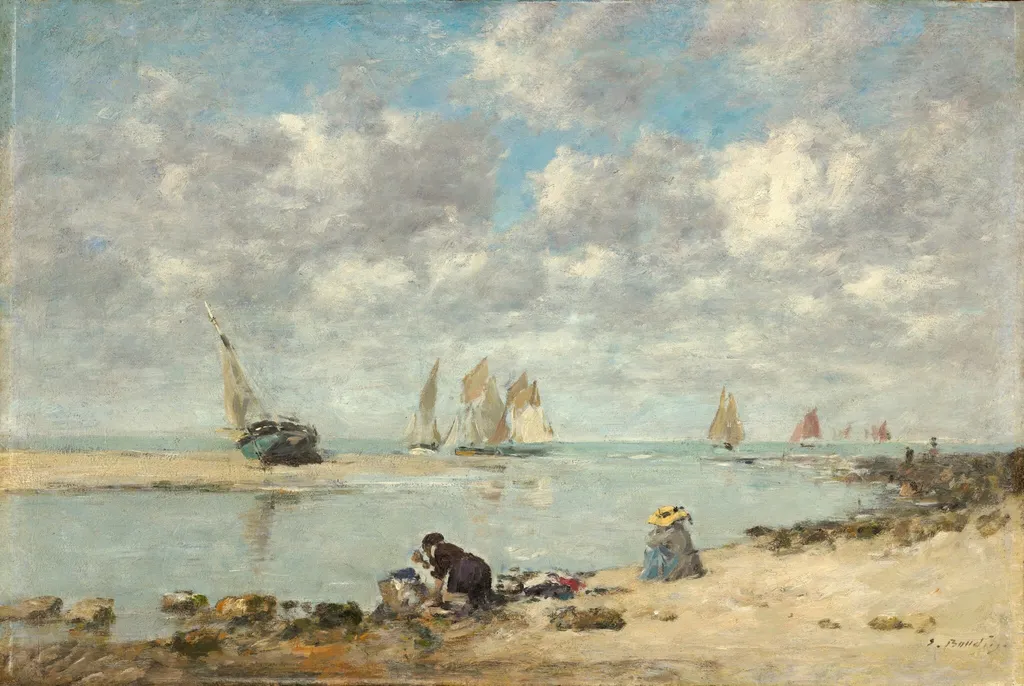
Washerwoman near Trouville is an oil painting by the Impressionist artist Eugène Louis Boudin. It dates from 1874 and is held in the collection of the National Gallery of Art. Eugène Boudin’s Washerwoman near Trouquette is an oil painting executed on a wooden panel around 1874.
- Inscription
- Inscribed:lower right: E. Boudin
About this work
Subject & Meaning
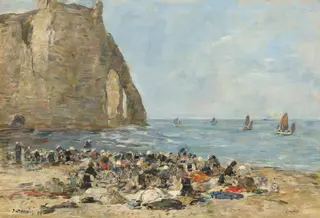
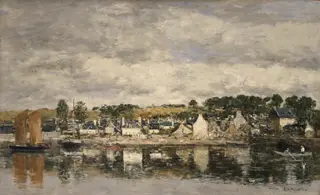
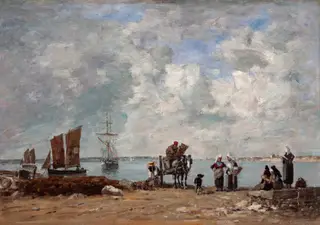
The painting depicts a washerwoman, a working-class figure engaged in laundry activities, situated in the vicinity of Trouville.
The painting depicts a washerwoman, a working-class figure engaged in laundry activities, situated in the vicinity of Trouville. Created in 1874, the work captures a specific moment of daily labor within the coastal environment of the French resort town. By focusing on this subject, the artist elevates a mundane, everyday scene to the status of high art, reflecting an interest in the lives of ordinary people rather than idealized or historical narratives.
The subject matter represents a shift towards realism and the documentation of contemporary life in the mid-19th century.
Technique & Style
Created in 1874, Washerwoman near Trouville is an oil painting executed on a wood panel support. The work measures 27.6 cm in height and 41.3 cm in width. As an Impressionist landscape, it employs the medium of oil paint to capture the atmospheric effects and daily life of the Trouville coast, consistent with Eugène Boudin's stylistic focus on beach scenes and figures. The painting remains in good condition as part of the National Gallery of Art collection.
History & Provenance
Eugène Boudin painted Washerwoman near Trouville in 1874, creating an oil on wood panel now held by the National Gallery of Art in Washington, D.C. The work first entered the Paris auction market when sold at Hôtel Drouot on 28 February 1877 as lot no. 9. It later passed through the Paris gallery of Hutinel, was consigned to Hector Brame in 1962, and was sold to American collector Paul Mellon the same year. In 1983, Mellon gifted the painting to the National Gallery of Art, where it remains in the collection today.
The painting was acquired by the National Gallery of Art in Washington, D.C., following its sale in 1962 to Paul Mellon and subsequent gift in 1983. Its documented provenance includes a sale at Hôtel Drouot in Paris on 28 February 1877 (no. 9), a consignment to Hector Brame in 1962, and eventual purchase by Paul Mellon before donation to the museum.[1][2] The work remains part of the National Gallery of Art's collection and has been exhibited as part of its permanent displays.[1][2]
Context
The painting was first documented in the 1877 Hôtel Drouot sale in Paris (sale no. 9) and later entered the collection of Hector Brame in 1962 before being acquired by Paul Mellon in the same year. It was subsequently gifted to the National Gallery of Art in 1983. The work has been studied within the context of Boudin’s engagement with genre scenes and coastal laborers, reflecting his interest in everyday life and the social realism that prefigured Impressionist concerns.
Scholarship emphasizes its role in tracing the development of rural realism in 19th-century French painting and its significance within the artist’s broader oeuvre.
Overview
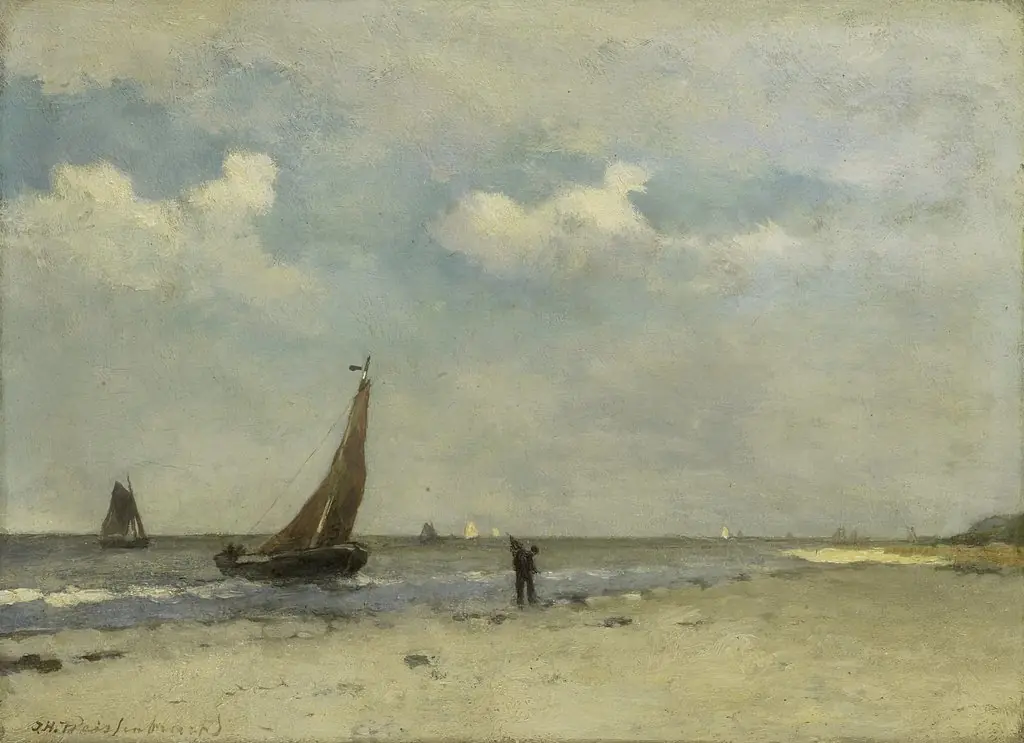
Eugène Boudin’s Washerwoman near Trouquette is an oil painting executed on a wooden panel around 1874. The work captures a quiet moment on a Normandy beach, where two women are engaged in the routine task of washing clothes. In the distance, small sailing vessels bob on a sea under a cloud‑filled sky, situating the scene within a coastal landscape.
Own this work as a print
Artist & collection

Artist
Eugène Louis Boudin (French: ; 12 July 1824 – 8 August 1898) was one of the first French landscape painters to paint outdoors.