Artwork
Preliminary Drawing for "A Donkey-Team (Attelage d'ânes)"
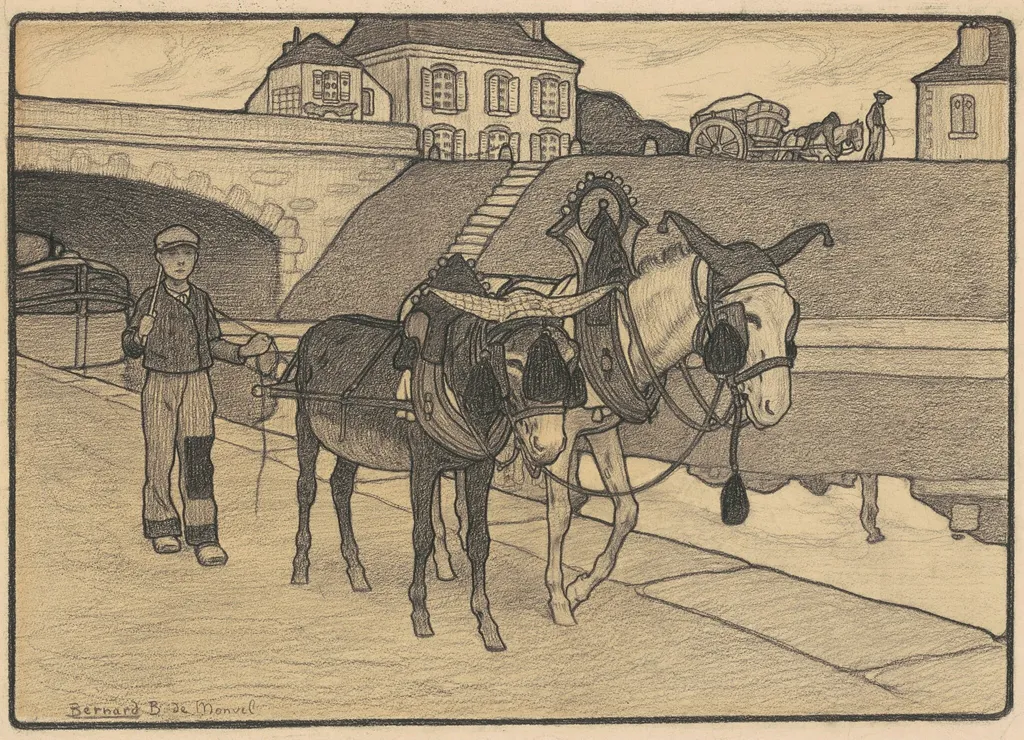
Preliminary Drawing for "A Donkey-Team (Attelage d'ânes)" is a graphite drawing by Bernard Boutet de Monvel. It dates from 1904 and is held in the collection of the National Gallery of Art.
- Inscription
- Inscribed:recto: at lower left, in graphite:Bernard [underlined] B de Monvel; at bottom center, in graphite, in later hand: Attelage d'ânes; verso: various editorial annotations in black chalk, graphite, and blue pencil
- Markings
- Marked:recto: printed in black ink on label pasted at upper left: 7655; verso: written in black ink on Art Department, The Century Co. label at upper left: Tracking with Trackers / Attelage d'ânes; B. B. de Monvel; stamped in red ink at top center: ART DEPARTMENT / The CENTURY Co. / 33 East 17th St. / NEW YORK CITY
About this work
Overview
The work reflects the artist’s interest in everyday rural life and his methodical approach to composition before final execution.
This graphite and black conté crayon drawing, dated around 1904, serves as a preparatory study for Bernard Boutet de Monvel’s finished painting A Donkey-Team (Attelage d'ânes). Executed on wove paper, it captures a rural scene with careful attention to tonal variation and spatial arrangement. The work reflects the artist’s interest in everyday rural life and his methodical approach to composition before final execution.
Subject & Meaning
The scene portrays a man guiding two donkeys, one black, one white, across a wooden bridge. Behind them, a house with a staircase and a horse-drawn cart suggest a quiet agricultural setting. The figures and animals are rendered without sentimentality, emphasizing labor and routine.
The composition conveys a sense of quiet movement, grounding the image in the rhythms of provincial life rather than idealized pastoralism.
Technique & Style
Boutet de Monvel employed graphite for fine linear detail and black conté crayon for rich, velvety shadows, creating a strong chiaroscuro effect. The textures of the donkeys’ coats, the wooden bridge, and the stone walls are suggested through varied pressure and hatching. The wove paper’s smooth surface enhances the precision of the strokes, allowing subtle gradations that model form without overt modeling.
History & Provenance
The drawing entered the collection of the National Gallery of Art in Washington, D.C., as part of a broader acquisition of works by Boutet de Monvel. Its status as a preparatory study indicates it was retained by the artist or his circle, likely preserved for its compositional value. No earlier provenance is publicly documented, but its condition suggests careful handling since its creation.
Context
Created during a period when French artists increasingly turned to rural subjects, this drawing aligns with a broader interest in regional life and vernacular labor. Boutet de Monvel, known for illustrations and historical scenes, here focuses on unembellished observation. The work reflects influences from Realism and the late 19th-century revival of drawing as an autonomous art form, distinct from academic painting traditions.
Legacy
Though not widely exhibited, this drawing remains a key example of Boutet de Monvel’s draftsmanship and his commitment to observational accuracy. It contributes to understanding his process in translating sketches into finished paintings. As a record of rural France at the turn of the century, it holds value for scholars studying the transition from traditional labor to modernization in early 20th-century Europe.
Own this work as a print
Artist & collection
Artist
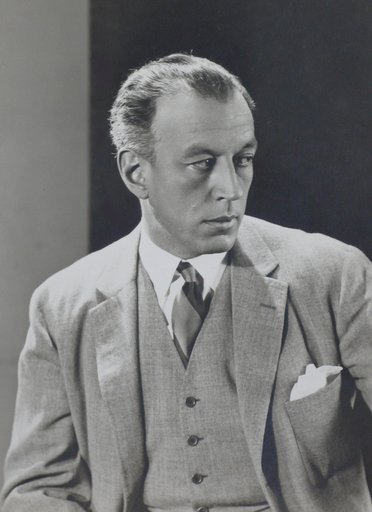
Bernard Boutet de Monvel was a French painter, sculptor, engraver, fashion illustrator and interior decorator.

- Paris, Le Pont des Arts avec Remorqeurs
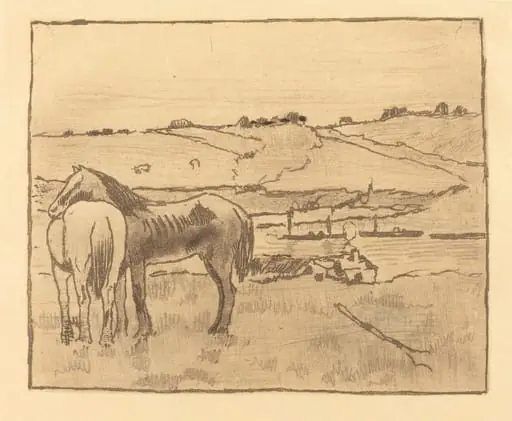 Horses in the Meadow (Chevaux dans la prairie)
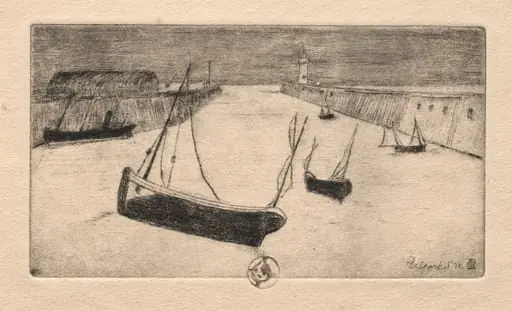 Six Etchings: Tréport
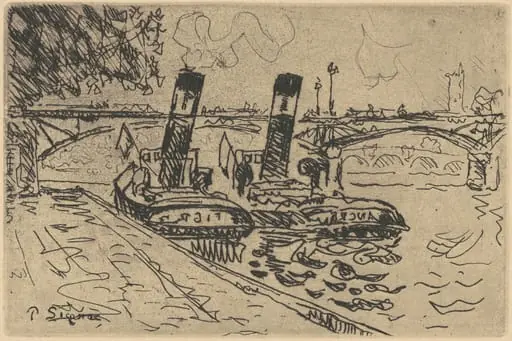 Bateaux sur la Seine
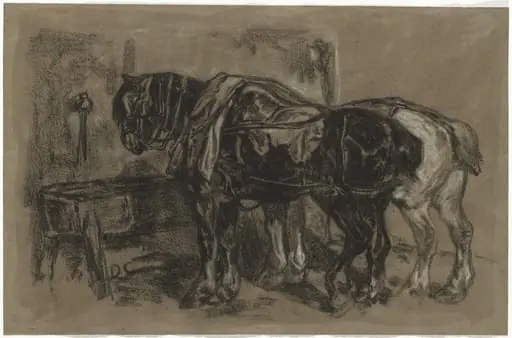 Two Draft Horses
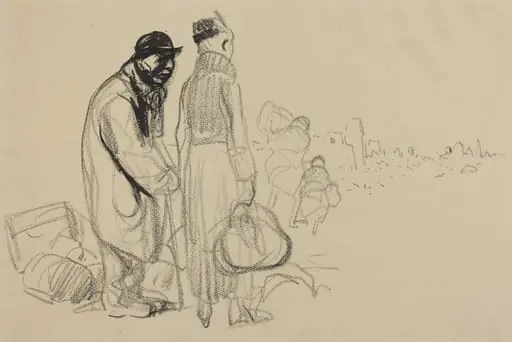 La retour (The Return)
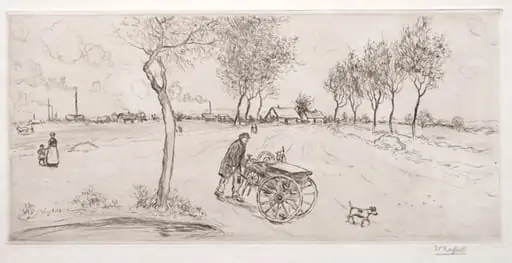 The Knifesharpener
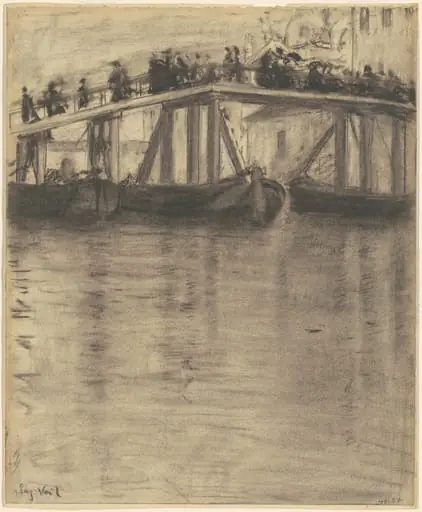 Venetian Bridge
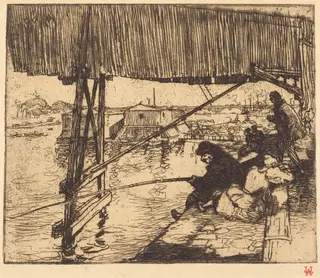 Under the Bridge of Bercy (Sous le pont de Bercy)
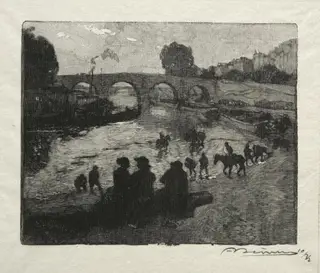 L'Abreuvoir du Pont Marie
 Etchings of Venice: Castello Quarters, Riva
 Pont Neuf