Artwork
Enthroned Madonna and Child
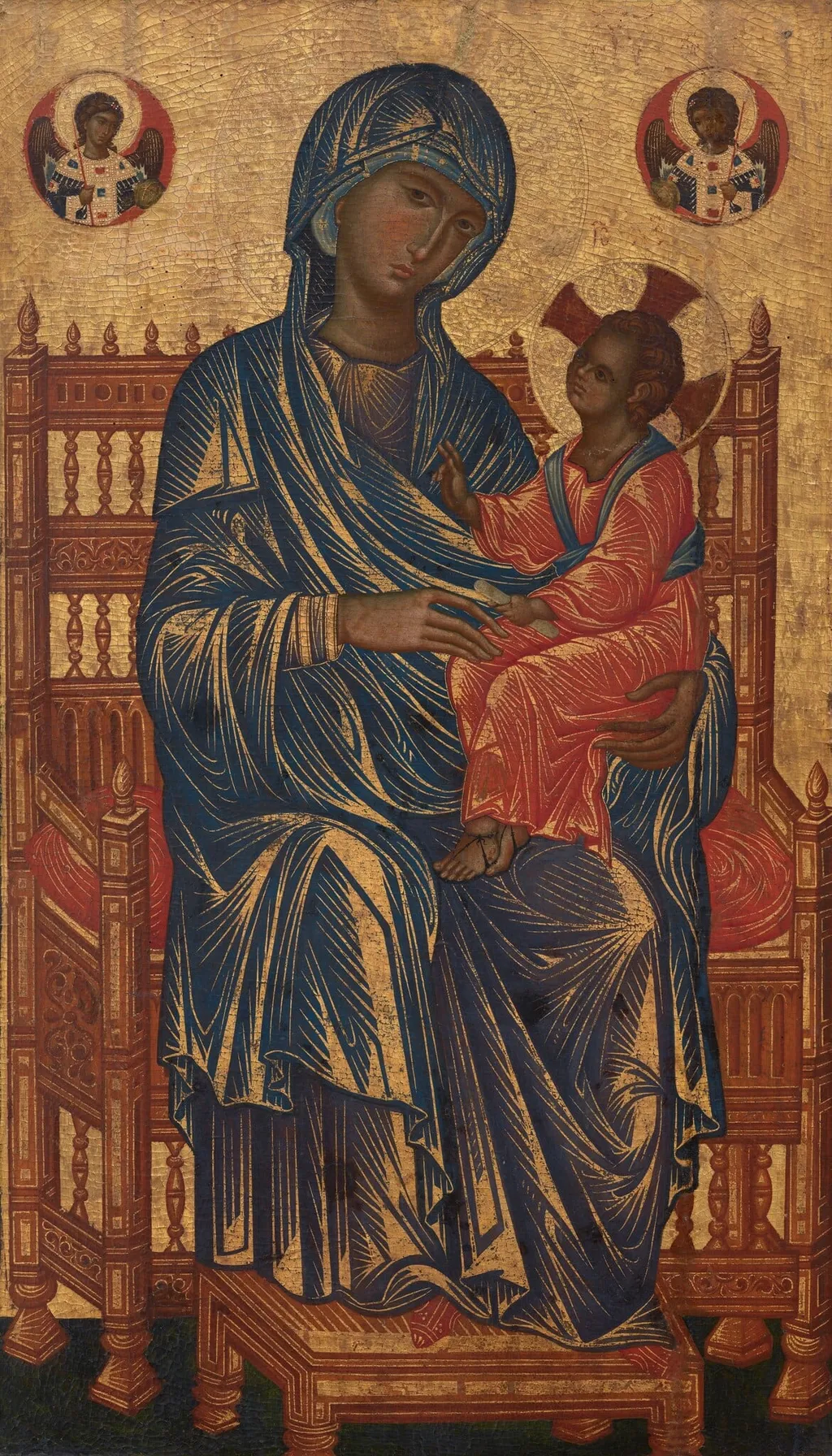
Enthroned Madonna and Child is a tempera painting. It dates from 1262 and is held in the collection of the National Gallery of Art. This tempera painting on poplar panel depicts the Madonna and Child seated upon a grand, golden throne.
About this work
Subject & Meaning
The work portrays the traditional Byzantine image of the enthroned Madonna cradling the infant Christ, a composition that emphasizes the theological link between the Old and New Covenants. In this iconography the Virgin is presented as the heavenly throne of the Incarnation, her regal posture and the Child's blessing gesture underscoring her role as intercessor and protector. The painting's formal elements, gold background, flat spatial treatment, and richly patterned drapery, reflect the devotional aims of 13th‑century sacred art, directing the viewer's focus toward the sacred mystery of the Incarnation rather than naturalistic detail.
Technique & Style
The composition features the Madonna enthroned with the Christ Child, adhering to the iconographic conventions of the period.
Executed circa 1262, this religious work is a tempera painting on a poplar panel support. The piece measures approximately 124.8 cm in height and 70.8 cm in width. Stylistically, the artwork is attributed to the Byzantine tradition of the thirteenth century.
The composition features the Madonna enthroned with the Christ Child, adhering to the iconographic conventions of the period. While the specific surface condition or detailed handling techniques are not explicitly described in the available records, the identification of tempera on wood confirms the standard materials and medium employed for panel paintings of this era and origin.
History & Provenance
The work was originally housed in a church or convent in Calahorra, Spain, before entering the European art market via Emile Pares, who sold it at Anderson Galleries in New York on 18–19 February 1915 (lot 306, attributed to Giovanni Cimabue). It was purchased by F. Kleinberger & Co. in November 1915 and acquired by Otto Kahn by 1917; after Kahn's death it passed to his widow Addie Wolff Kahn, who gifted the piece to the National Gallery of Art in 1949. Executed in the 13th century, the panel is painted in tempera on poplar and belongs to the Byzantine tradition, depicting the Virgin Mary with the Christ Child (dated 1262).
The painting entered the collection of the National Gallery of Art in Washington, D.C., in 1949 as a gift from Addie Wolff Kahn, the widow of financier Otto Kahn, who had owned the panel by 1917. Its NGA accession number is 1949.7.1. Earlier in its documented history, the work was sold on 26 November 1915 through the New York firm F. Kleinberger & Co. to Kahn, having previously been offered at the Anderson Galleries in New York on 18–19 February 1915 (second day, lot 306) from the collection of Emile Pares, with the panel attributed at that sale to Giovanni Cimabue.
The painting is said to have originated in a church or convent in Calahorra, in the Spanish province of La Rioja, before appearing on the Madrid art market in 1912 through Herbert P. Weissberger.
Context
The Enthroned Madonna and Child has been situated within debates about its origin and attribution since its emergence in the early 20th century. Initially catalogued in 1915 as a work by Giovanni Cimabue, the painting's Spanish provenance, linked to Calahorra, has been repeatedly questioned, with scholars such as Miklòs Boskovits dismissing unsubstantiated claims. Boskovits argued that the unlikely Spanish connection may have been constructed to align the work with a celebrated Italian master, reflecting early 20th-century market preferences for attributions to prominent artists rather than anonymous Byzantine or Italo-Byzantine hands.
The painting's later inclusion in the National Gallery of Art, Washington, following its acquisition from Otto Kahn's collection in 1949, cemented its place in American institutional holdings, though its stylistic placement within 13th-century Byzantine or Italo-Byzantine production remains unresolved. Its classification as a religious panel underscores its liturgical function, typical of the genre, while its technical and stylistic features situate it within broader trends of late Byzantine or transitional Italo-Byzantine art.
Overview
This tempera painting on poplar panel depicts the Madonna and Child seated upon a grand, golden throne. The figures of Mary and Christ exhibit a stylized, formal quality in their countenances and gestures. A background of genuine gold leaf, rather than pigment, envelops the scene, contributing to the work's radiant and otherworldly presence. This approach emphasizes the sacred nature of the subjects, presenting them with solemn dignity.
Artist & collection

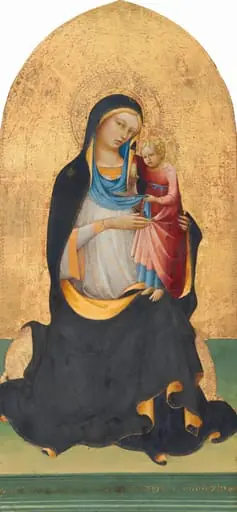 Madonna and Child
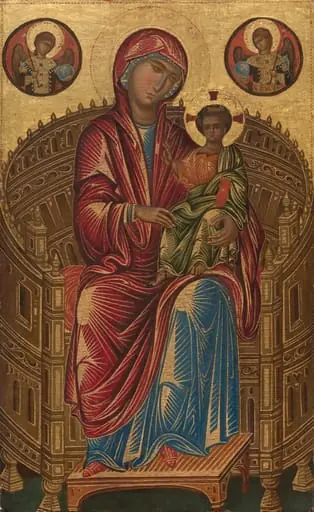 Madonna and Child on a Curved Throne
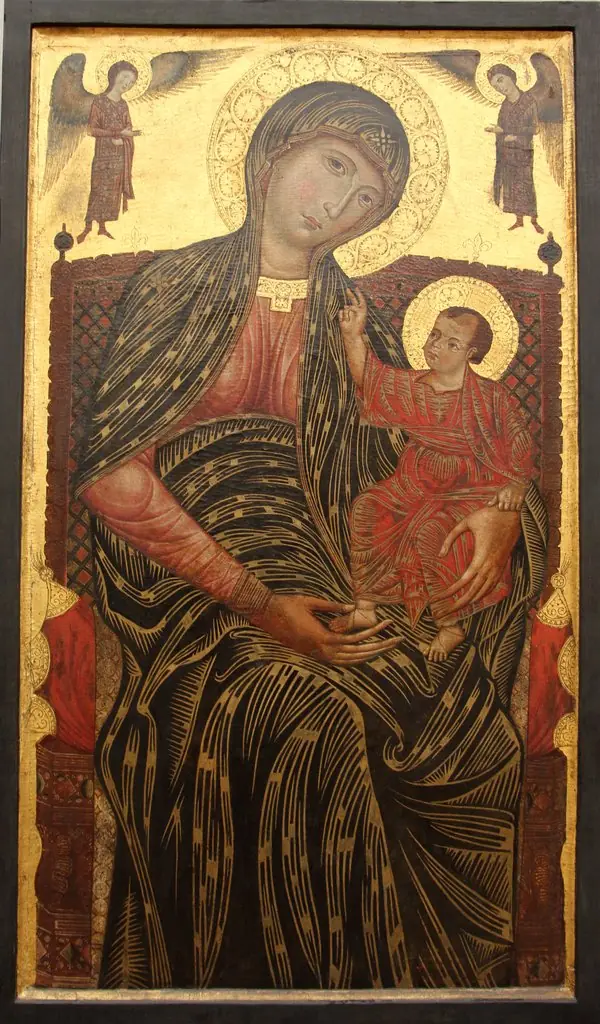 Madonna enthroned with two angels
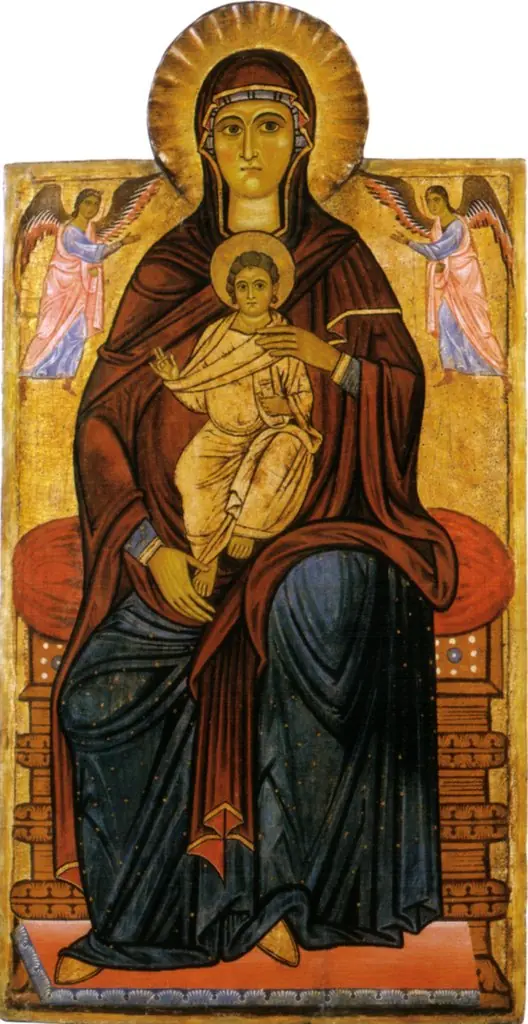 Madonna with Child enthroned with two Angels
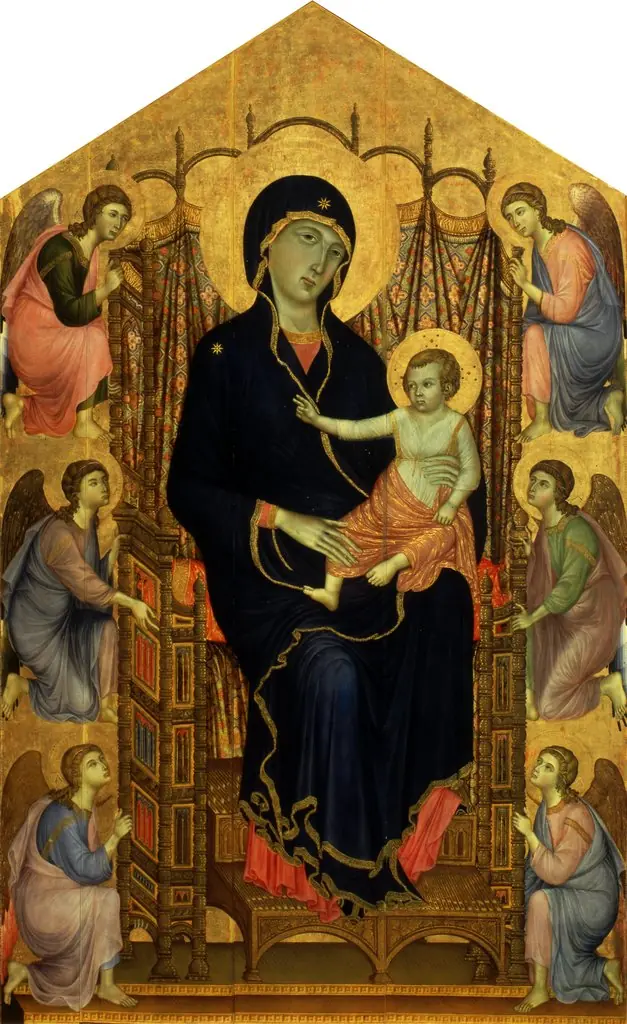 Rucellai Madonna
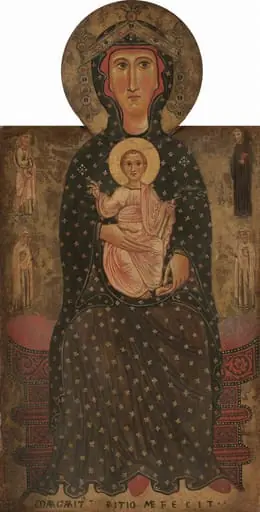 Madonna and Child Enthroned with Four Saints
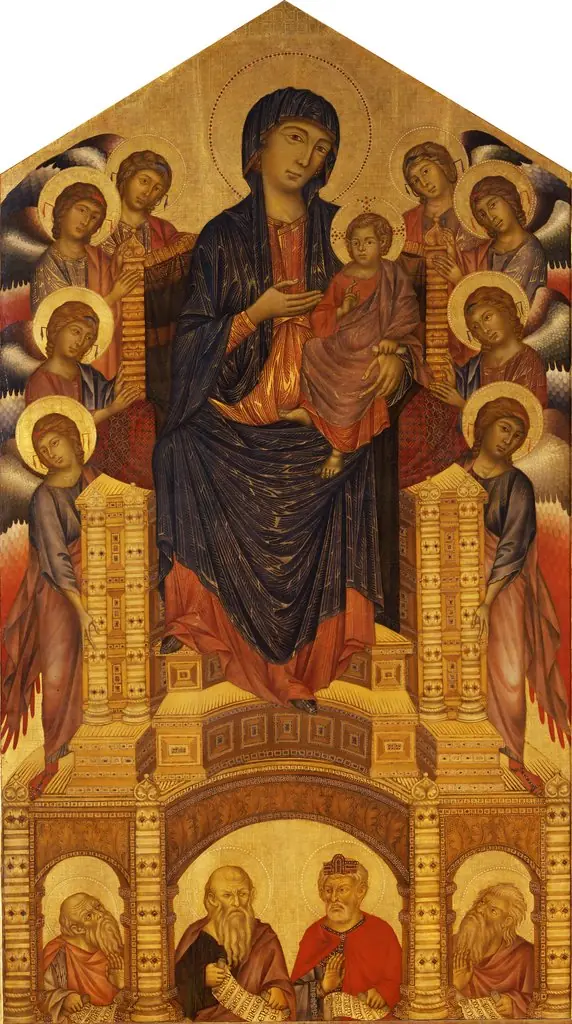 Madonna and Child Enthroned with Angels and Prophets. ˋSanta Trinità Maestà´
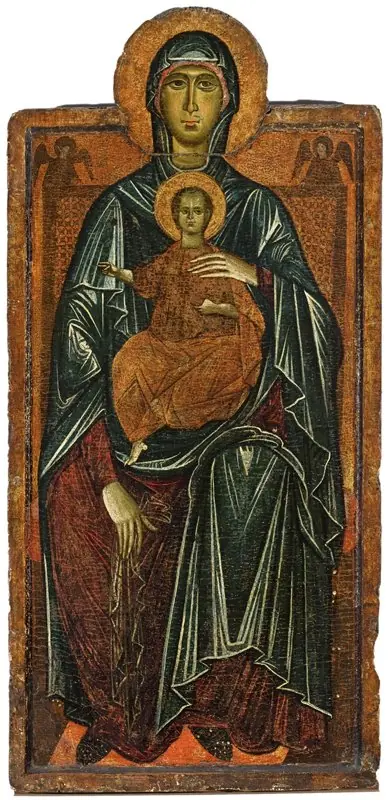 Maestà attributed to the Master of Bigallo
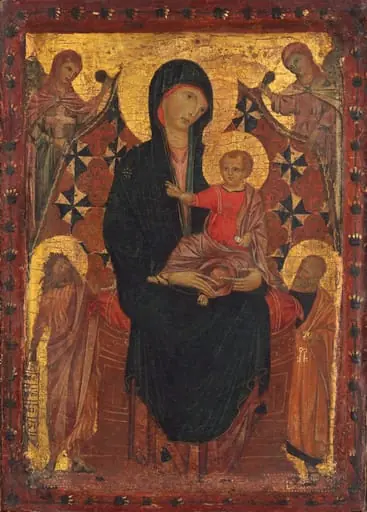 Madonna and Child with Saint John the Baptist, Saint Peter, and Two Angels
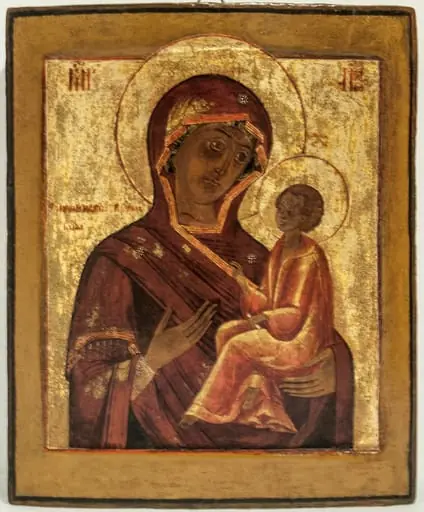 Icoa cee