Artwork
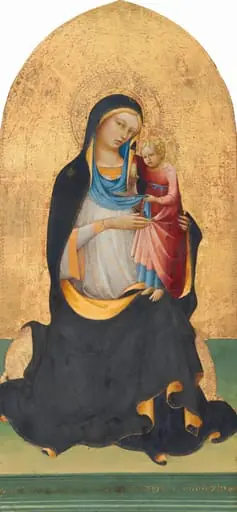
Madonna and Child on a Curved Throne
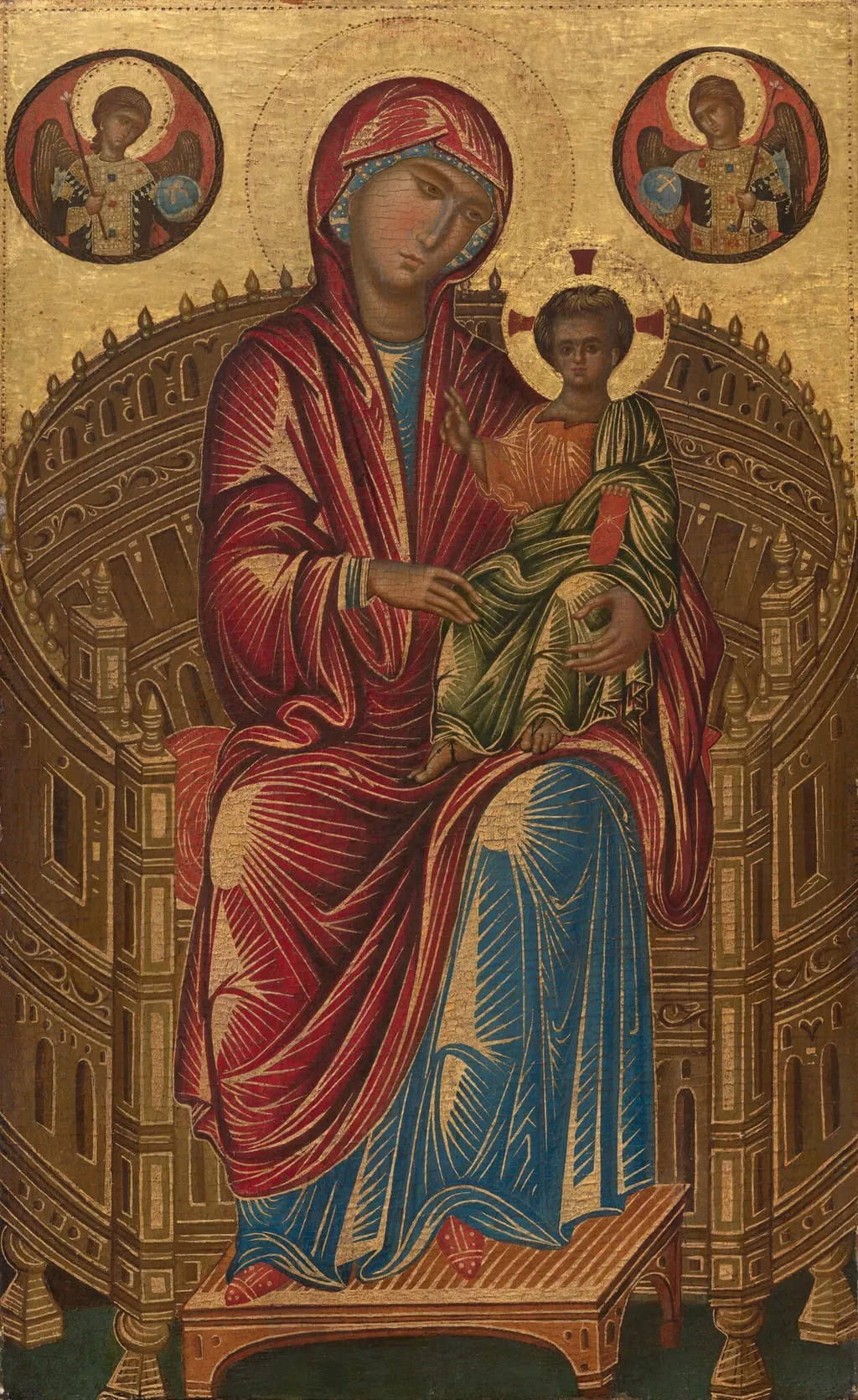
Madonna and Child on a Curved Throne is a tempera painting. It dates from 1270 and is held in the collection of the National Gallery of Art.
About this work
Technique & Style
It depicts the Madonna and Child seated on a curved throne, a composition that emphasizes the sacred relationship through a formal, hieratic arrangement.
The work is executed in tempera on a curved linden panel, a support typical of 13th‑century Byzantine icons. It depicts the Madonna and Child seated on a curved throne, a composition that emphasizes the sacred relationship through a formal, hieratic arrangement. As a religious painting, it belongs to the iconographic tradition of the period, reflecting the stylized modeling and flattened space characteristic of Byzantine art.
The curved throne functions both as a structural element and as a symbolic device, guiding the viewer’s gaze toward the central figures. The painting entered the National Gallery of Art through the Andrew W. Mellon collection in 1937.
History & Provenance
Dated to 1260, this tempera painting on linden panel reportedly originated from a church or convent in Calahorra, Spain. Gabriel Dereppe of Madrid first brought the work to the attention of the Duveen Brothers in May 1918, initially attributing it to Pietro Cavallini. The firm purchased the piece on September 11, 1919, subsequently selling it to New York collector Carl W. Hamilton in the early 1920s.
Duveen Brothers reacquired the panel from Hamilton and later sold it to the Andrew W. Mellon Educational and Charitable Trust on December 15, 1936. Mellon gifted the artwork to the National Gallery of Art in Washington, D.C., in 1937. While some scholars have questioned the Calahorra origin story first published by Bernard Berenson in 1921, cataloguer Miklòs Boskovits maintains there are no substantial grounds for such doubt.
The Madonna and Child on a Curved Throne is held by the National Gallery of Art in Washington, D.C., as part of the Andrew W. Mellon collection. The work was accessioned by the museum in 1937, following its acquisition by The Andrew W. Mellon Educational and Charitable Trust in Pittsburgh the previous year. Prior to entering the national collection, the painting passed through the hands of Carl W. Hamilton in New York and the Duveen Brothers, who handled its sale in 1936.
Its provenance traces back to a reported origin in a church or convent in Calahorra, Spain, before it was purchased by the gallery.
Legacy
Scholarly attention to the Madonna and Child on a Curved Throne has been shaped by its contentious provenance and debated attribution. Early documentation by Bernard Berenson and subsequent analysis by Miklòs Boskovits affirmed the work’s medieval origin and suggested a possible link to Pietro Cavallini, reinforcing its reputation among specialists. The painting’s inclusion in the National Gallery of Art, acquired through the Andrew W. Mellon collection, has elevated its public profile and ensured its continued study in exhibitions and catalogues.
Its trajectory from a Spanish monastery to prominent museum shelves illustrates a legacy of academic interest and institutional recognition.
Overview
This painting, titled "Madonna and Child on a Curved Throne," presents a traditional religious subject. It depicts the Virgin Mary seated on an ornate throne, holding the infant Jesus. The composition is characterized by a gold background and intricate patterns, typical of devotional art from an earlier period.
Executed in tempera on a linden wood panel, the work showcases the artistic techniques and visual conventions prevalent before the Renaissance, emphasizing spiritual symbolism over naturalistic representation.
Subject & Meaning
The central figures are the Virgin Mary, dressed in a deep red robe with blue undergarments and a blue headscarf, and the Christ Child, whom she cradles on her lap. Mary is enthroned on a seat with a curved back, adorned with gold patterns, signifying her regal status. Above her shoulders, two small winged angels appear within round frames, each holding a globe, which traditionally symbolizes divine authority and the universal reach of Christianity.
Artist & collection

- Enthroned Madonna and Child
 Icoa cee
 Madonna with Child enthroned with two Angels
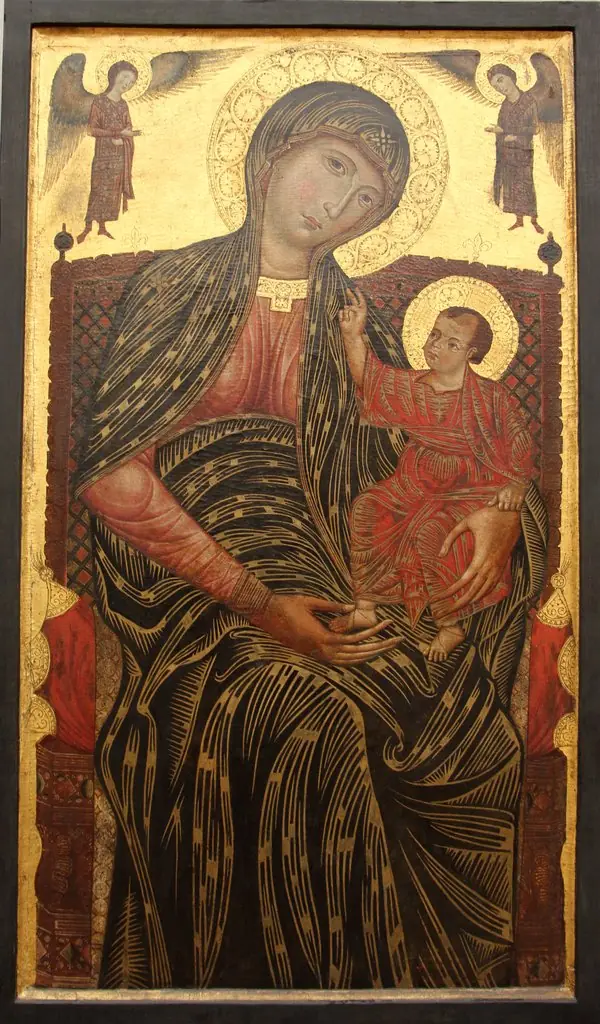 Madonna enthroned with two angels
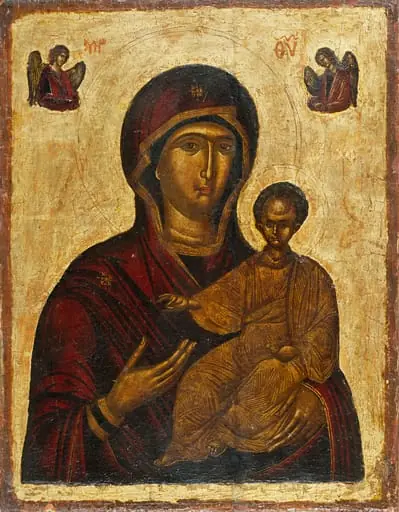 Jumalanäiti, Hodigitria - Tiennäyttäjä, bysanttilainen ikoni
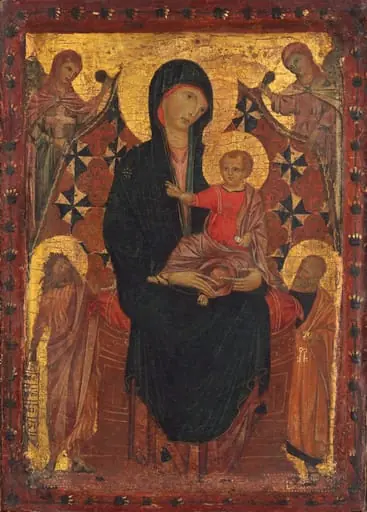 Madonna and Child with Saint John the Baptist, Saint Peter, and Two Angels
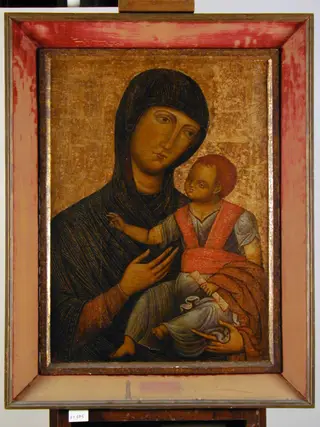 Madonna and Child
 Virgin and Child
 Mother of God from Iviron
 Maica Domnului cu Pruncul - Stăpâna Îngerilor
 Our Lady of the Great Panagiya
 Madonna and Child