Artwork
Madonna and Child Enthroned with Angels and Prophets. ˋSanta Trinità Maestà´
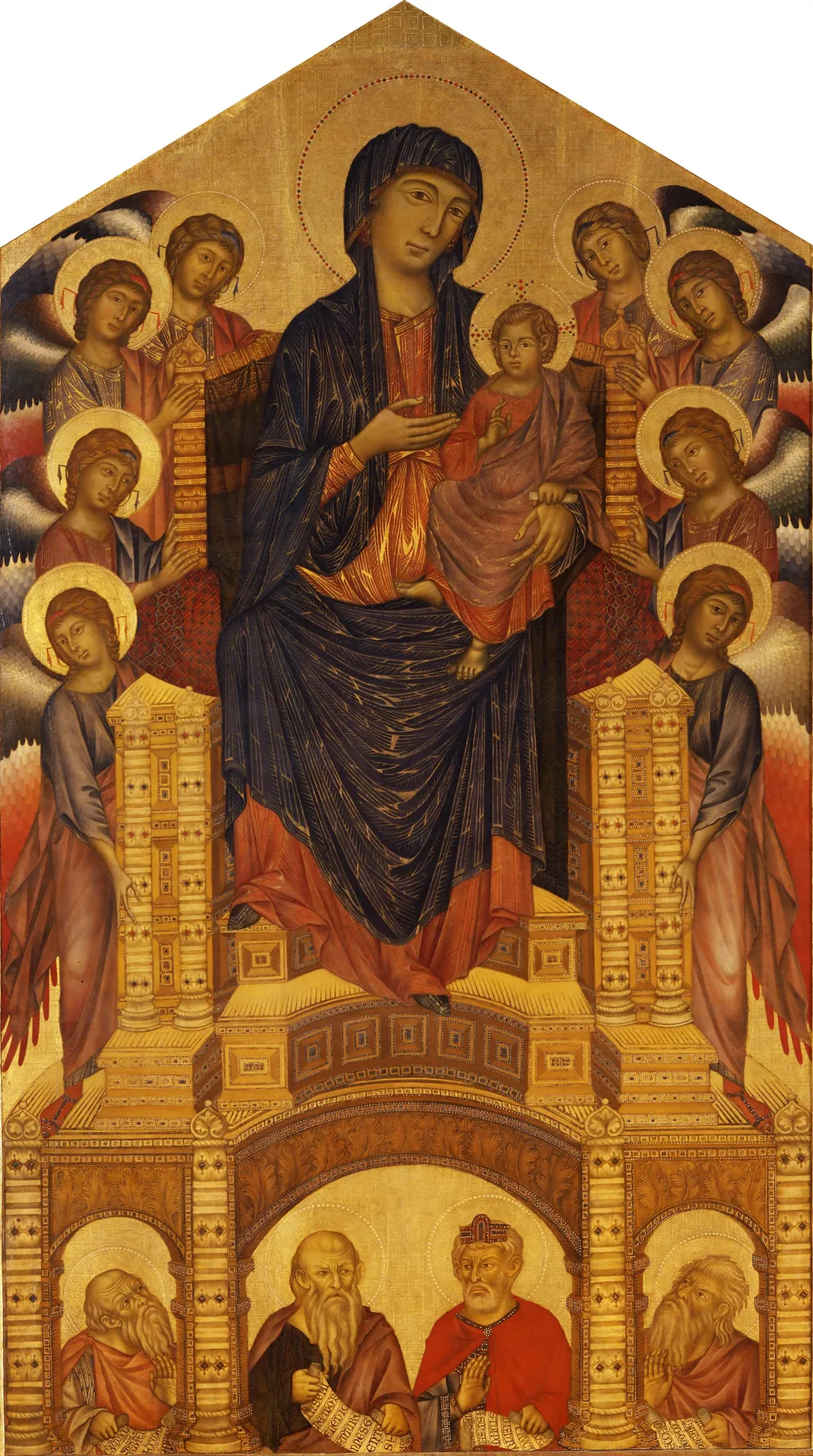
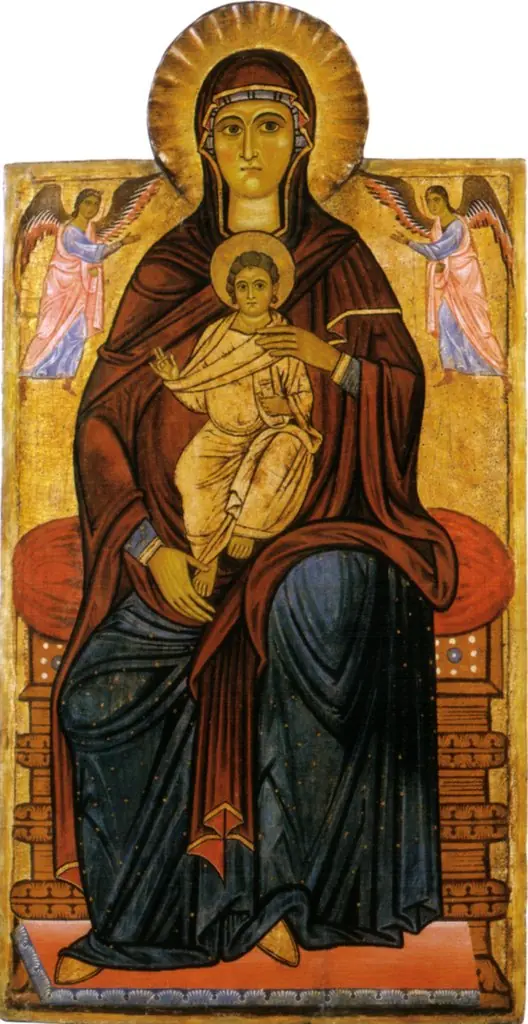
Madonna and Child Enthroned with Angels and Prophets. ˋSanta Trinità Maestà´ is a tempera painting by the Byzantine icon painting artist Cimabue. It dates from 1296 and is held in the collection of the Uffizi Gallery.
About this work
Subject & Meaning
The composition includes eight angels surrounding the throne and four Old Testament prophets positioned in niches beneath the architectural structure.
The work depicts the Maestà iconography, centering on the Virgin Mary enthroned with the Christ Child, following the Byzantine Hodegetria tradition where the Virgin points to Jesus as the path to salvation. In this symbolism, the Madonna represents the Christian Church, while the Child signifies Life, Truth, and the Way. The composition includes eight angels surrounding the throne and four Old Testament prophets positioned in niches beneath the architectural structure.
These prophets, Jeremiah, Abraham, David, and Isaiah, are identified by scrolls containing verses foretelling the Incarnation and the Virgin birth. The arrangement carries specific doctrinal meaning: the central patriarchs represent human rational inquiry into the mystery of the Incarnation, while the lateral prophets, gazing upward, embody a state of mystical rapture having resolved their doubts. The gold background serves as a symbol of the divine realm, and the throne itself acts as a stage linking the earthly lineage of the prophets to the heavenly majesty of the Mother and Child.
Technique & Style
Created between 1290 and 1300, the Santa Trinità Maestà is a tempera painting on a wooden panel measuring 385 by 223 cm. The work originally featured a pointed apex, which was later altered to a rectangular shape by cutting the top and adding angel wings; this was reversed during an 1890 restoration by Oreste Cambi to recreate the original cusped form. Stylistically, the piece marks a transition from rigid Byzantine conventions to a more humanistic approach. Cimabue employs an innovative frontal perspective for the throne, utilizing intuitive depth and architectural massing that departs from earlier angular representations.
The figures exhibit a novel use of delicate sfumato and chiaroscuro to model solid forms, particularly in the angels' drapery and the prophets' faces. A gold ground surrounds the figures, yet the composition creates a sense of spatial depth, making the prophets appear to emerge from niches rather than standing flat against the background.
History & Provenance
The Santa Trinità Maestà was commissioned for the church of Santa Trinita in Florence, likely by the Vallombrosan order, though the specific patron remains unidentified. Created by Cimabue between 1290 and 1300, the work was executed during a period when the artist had returned from fresco work in Assisi. According to Giorgio Vasari, the painting remained on the high altar until 1471, when it was replaced by a work by Alesso Baldovinetti and moved to a side chapel due to declining appreciation for its style.
It was later relegated to the monastery infirmary before being transferred to the Florentine Galleria dell'Accademia in 1810 during Napoleonic suppressions. The painting finally entered the Uffizi Gallery in 1919. The panel was at one time cut into a rectangular shape with added angel wings; it was restored to its original pointed form by Oreste Cambi in 1890, with further restorations completed in 1947–1948 and 1993.
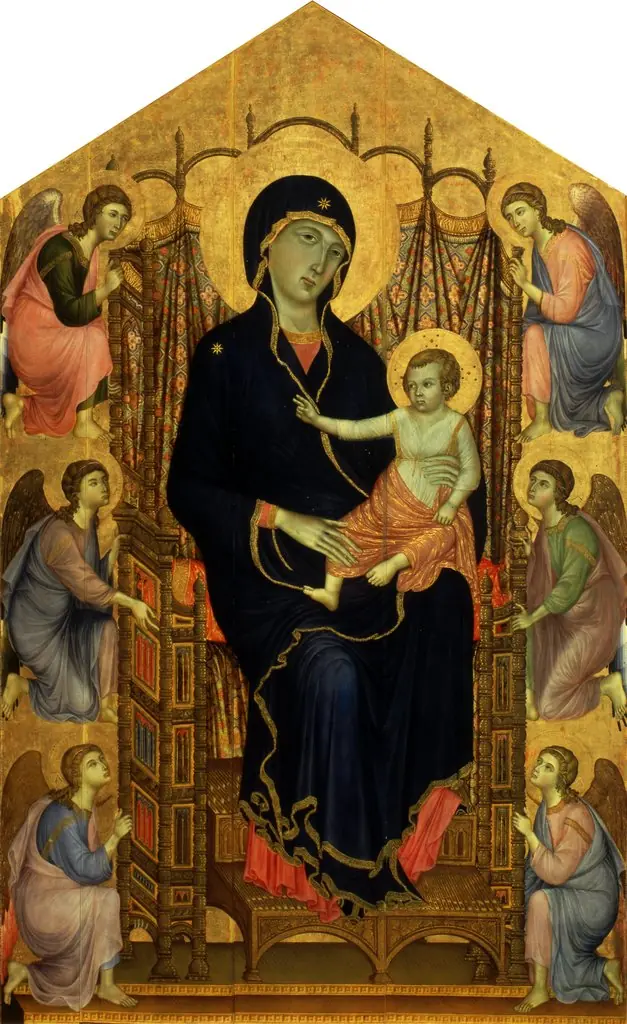
The Santa Trinita Maestà is held in the Uffizi Gallery in Florence, where it is displayed in the gallery's room of Maestà alongside Duccio's Madonna Rucellai and Giotto's Ognissanti Madonna. Originally painted for the high altar of the Basilica of Santa Trinita, the panel remained there until 1471, when it was displaced by Alesso Baldovinetti's Trinity and relegated first to a side chapel and later to the monastery's infirmary. During the Napoleonic suppressions it was transferred in 1810 to the Galleria dell'Accademia in Florence, and in 1919 it was moved to the Uffizi, where it has remained since. The sources do not record a specific inventory or accession number for the work.
Context
Attributed to Cimabue and dated to around 1290–1300, the Santa Trinita Maestà was originally installed in Florence's Santa Trinita church before being moved to the Uffizi in 1919. Vasari and later scholarship credit Cimabue with the work, though the eighteenth-century critic Guglielmo della Valle questioned the attribution. Modern studies view the panel as a pivotal transitional piece that introduces a frontally rendered, architecturally scaled throne and a novel arrangement of Old Testament prophets, signaling a move from Byzantine rigidity toward early Renaissance naturalism.
Its innovative perspective and treatment of the angels influenced later artists such as Giotto, marking the painting's enduring significance in art-historical narratives.
Legacy
The Santa Trinita Maestà became a pivotal model in the transition from Byzantine stylization to early Renaissance naturalism. Its innovative use of central perspective in the throne and the modulated chiaroscuro of the angels were influential on contemporaries such as Giotto, whose Ognissanti Madonna (c. 1310) echoes Cimabue's spatial and volumetric innovations.
By the late nineteenth century, the work's reputation was revived through restoration and reinstallation. Exhibited alongside Duccio's and Giotto's Maestà in the Uffizi's Sala delle Maestà, it anchored modern narratives of Italian "primitive" art and the origins of Renaissance painting. Conservation in 1890 and 1947–48 further stabilized its status as a canonical touchstone for studying Cimabue's mature style and its diffusion across fourteenth-century workshops.
Overview
Cimabue's Santa Trinità Maestà is a large tempera panel painting from the late 13th century. It depicts the Virgin Mary and Christ Child seated on a grand throne, flanked by angels and prophets. Originally created for a Florentine church, this work exemplifies the devotional art of the medieval period, showcasing a formal composition designed to inspire reverence. It is now a prominent piece in the Uffizi Gallery in Florence.
Artist & collection
Artist
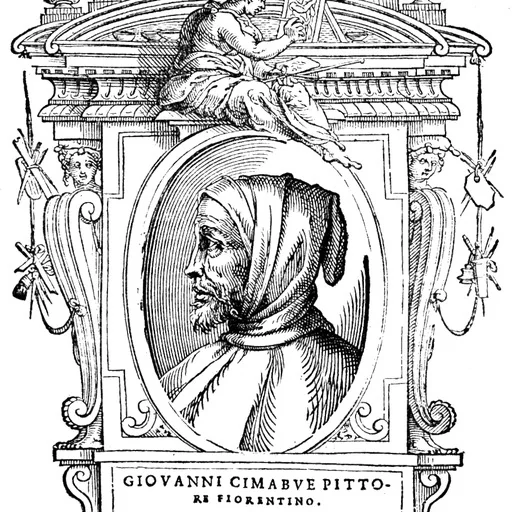
Giovanni Cimabue ( CHEE-mə-BOO-ay, Italian:; c. 1240 – 1302), also known as Cenni di Pepo or Cenni di Pepi, was an Italian painter and designer of mosaics from Florence. Although heavily influenced by Byzantine models,…