Artwork
Madonna with Child enthroned with two Angels
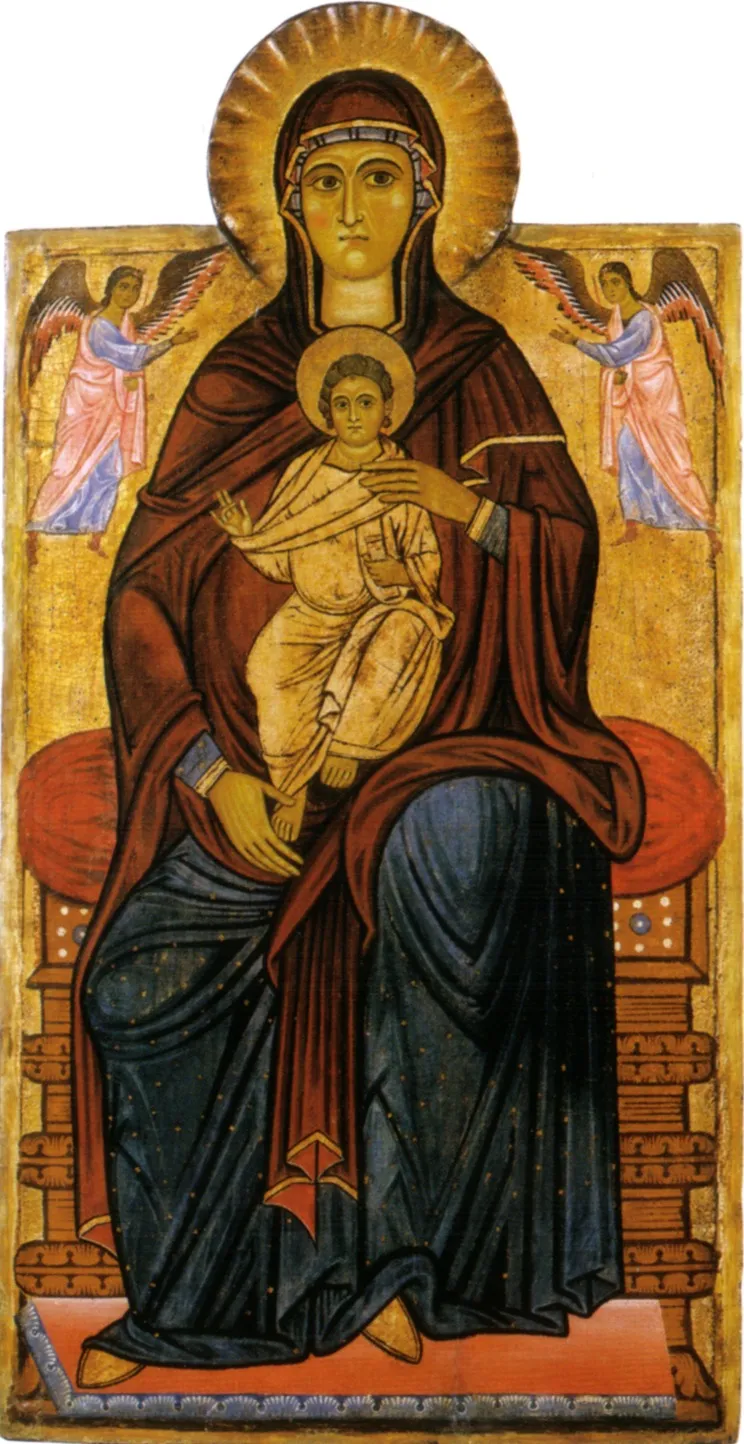
Madonna with Child enthroned with two Angels is an oil painting by the Byzantine icon painting artist Master of the Bigallo Crucifixion. It dates from 1230 and is held in the collection of the Uffizi Gallery.
About this work
Subject & Meaning
It is housed in the Uffizi Gallery, Florence, where it has been on display since 2007 after being acquired from antiquarian Fabrizio Moretti.
The work depicts the Virgin Mary seated on a stylized throne holding the infant Christ, accompanied by two angels, a composition typical of early 13th-century Florentine religious painting. Mary is shown extending her head and halo beyond the panel’s edge, wearing a richly pleated red mantle over a blue undergarment with gold-dotted details, while the child blesses with a gesture derived from the Madonna di Rovezzano but softened by the Master of the Bigallo to appear more engaging. The painting’s formal qualities, including geometric drapery and elongated forms, reflect the stylistic traits of Florentine art in the first half of the 1200s and underscore its devotional and symbolic emphasis on maternal tenderness and divine intercession.
It is housed in the Uffizi Gallery, Florence, where it has been on display since 2007 after being acquired from antiquarian Fabrizio Moretti.
Technique & Style
The artwork is a tempera painting on a wooden panel measuring 119.5 by 61 cm. It is in good condition. Stylistically, the work exemplifies Florentine painting from the first half of the thirteenth century. The Virgin is seated on a stylized throne with convex layers and a red cushion, her head and halo projecting beyond the rectangular panel boundaries, a convention typical of the era.
Two small, symmetrical flying angels occupy the corners beside her shoulders. Her red mantle drapes in heavy, geometric, and flat folds, modeled with shaded color stripes, while her blue, gold-dotted garment reveals stylized folds that loosely suggest the knees beneath. The forms expand outward, lending the sacred group a solemn and majestic tone.
The Christ Child extends his arm from a white mantle, a motif softened by the artist to reveal the elbow beneath a neck-length band. The Virgin's gaze deviates slightly diagonally, a characteristic feature of the Master's style.
History & Provenance
The painting Madonna with Child enthroned with two Angels was created around 1230 by the Master of the Bigallo Crucifixion, an anonymous Italian painter active in the first half of the 13th century. It was originally sold by antiquarian Stefano Bardini in the 19th century and later entered the collections of Charles Fairfax Murray, Joseph Duveen, Carl W. Hamilton, George R. Hann, Harari & Johns Limited, and Fabrizio Moretti before being acquired by the Uffizi Gallery in Florence. The work was purchased in 2006 from Fabrizio Moretti using funds managed by the Soprintendenza per il Polo Museale Fiorentino and has been on display in Room A3 since 2007.
The painting measures 119.5 cm in height and 61 cm in width and is executed in tempera on panel. It depicts the Virgin Mary seated on a stylized throne with the Christ Child on her lap, flanked by two angels, a composition typical of early 13th-century Florentine devotional art.
The attribution to the Master of the Bigallo Crucifixion is based on stylistic analysis and archival research, including comparisons with other works linked to this painter. The Master is recognized as one of the earliest identifiable Italian painters, and this work is considered one of his most significant surviving pieces, reflecting the development of Florentine painting in the early Duecento. The composition shows the Virgin extending her head and halo beyond the panel’s edge, seated on a multi-tiered throne with a red cushion, while the Child blesses with a gesture reminiscent of the earlier Madonna di Rovezzano, though softened by the Master’s more lyrical style.
The painting is held in the Uffizi Gallery, Florence, where it has been on display since 2007. It was acquired in 2006 from antiquarian Fabrizio Moretti using funds administered by the Soprintendenza per il Polo Museale Fiorentino. Prior to its museum acquisition, the work passed through several collections, including those of Stefano Bardini, Charles Fairfax Murray, Joseph Duveen, and Carl W. Hamilton, among others. The artwork is catalogued under inventory number 1890.12345 in the Uffizi's collection records.
Context
The attribution to the Master of the Bigallo links the work to early 13th-century Florentine painting, a period marked by devotional imagery that blended Byzantine tradition with emerging naturalism. Contemporary scholarship highlights its significance as one of the few securely attributed works by this anonymous master, reflecting the evolution of Marian iconography in Italian art. The painting’s composition, featuring the Virgin enthroned with symbolic throne elements and flanking angels, aligns with devotional practices of the time while demonstrating stylistic innovations noted by art historians.
Its provenance through private collectors before acquisition by the Uffizi Gallery underscores the 19th-century art market dynamics that shaped the dispersal of Italian primitives abroad.
Legacy
The painting is considered one of the finest works by the anonymous Master of the Bigallo Crucifixion, who is recognized as one of the earliest Italian painters for whom a catalog of works has been successfully reconstructed. The artwork is highly significant for understanding Florentine painting in the first half of the 13th century. Its iconographic elements, such as the Christ Child's arm emerging from a white mantle, directly echo the earlier Madonna di Rovezzano, though the Bigallo Master softened the gesture to make it more visually engaging.
The painting's historical importance was underscored in 2006 when the Uffizi Gallery acquired it from antiquarian Fabrizio Moretti using special funds, leading to its prominent display in the museum's 13th-century room starting in 2007.
Overview
Madonna with Child Enthroned with Two Angels is a 13th-century oil painting created in 1230 by the Master of the Bigallo Crucifixion, an early organized workshop leader in Florence.
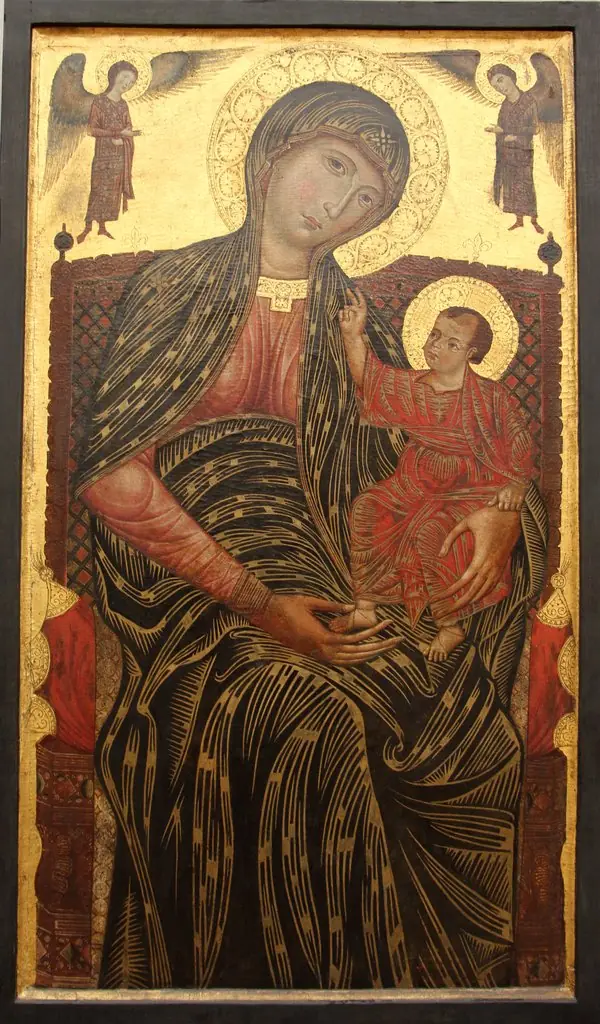
Artist & collection
Artist
Master of the Bigallo Crucifixion
The Master of the Bigallo Crucifix or Bigallo Master (fl. 1215/20-1265) was an Italian painter active around Florence in the first half of the 13th century. He ran one of the first fully organized workshops before…

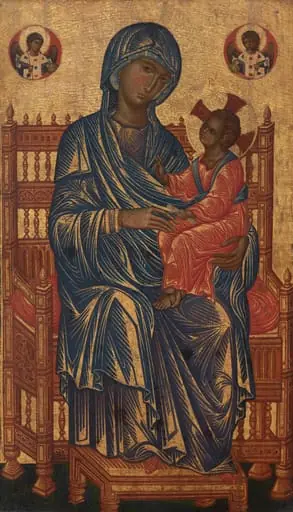 Enthroned Madonna and Child
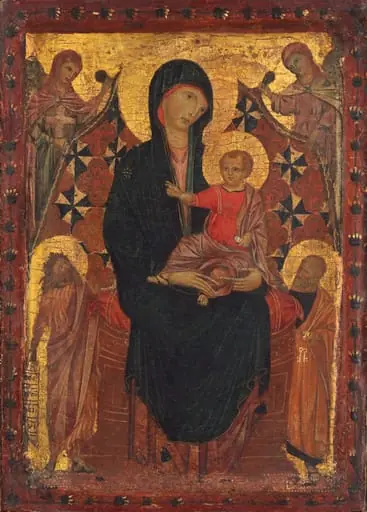 Madonna and Child with Saint John the Baptist, Saint Peter, and Two Angels
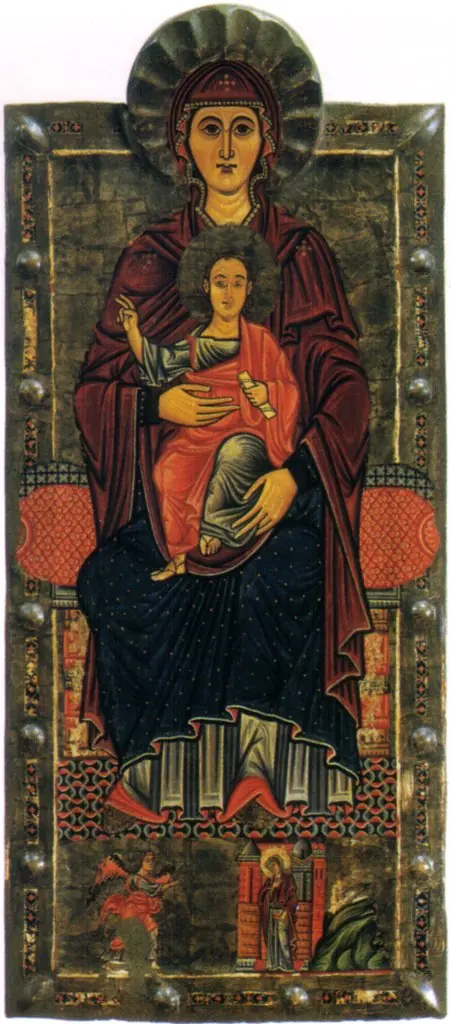 Virgin and Child enthroned; Annunciation
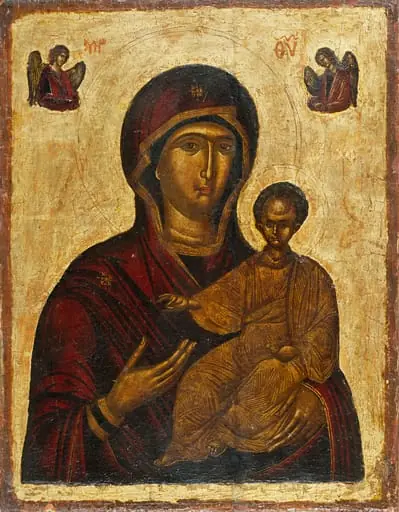 Jumalanäiti, Hodigitria - Tiennäyttäjä, bysanttilainen ikoni
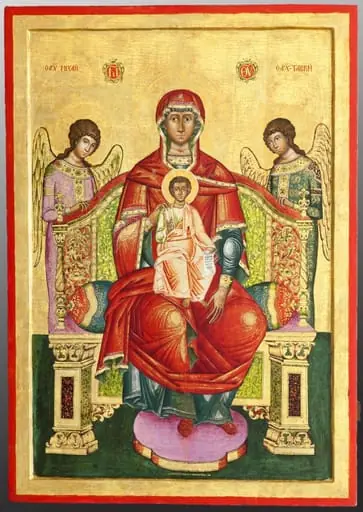 Maica Domnului cu Pruncul - Stăpâna Îngerilor
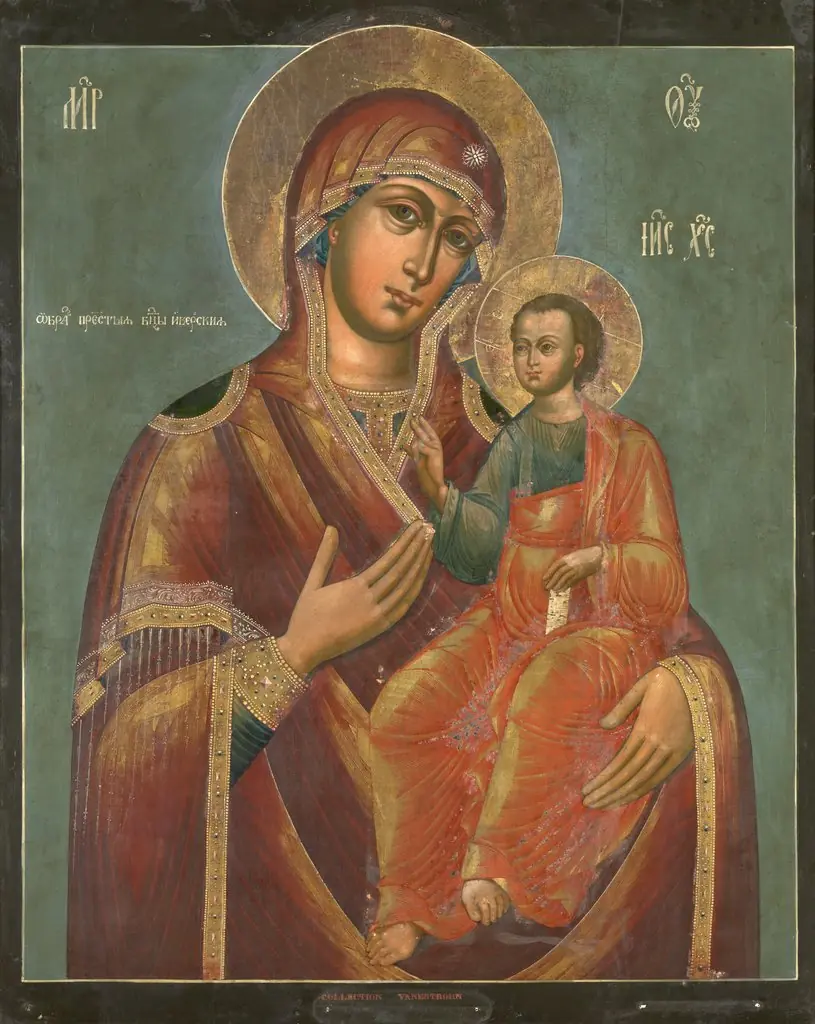 Mother of God from Iviron
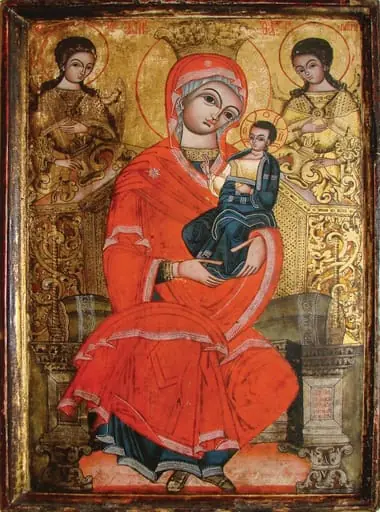 Maica Domnului cu Pruncul
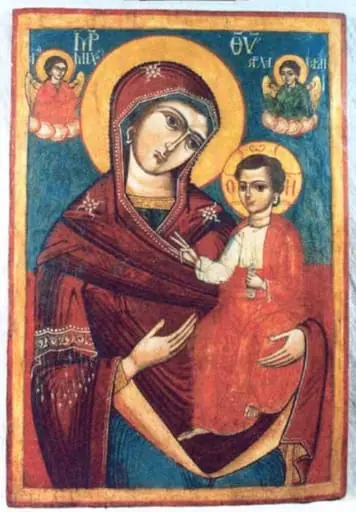 Maica cu Pruncul-Axionița
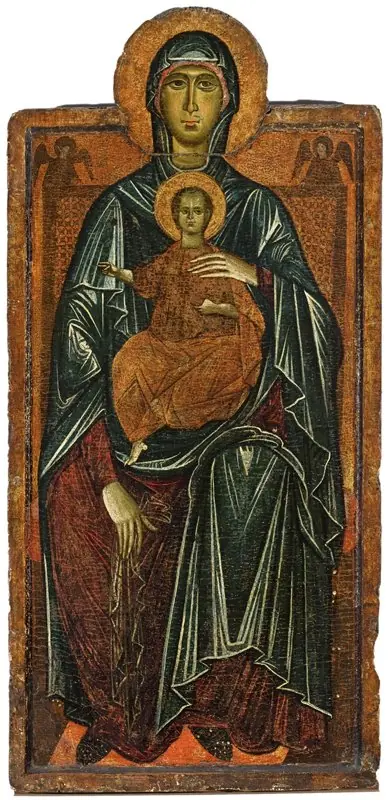 Maestà attributed to the Master of Bigallo
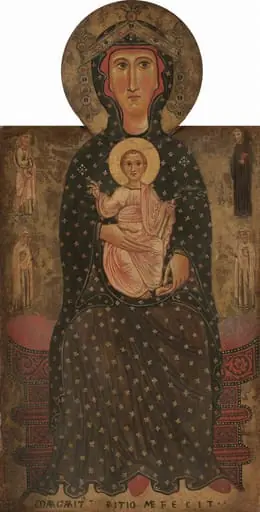 Madonna and Child Enthroned with Four Saints
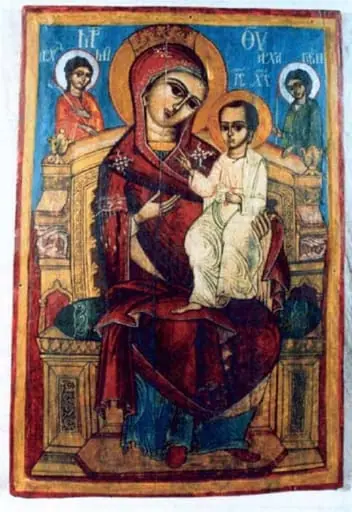 Maica cu Pruncul/Maica Împărăteasă-Doamnă
- Madonna enthroned with two angels
 Woman with a Parasol - Madame Monet and Her Son
 Mrs. Noah Smith and Her Children
 Madonna and Child with the Young Saint John the Baptist
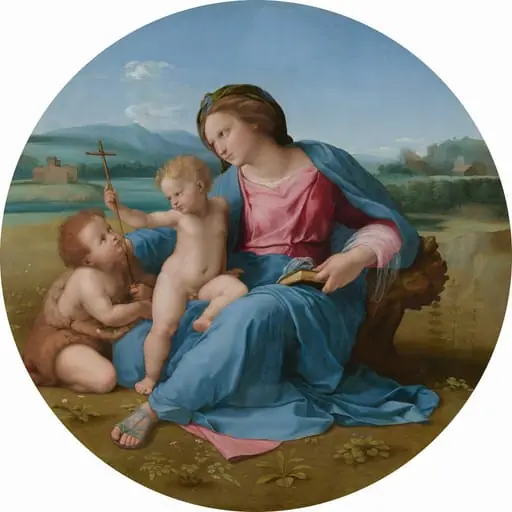 The Alba Madonna
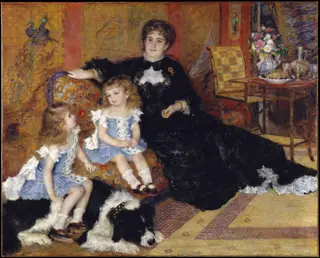 Madame Georges Charpentier and her Children
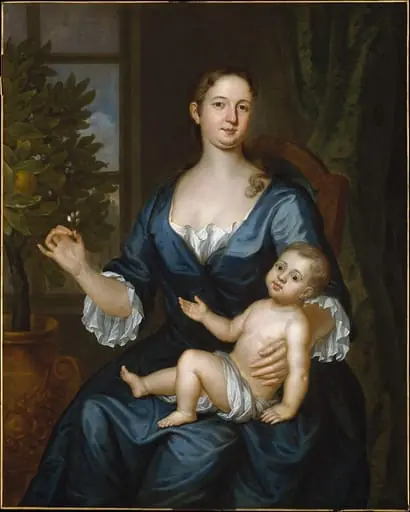 Mrs. Francis Brinley and Her Son Francis
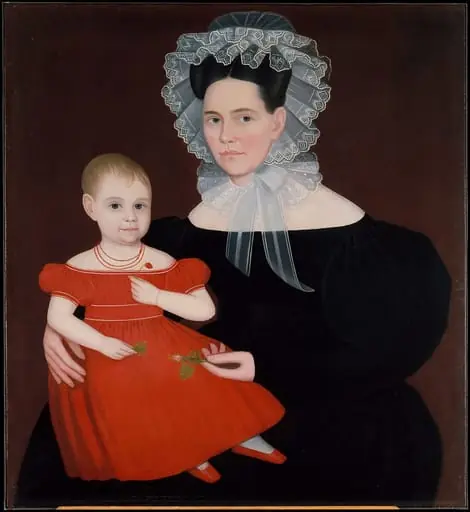 Mrs. Mayer and Daughter
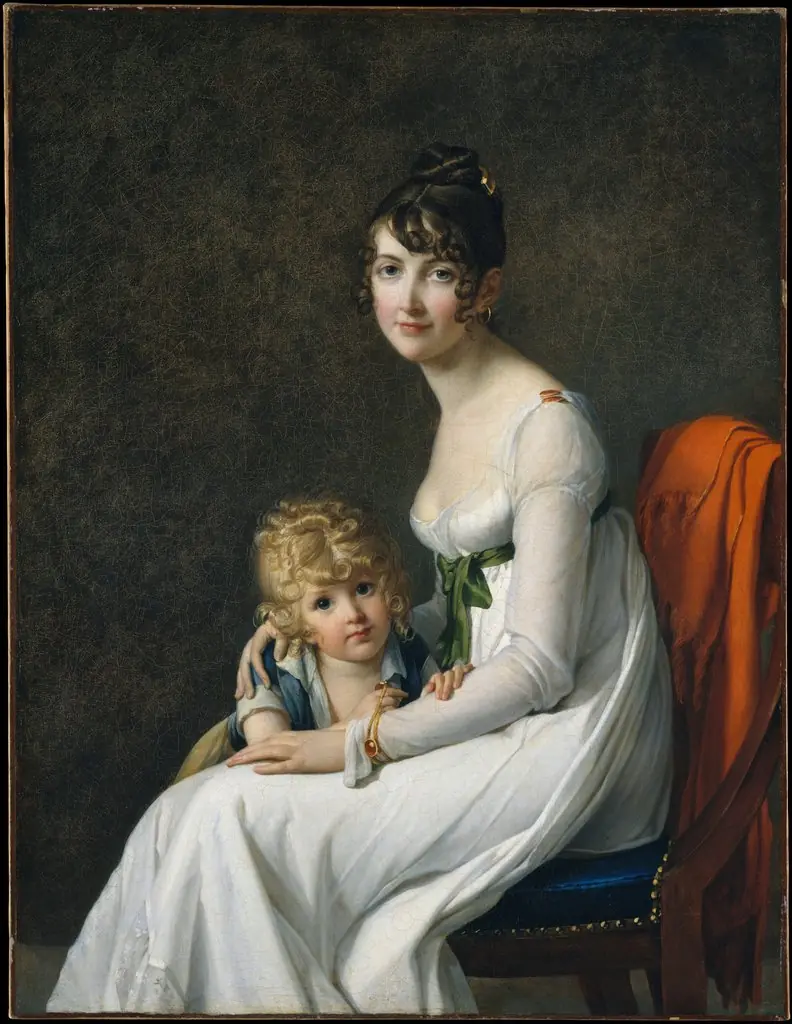 Madame Philippe Panon Desbassayns de Richemont (Jeanne Eglé Mourgue, 1778–1855) and Her Son, Eugène (1800–1859)