Artwork
Diana Wood's Wedding : The Departure
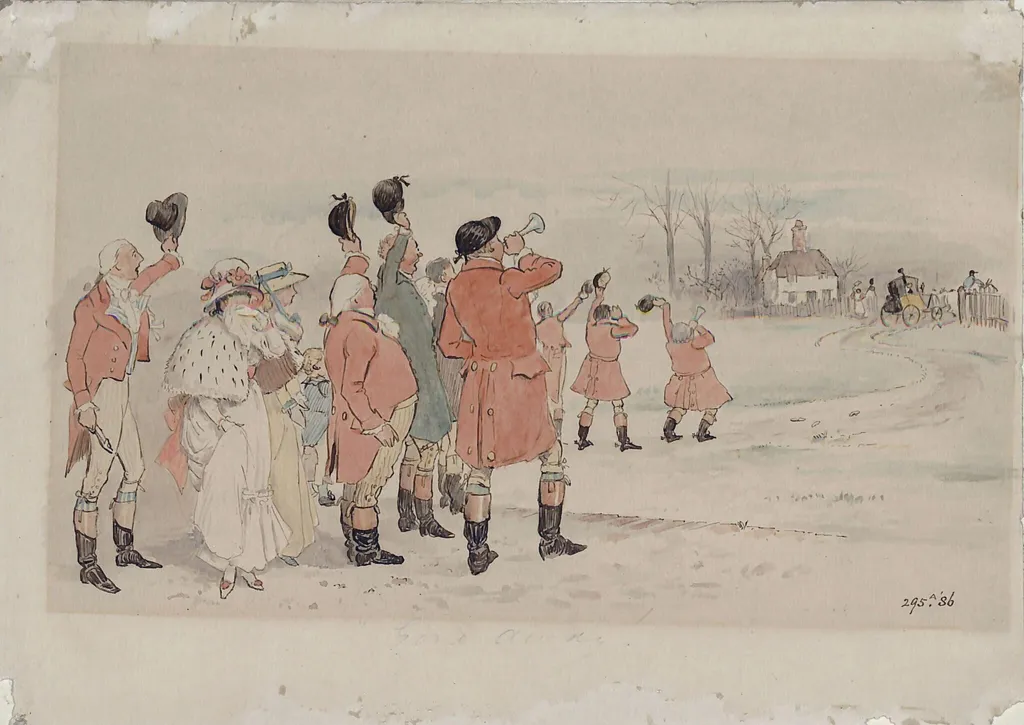
Diana Wood's Wedding : The Departure is a watercolor work on paper by the Impressionist artist Randolph Caldecott. It dates from 1883 and is held in the collection of the Victoria and Albert Museum.
About this work
Overview
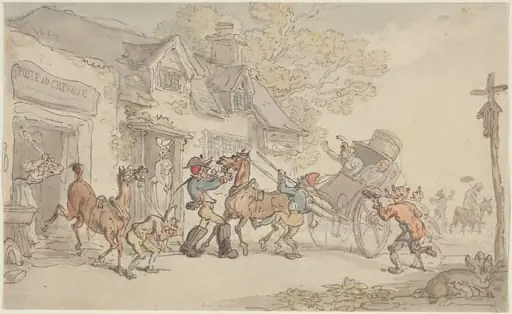
A horse-drawn carriage, central to the image, holds the newlyweds as guests gather around, some waving, others watching.
Created in 1883, this watercolour by Randolph Caldecott captures a moment of departure at a rural wedding. The scene is rendered in delicate washes of muted tones, with a pale grey sky softening the composition. A horse-drawn carriage, central to the image, holds the newlyweds as guests gather around, some waving, others watching. An inscribed verse accompanies the image, linking visual narrative with poetic sentiment.
Subject & Meaning
The painting illustrates the departure of Diana Wood and her groom, marking the transition from family home to married life. Figures in 19th-century attire, men in red coats, women in white dresses and bonnets, convey communal celebration. The absence of overt ceremony suggests intimacy, emphasizing personal connection over spectacle.
The verse reinforces themes of parting and new beginnings, grounding the scene in emotional resonance rather than grandeur.
Technique & Style
Caldecott employs transparent watercolour with light, fluid brushwork to suggest movement and atmosphere. Details like fabric folds and facial expressions are rendered with economy, relying on subtle tonal shifts rather than sharp lines. The bare trees and soft sky create a quiet, seasonal mood, while the vivid red coats provide restrained contrast. His approach balances precision with spontaneity, characteristic of his illustrative style.
History & Provenance
The work was produced during Caldecott’s peak years as a illustrator, shortly before his death in 1886. It was likely commissioned for a private occasion, given its specific subject and accompanying verse. The painting remained in the Wood family until the 20th century, later entering public collections where it is now recognized as a personal, rather than commercial, work within his oeuvre.
Context
In the 1880s, Caldecott was renowned for children’s book illustrations, yet this piece reflects his engagement with domestic life beyond the printed page. The scene aligns with Victorian ideals of family and rural tradition, while its quiet tone distinguishes it from more theatrical wedding depictions. It reveals his interest in everyday moments, bridging illustration and fine art traditions of the period.
Legacy
Though less known than his children’s book illustrations, this watercolour exemplifies Caldecott’s sensitivity to human gesture and seasonal atmosphere. It contributes to a broader understanding of his artistic range, showing his ability to convey narrative emotion in small-scale, personal works. The piece remains a quiet testament to his skill in capturing fleeting, intimate moments with grace.
Own this work as a print
Artist & collection