Artwork
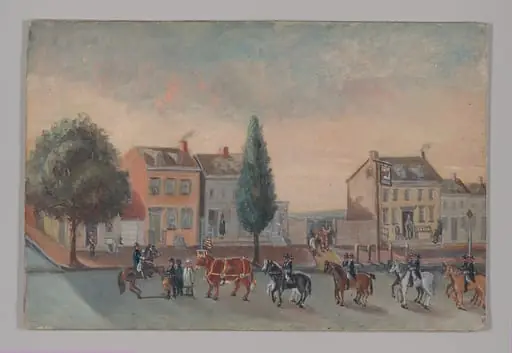
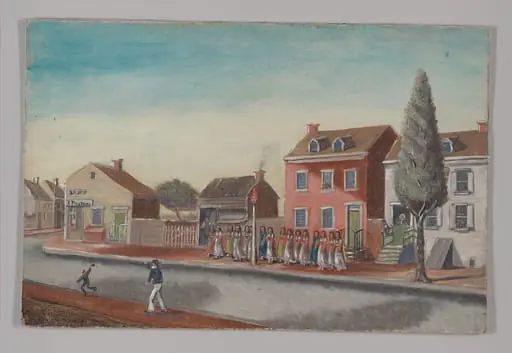
Infant Funeral Procession
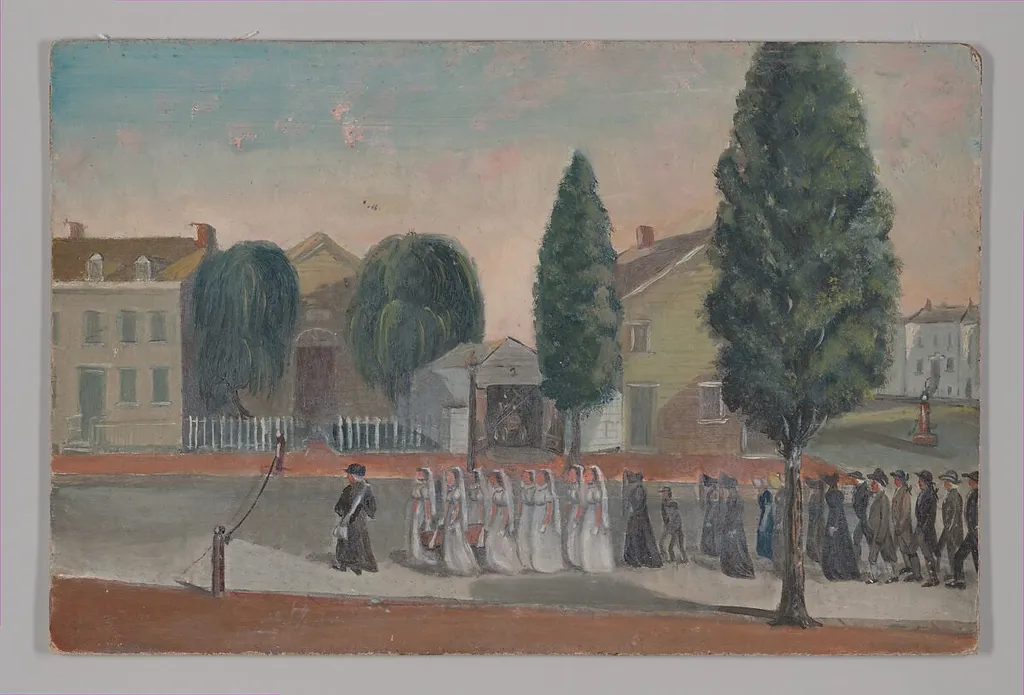
Infant Funeral Procession is an oil painting by the American Folk Art artist William P. Chappel. It dates from 1874 and is held in the collection of the Metropolitan Museum of Art.
- Accession no.
- 54.90.502
- Credit line
- The Edward W. C. Arnold Collection of New York Prints, Maps, and Pictures, Bequest of Edward W. C. Arnold, 1954
About this work
Subject & Meaning
As an oil painting on slate paper housed in The American Wing of the Metropolitan Museum of Art, the work captures a specific moment of Victorian-era grief.
Created in 1870, William P. Chappel's Infant Funeral Procession is a genre scene depicting a somber funeral cortege. The composition features a man and a woman participating in a processional parade, visually narrating the ritualized mourning of a child's death. As an oil painting on slate paper housed in The American Wing of the Metropolitan Museum of Art, the work captures a specific moment of Victorian-era grief.
The presence of both male and female figures within the parade underscores the communal nature of the event, while the title explicitly defines the subject as the burial of an infant. The artwork serves as a historical record of 19th-century mourning customs, focusing on the solemnity of the procession rather than the deceased child, who remains unseen within the frame.
Technique & Style
The work is an oil painting executed on slate paper, measuring approximately 15.4 cm in height by 23.3 cm in width. It belongs to the genre‑scene category within the American Wing collection and portrays a funeral procession that includes a man and a woman participating in a processional parade. The composition emphasizes the ceremonial nature of the event through the arrangement of figures and the somber subject matter, characteristic of 19th‑century American genre painting. No detailed records of handling or current condition are provided in the available documentation.
Overview
Chappel's Infant Funeral Procession depicts a somber moment from 1870s New York City life. The painting captures a line of figures dressed in black, moving down a street while carrying a small, white coffin. This work exemplifies the artist's focus on ordinary, unheroic scenes, offering a glimpse into the daily experiences and quiet sorrows of the period rather than grand historical narratives or dramatic events.
Artist & collection