Artwork
Jesus with the Pharisees
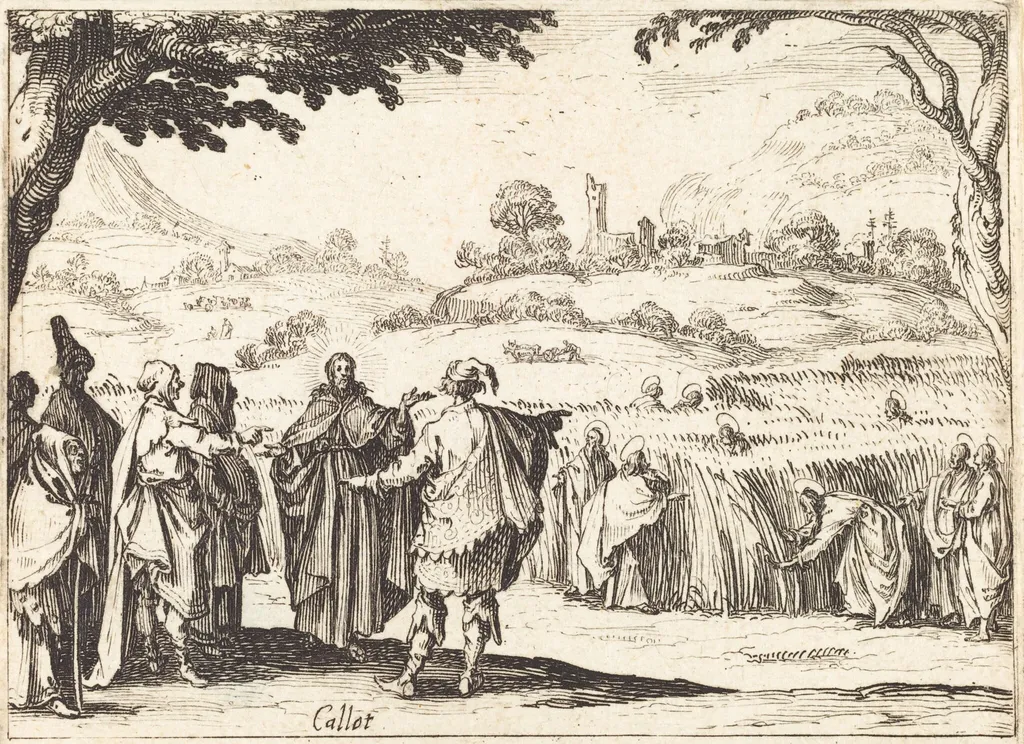
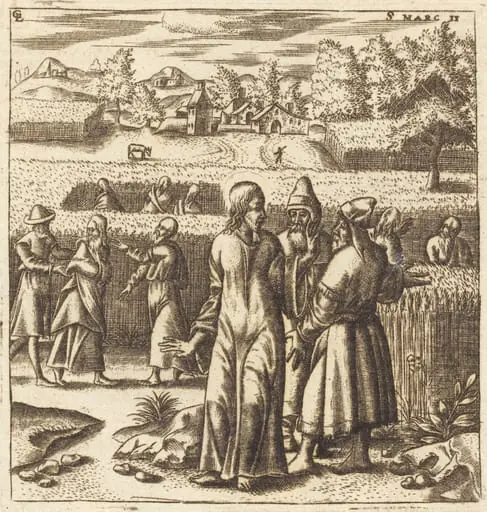
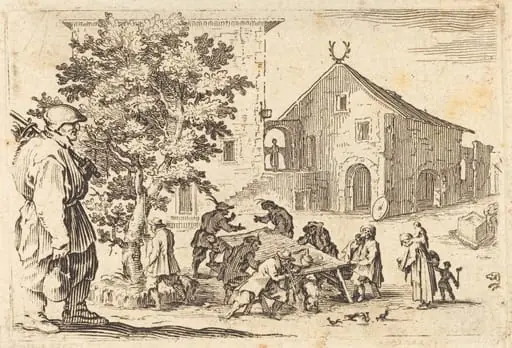
Jesus with the Pharisees is an ink print by the Baroque artist Jacques Callot. It dates from 1635 and is held in the collection of the National Gallery of Art.
About this work
Overview
Jacques Callot, a 17th-century printmaker from the Duchy of Lorraine, created this etching in 1635 as part of a broader series of religious scenes.
Jacques Callot, a 17th-century printmaker from the Duchy of Lorraine, created this etching in 1635 as part of a broader series of religious scenes. Working primarily in etching on laid paper, he produced more than 1,400 prints that captured both sacred narratives and everyday life. This piece belongs to his extensive output on biblical themes, reflecting his technical precision and interest in human interaction within architectural and natural settings.
Subject & Meaning
The scene portrays Jesus engaged with a group of Pharisees, likely illustrating a moment of theological exchange from the Gospels. Jesus stands centrally, one arm raised as if speaking, while others surround him in attentive or disputatious postures. The composition emphasizes dialogue rather than conflict, conveying a quiet intensity.
The setting suggests a public space, reinforcing the theme of religious authority and public teaching in early Christian tradition.
Technique & Style
Callot employed fine-line etching to render intricate details in clothing, facial expressions, and architectural elements. His use of delicate hatching and varied line weight creates depth and texture without heavy shading. The landscape background, rendered with subtle tonal gradations, extends the spatial field, grounding the figures in a believable environment. The paper’s laid texture subtly enhances the print’s tactile quality, characteristic of his mature technique.
History & Provenance
Created during Callot’s time in Florence and Paris, the etching was likely made for private collectors or ecclesiastical patrons interested in devotional imagery. While its early ownership is undocumented, it entered institutional collections in the 18th or 19th century as interest in Northern Renaissance and Baroque prints grew. It remains part of the broader corpus of Callot’s religious etchings preserved in major European print rooms.
Context
In the 1630s, religious imagery remained central to print culture despite rising secular interests. Callot’s work responded to Counter-Reformation demands for clear, emotionally resonant biblical scenes. Unlike dramatic altarpieces, his etchings offered intimate, accessible visions of scripture, suited for personal contemplation.
His focus on narrative detail and spatial coherence aligned with broader trends in Northern European printmaking of the period.
Legacy
Callot’s etchings, including this one, influenced later generations of printmakers through their compositional clarity and technical refinement. Though less widely known than painters of his era, his ability to convey complex narratives in small formats established him as a pivotal figure in print history. His religious works, though not overtly polemical, contributed to the visual language of Christian devotion in early modern Europe.
Own this work as a print
Artist & collection
Artist
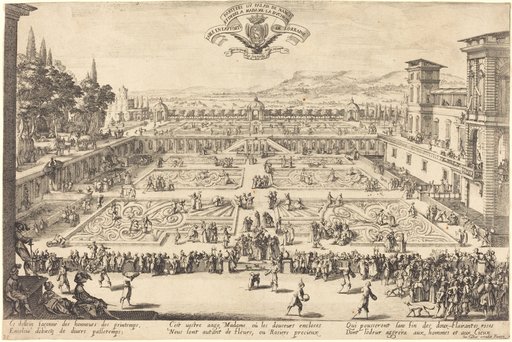
Jacques Callot (French: ; c. 1592 – 1635) was a baroque printmaker and draftsman from the Duchy of Lorraine. He is an important person in the development of the old master print. He made more than 1,400 etchings that…

 Holy Family at supper
 Restoration of the Aqueduct at Pisa
 Restoration of the Aqueduct at Pisa
 Square in Paris with Many Figures
 Square in Paris with Many Figures
 Horsemen Attacked by Robbers
 HOW WILL A COVERED PART BE CORRECTED?HOW WIKA A COVERED HEART DEED CORRECTED?
![Christ Walking on the Water [second plate], by Jacques Callot](https://artifactworldgallery.com/img/jacques-callot--christ-walking-on-the-water-second-plate--2069f3bfe4cb2126-w320.webp) Christ Walking on the Water [second plate]
Christ Walking on the Water [second plate]