Artwork
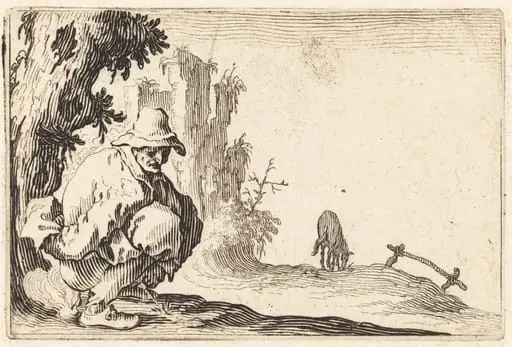
Shepherd and Ruins
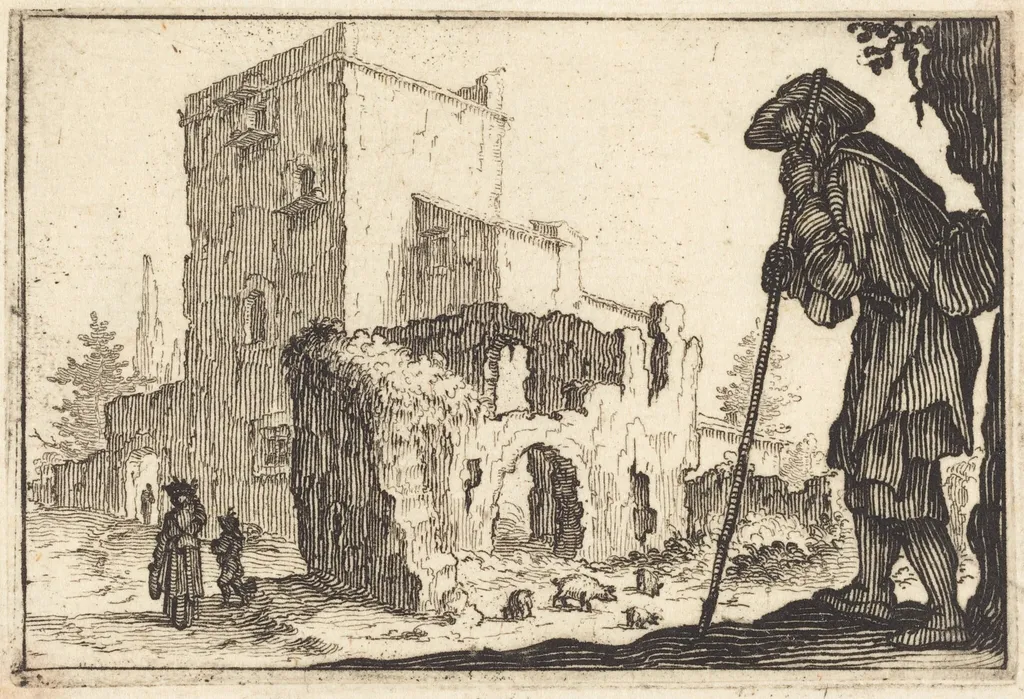
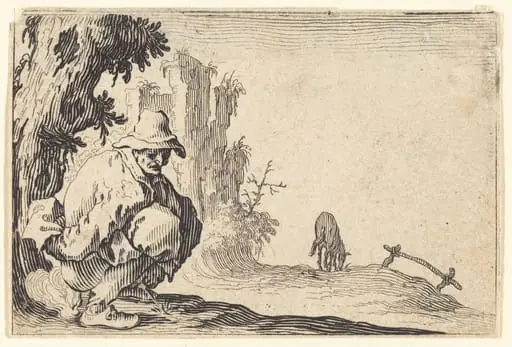
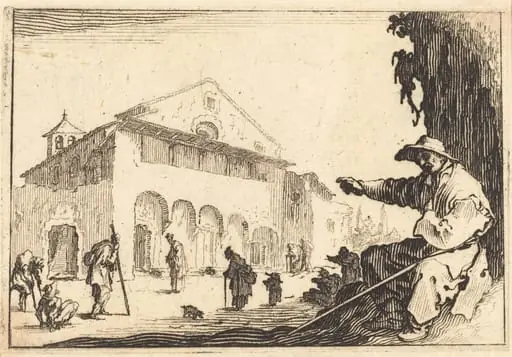
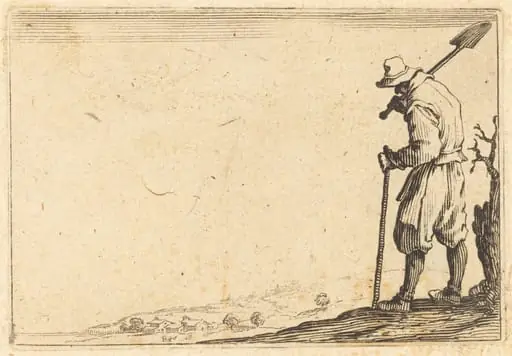
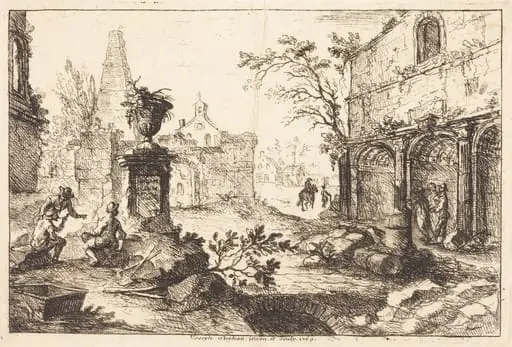
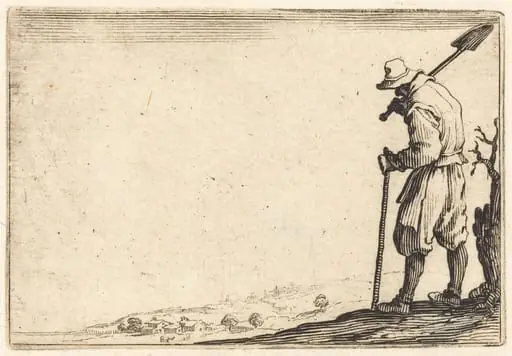
Shepherd and Ruins is an ink print by the Baroque artist Jacques Callot. It dates from 1617 and is held in the collection of the National Gallery of Art.
About this work
Overview
Created around 1617 by Jacques Callot, this etching on laid paper captures a quiet moment in the rural landscape of early 17th-century Lorraine.
Created around 1617 by Jacques Callot, this etching on laid paper captures a quiet moment in the rural landscape of early 17th-century Lorraine. As one of over 1,400 prints in his career, it exemplifies his focus on everyday life and architectural remnants. The composition centers on a solitary shepherd beside ancient ruins, rendered with precise line work and subtle tonal gradations that define space without color.
Subject & Meaning
The scene portrays a shepherd, cloaked and staff in hand, accompanied by a small dog, standing before the remains of a classical structure. The contrast between the humble figure and the decaying monument suggests a meditation on time, transience, and the quiet persistence of rural life amid the ruins of earlier civilizations. No overt narrative is given; instead, mood and stillness invite contemplation.
Technique & Style
Callot employed fine, controlled etching lines to build texture and depth, using varying densities of hatching to model light and shadow. The paper’s laid texture subtly enhances the atmospheric effect. His mastery of tonal range, from deep blacks in the shepherd’s cloak to delicate grays in the distant arches, creates a sense of spatial recession and quiet luminosity, characteristic of his refined approach to the medium.
History & Provenance
The print originates from Callot’s early period, before his famous series on war and social unrest. It likely circulated among collectors and artists in Nancy and Paris, where his work was admired for its technical precision. No documented early ownership is recorded, but its survival in multiple museum collections indicates its recognition within printmaking circles by the late 17th century.
Context
In early 17th-century Europe, interest in antiquity and pastoral life flourished among artists and intellectuals. Callot’s depiction of ruins alongside a shepherd aligns with broader Renaissance and Baroque trends that juxtaposed classical remnants with contemporary rural existence. Unlike grand historical scenes, this work favors intimacy, reflecting a growing appreciation for quiet, observational subjects in printmaking.
Legacy
Though less known than his military etchings, this piece exemplifies Callot’s versatility and sensitivity to landscape and mood. It influenced later printmakers who sought to convey atmosphere through line alone. Its enduring presence in institutional collections underscores its role as a quiet but significant example of Baroque graphic art focused on contemplative, non-dramatic subjects.
Own this work as a print
Artist & collection
Artist
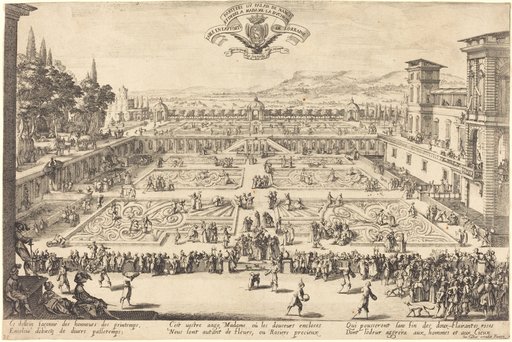
Jacques Callot (French: ; c. 1592 – 1635) was a baroque printmaker and draftsman from the Duchy of Lorraine. He is an important person in the development of the old master print. He made more than 1,400 etchings that…

 Holy Family at supper
 Restoration of the Aqueduct at Pisa
 Restoration of the Aqueduct at Pisa
 Square in Paris with Many Figures
 Square in Paris with Many Figures
 Horsemen Attacked by Robbers
 HOW WILL A COVERED PART BE CORRECTED?HOW WIKA A COVERED HEART DEED CORRECTED?
![Christ Walking on the Water [second plate], by Jacques Callot](https://artifactworldgallery.com/img/jacques-callot--christ-walking-on-the-water-second-plate--2069f3bfe4cb2126-w320.webp) Christ Walking on the Water [second plate]
Christ Walking on the Water [second plate]