Artwork
Poplars, Éragny
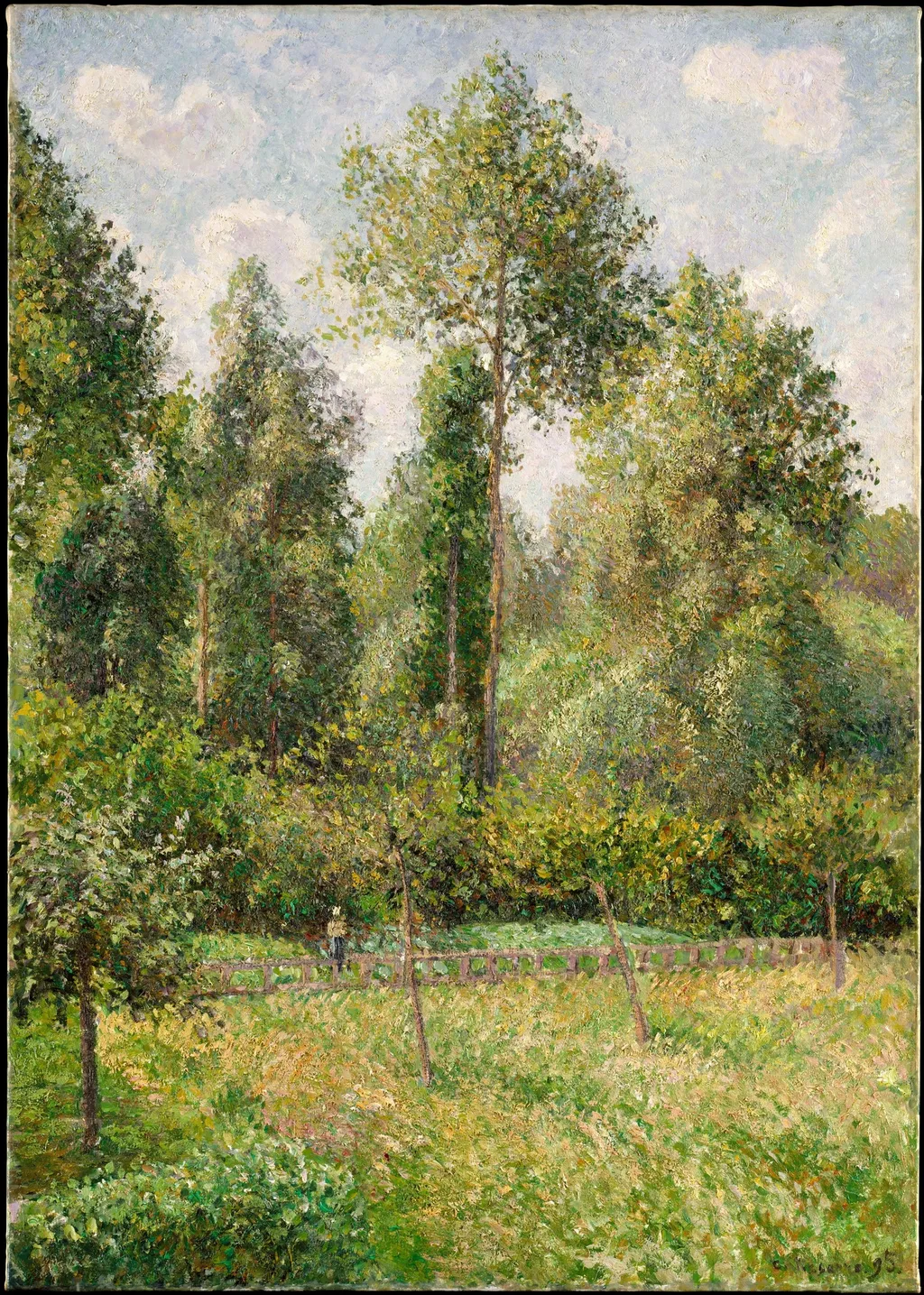
Poplars, Éragny is an oil painting by the Post-Impressionist artist Camille Pissarro. It dates from 1898 and is held in the collection of the Metropolitan Museum of Art.
About this work
Subject & Meaning
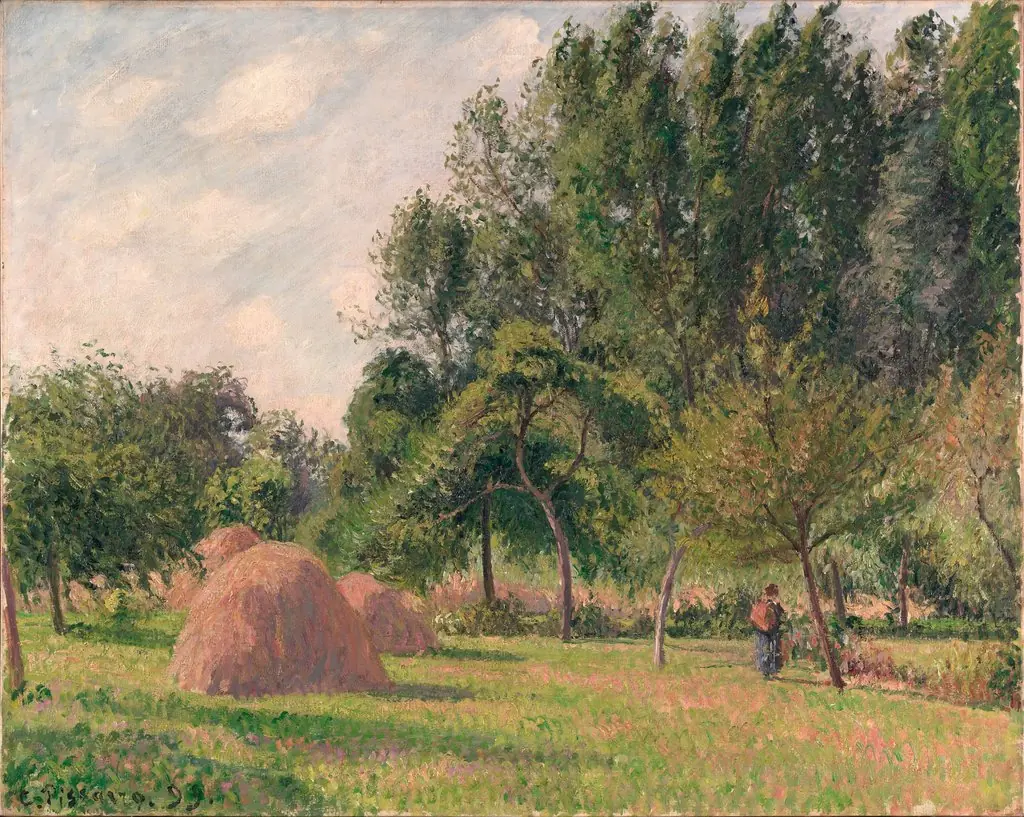
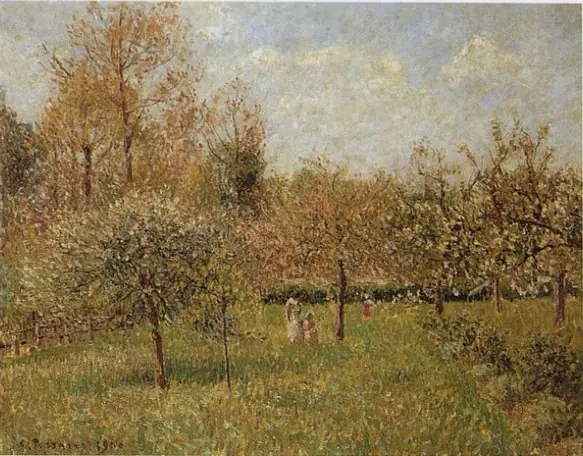
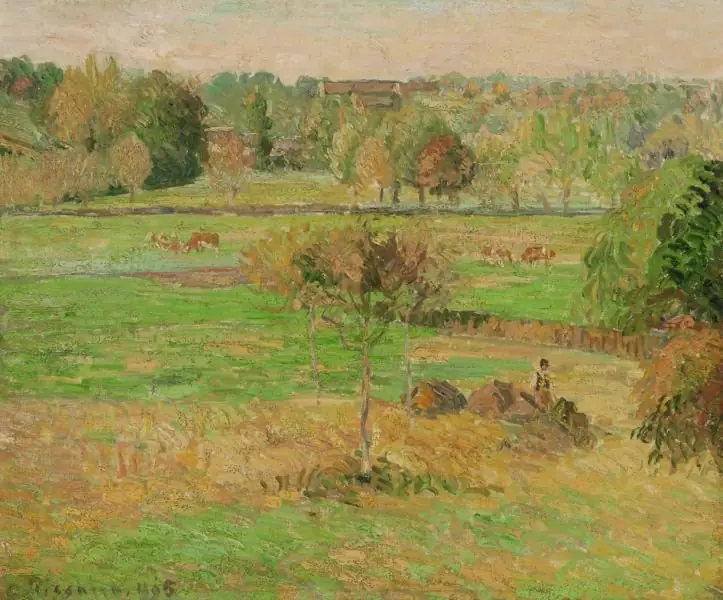
Poplars, Éragny depicts a summer view of Camille Pissarro's orchard and the adjacent wild poplar grove in Éragny, Normandy.
Poplars, Éragny depicts a summer view of Camille Pissarro's orchard and the adjacent wild poplar grove in Éragny, Normandy. The composition features a cultivated garden with fruit trees in the foreground, separated by a fence from the untamed growth behind, with a slender summer-green tree serving as the vertical axis. A small human figure acts as staffage along the fence line.
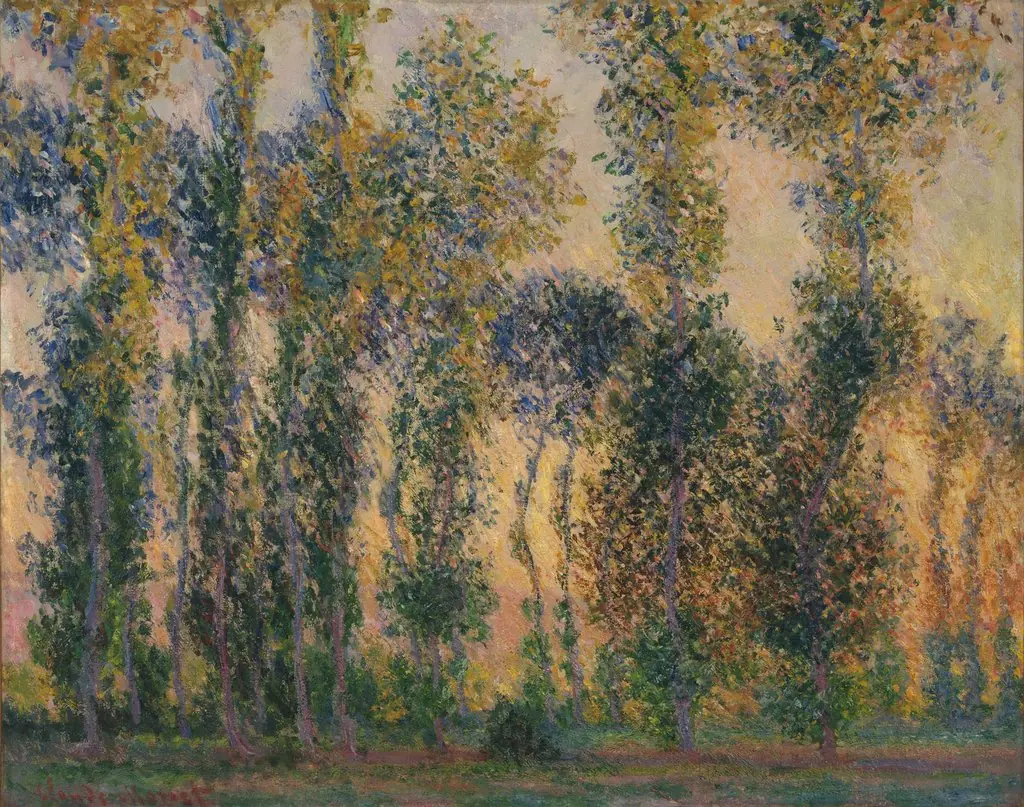
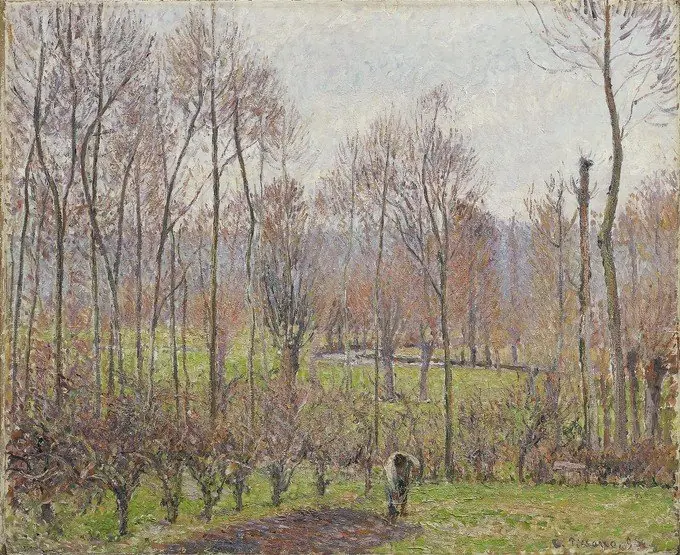
The work represents a rural idyll, deliberately omitting industrial elements like factory chimneys or modern bridges that appeared in the artist's earlier landscapes. This focus on an agrarian ideal reflects Pissarro's adherence to anarchist-influenced beliefs popular during the 1890s, emphasizing a harmonious, unspoiled natural existence. The painting captures the specific light and atmosphere of the poplars, a motif the artist revisited across different seasons and weather conditions to explore natural effects.
Technique & Style
Executed in 1895, Poplars, Éragny is an oil painting on canvas measuring 92.7 by 64.8 centimeters. The work marks Pissarro's return to his established style after abandoning pointillism, utilizing shorter brushstrokes and a pastose application of luminous colors to create a highly structured surface. This technique allows for the detailed rendering of leaf forms, flowers, and grasses.
The composition is vertically oriented, anchored by a slender deciduous tree that serves as a central axis, while a nearly horizontal garden fence and a small human figure provide depth. The scene depicts a cultivated orchard in the foreground contrasted with wild growth beyond the fence, emphasizing a rural idyllic quality free of industrial elements. The artist signed and dated the piece in the lower right corner.
History & Provenance
Camille Pissarro created the oil-on-canvas landscape Poplars, Éragny in the summer of 1895, signing and dating it "C. Pissarro. 95" in the lower right corner. This work belongs to a series depicting the poplar grove adjacent to the artist's orchard in Éragny, marking a return to his established style after abandoning pointillism.
The painting measures 92.7 by 64.8 cm and features a vertical composition centered on a slender tree, with a garden fence and a human figure providing depth. Following its creation, the work entered the collection of American art patron Adelaide Milton de Groot (1876–1967). Upon her death in 1967, the painting was transferred to the Metropolitan Museum of Art in New York, where it remains part of the institution's holdings.
The work is held at the Metropolitan Museum of Art, New York, where it entered the collection following the bequest of Adelaide Milton de Groot in 1967. Its accession number is 67.187.3. The painting has not been recorded in major temporary exhibitions since its acquisition by the museum.
Context
Poplars, Éragny (1895) exemplifies Pissarro’s late‑1890s turn toward a bucolic vision of his Éragny garden, abandoning the pointillist experiments of the early 1890s for a looser, pastose handling of light and foliage. The work belongs to a series of poplar paintings that document varying weather and time of day, reflecting the artist’s fascination with rural idylls amid a broader cultural turn toward pastoral idealism. Owned by Adelaide Milton de Groot before entering the Metropolitan Museum of Art, the canvas was praised for its structured surface and subtle tonal modulation, and scholars note its influence on Claude Monet’s own poplar series, positioning Pissarro’s landscape as a pivotal link between Impressionist spontaneity and a more personal, pastoral idiom.
Overview
Poplars, Éragny, painted by Camille Pissarro in 1898, is an oil landscape depicting the rural surroundings of the artist's home in Éragny-sur-Epte. The composition features a row of tall poplar trees lining a fence that recedes diagonally into the middle distance, guiding the viewer's eye toward a bright, open field. The foliage displays a transition of seasons, with dominant greens accented by yellow leaves, set against a pale sky filled with soft clouds.
Executed in Pissarro's mature Neo-Impressionist style, the work utilizes short, distinct brushstrokes to build texture and light, creating a vibrant, rhythmic surface. This painting reflects Pissarro's enduring commitment to capturing the changing effects of light and atmosphere in the French countryside during the final years of his life. It stands as a representative example of his late-period landscapes, where he synthesized the scientific color theories of Seurat with his own deep observation of nature, moving away from strict pointillism toward a more fluid application of paint while maintaining structural clarity.
Own this work as a print
Artist & collection