Artwork
Mercury and Aglauros
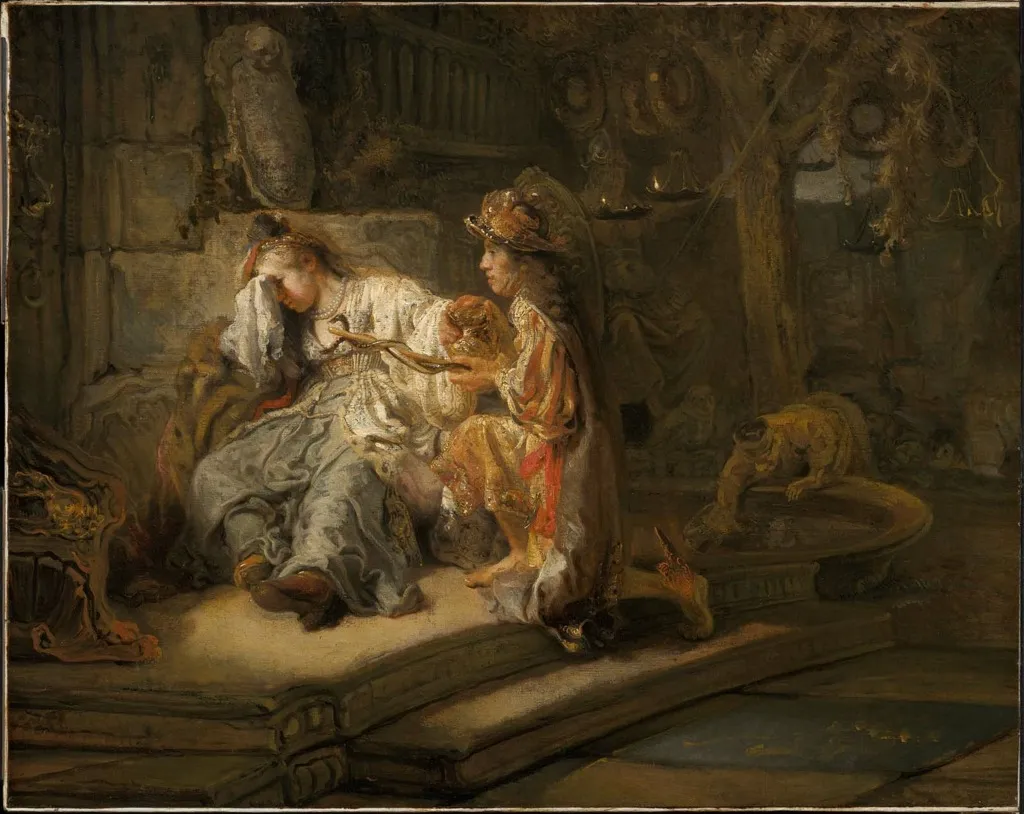
Mercury and Aglauros is an oil painting by the Dutch Golden Age artist Carel Fabritius. It dates from 1646 and is held in the collection of the Museum of Fine Arts Boston.
About this work
Subject & Meaning
The painting depicts a scene from the Metamorphoses of Ovid, showing Mercury falling in love with the mortal Herse while the jealous sister Aglauros watches.
The painting depicts a scene from the Metamorphoses of Ovid, showing Mercury falling in love with the mortal Herse while the jealous sister Aglauros watches. According to the narrative, Mercury is spotted by the sisters as they return from a ritual offering to Athena, and he enters the palace at night. When caught by Aglauros, he demands a reward for sparing her, but Minerva intervenes, sending Invidia to stir jealousy.
Mercury ultimately turns Aglauros to stone, symbolizing the triumph of desire over restraint. Fabritius renders Mercury in bright red and yellow against Aglauros' pale, stone‑like form, using contrasting colors to heighten drama and depth, a technique he learned from Rembrandt. The work was painted around 1645–1647, shortly after Fabritius left Rembrandt’s studio, and was created in his hometown of Middenbeemster.
The iconography draws on the myth of Mercury, Argus, and the sisters, with Mercury represented as a winged messenger and Aglauros caught in the act of withholding a golden cup. The painting’s subject reflects themes of love, jealousy, and divine punishment, and its meaning is tied to the moral lesson of unchecked envy. The work was later misattributed to Rembrandt, then to Flinck and van den Eeckhout, before being correctly identified as a Fabritius piece in 1986 after technical and provenance research.
Technique & Style
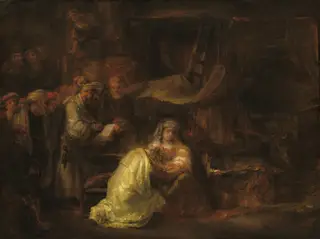
Created in 1646, Mercury and Aglauros is an oil painting executed on canvas, measuring 72.4 cm in height and 91.1 cm in width. The work demonstrates Carel Fabritius's early application of techniques learned from his teacher Rembrandt, specifically the use of contrasting and harmonizing colors to suggest light and depth. Fabritius places the principal figures in full illumination while rendering the background in shadow with loose, sketch-like brushstrokes.
The composition relies on a sharp chromatic contrast: the vibrant red and yellow of Mercury stand against the white and slate-grey tones of Aglauros. This color scheme visually reinforces the narrative moment where the jealous Aglauros, depicted stiffening and pushing away a golden cup, appears to be turning into stone.
History & Provenance
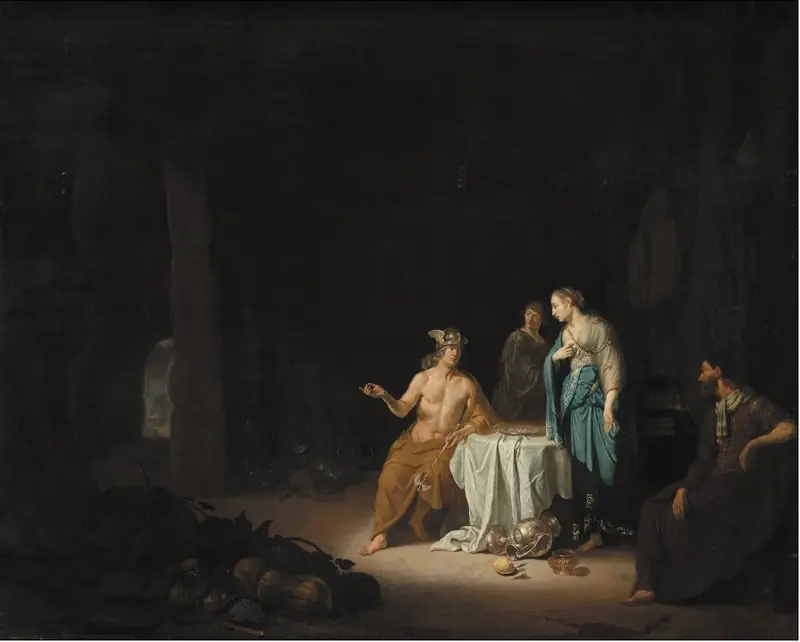
The painting was likely created between 1645 and 1647, shortly after Carel Fabritius’s apprenticeship in Rembrandt’s Amsterdam studio, while he was living in Middenbeemster. It may have been conceived as a pendant to Mercury and Argus, a pairing also noted in 18th‑century Parisian sales where both works were offered together.
By the mid‑18th century the work was in Paris, where it appeared in nine auctions between 1763 and 1778, attributed alternately to Rembrandt and Johann Liss. After a re‑emergence in 1851 at a Paris dealer’s on rue Saint Georges, it was purchased in 1854 by Francis Brooks in Paris. Brooks’s heirs sold it in 1903 to the Museum of Fine Arts, Boston for $27,500, funded by the Martha Ann Edwards Fund; at that time it bore the spurious signature "Rembrandt 1652." Technical examination later revealed pentimenti and an underlying signature consistent with Fabritius, confirming his authorship.
Carel Fabritius's Mercury and Aglauros is held in the collection of the Museum of Fine Arts, Boston. The work entered the museum's inventory in 1903 when it was purchased from the heirs of Francis Brooks for $27,500, funded by the Martha Ann Edwards Fund. Prior to this acquisition, the painting resided in Paris from at least the mid-18th century, where it appeared in nine auctions between 1763 and 1778, often paired with Mercury and Argus.
During these sales, it was attributed to artists such as Rembrandt and Johann Liss. Francis Brooks acquired the piece in Paris around 1854. The painting was later reattributed to Fabritius in 1986 following the rediscovery of a signed companion piece and infrared analysis that revealed hidden signature traces.
Context
Critical reception of Mercury and Aglauros has evolved through scholarly re-evaluation and technical analysis. Early misattributions linked the work to Rembrandt and Johann Liss, but infrared studies confirmed its alignment with Fabritius's signed corpus, particularly following the discovery of a signed piece in 1986. Scholars such as Duparc and Raux have contextualized the painting within Fabritius's mythological output, emphasizing its role as a pendant to Mercury and Argus and its reflection of Rembrandt's influence on composition and chiaroscuro.
The work's stylistic synthesis of Rembrandt's historiated pieces and its use of contrasting color to dramatize Ovidian narrative underscore its significance in Dutch Golden Age mythological painting.
Legacy
The painting entered Parisian collections by the late 18th century, appearing in nine auctions between 1763 and 1778, often paired with its pendant Mercury and Argus and initially attributed to Rembrandt or Johann Liss. After resurfacing with a Paris dealer in 1851, it was bought by Boston collector Francis Brooks and bequeathed to the Museum of Fine Arts, Boston in 1903. Long bearing a false Rembrandt signature, the work was variously assigned to Flinck and van den Eeckhout until the 1986 discovery of a signed Mercury and Argus allowed its reattribution to Carel Fabritius, a conclusion reinforced by infrared examination and subsequent scholarly studies.
Overview
Carel Fabritius painted Mercury and Aglauros in 1646, a work executed in oil on canvas during the height of the Dutch Golden Age. The composition presents a dimly lit interior where the Roman messenger god Mercury kneels beside a seated female figure identified as Aglauros. A crouching lion, assorted vessels on shelves, and a stone bench populate the space, while a single light source creates pronounced chiaroscuro.
Artist & collection
Artist
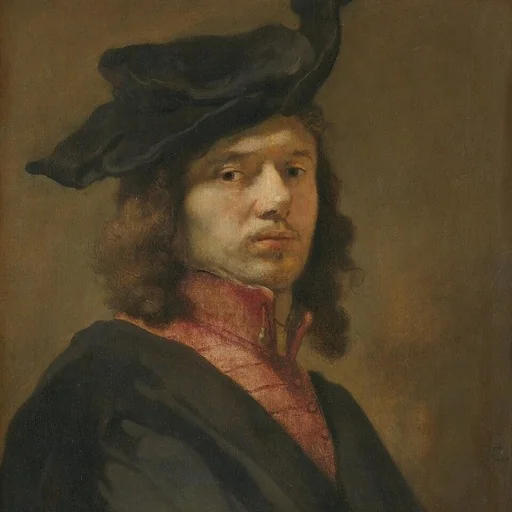
Carel Pieterszoon (abbr. Pietersz.) Fabritius (Dutch pronunciation:; bapt. 27 February 1622 – 12 October 1654) was a Dutch painter. He was a pupil of Rembrandt and worked in his studio in Amsterdam. Fabritius, who was…

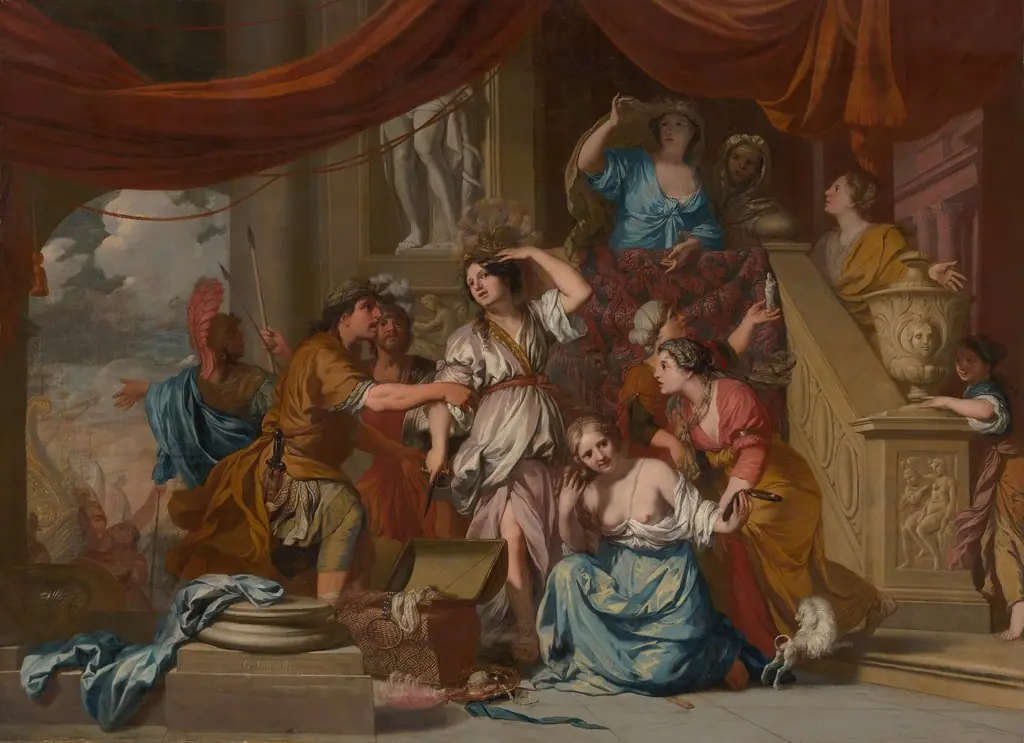 Achilles Discovered among the Daughters of Lycomedes
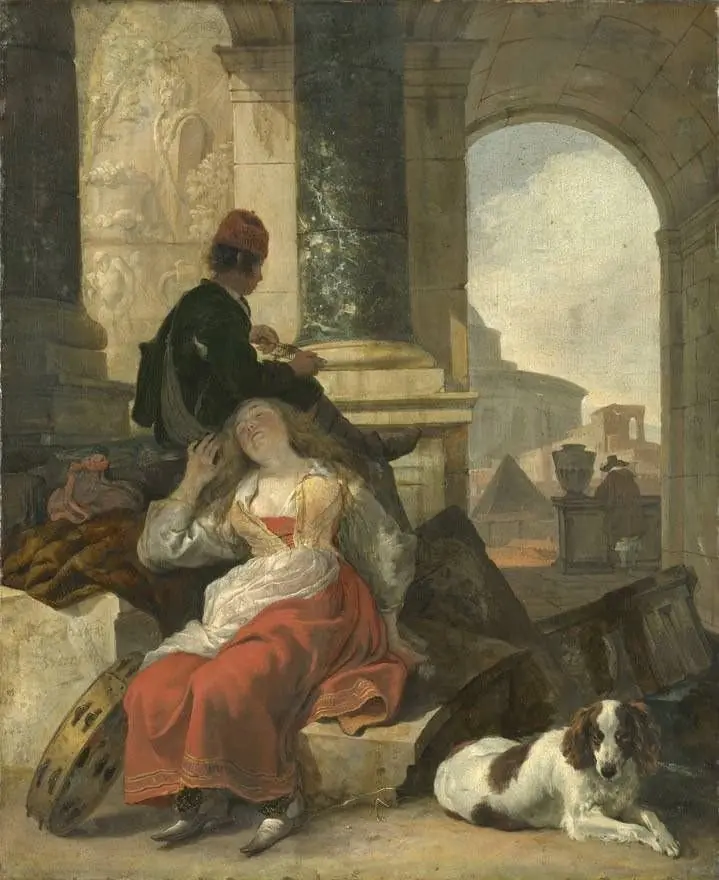 Sleeping girl
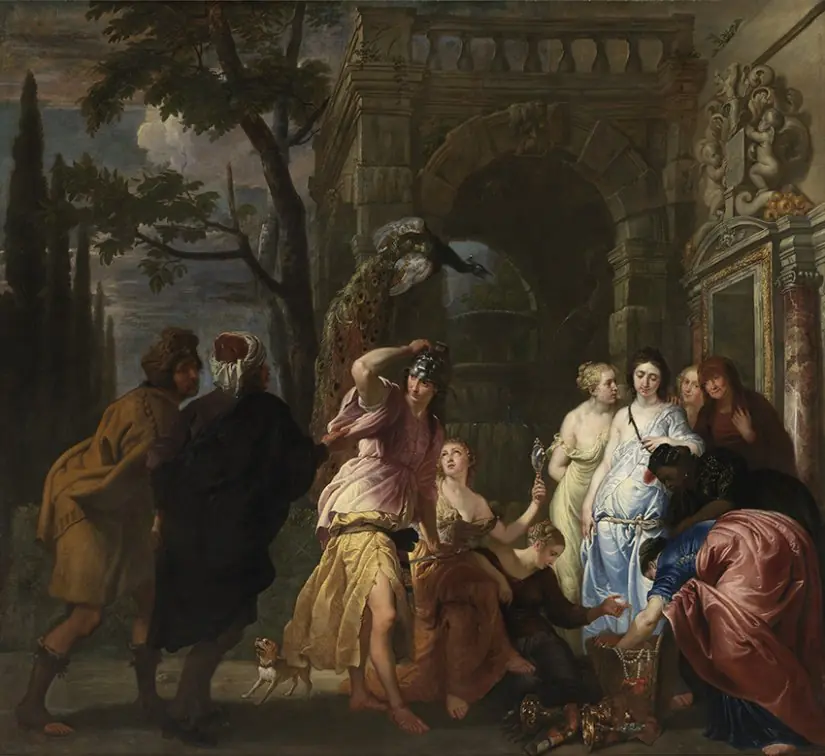 Achilles among the Daughters of Lycomedes
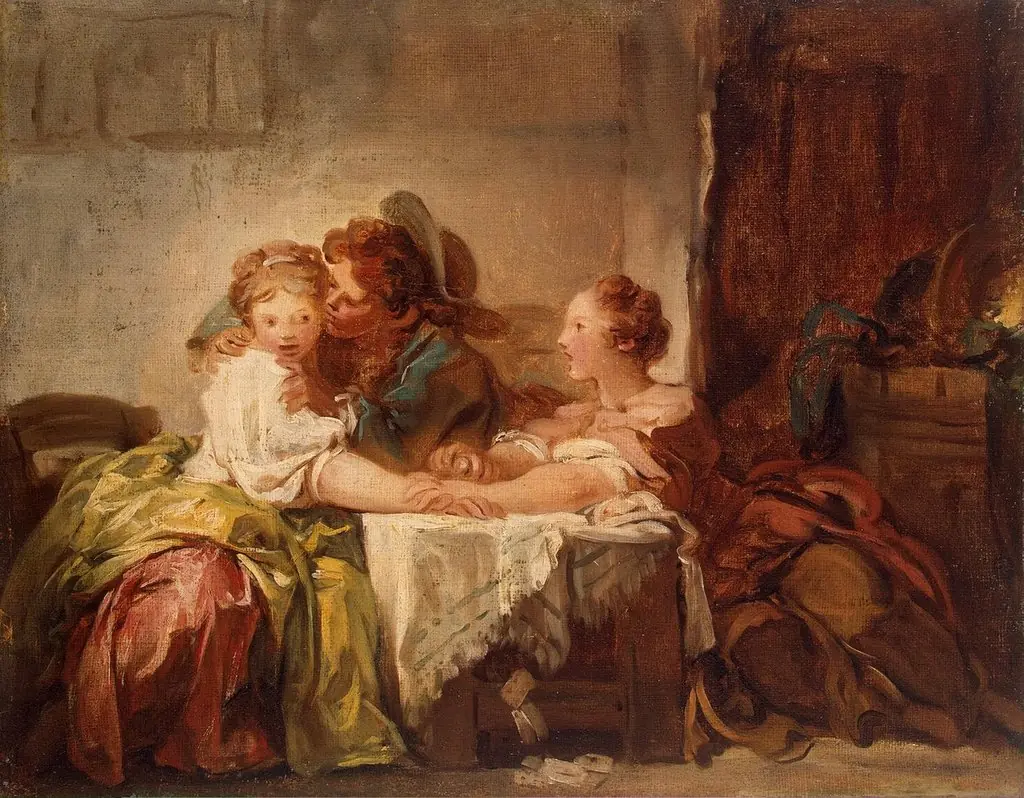 The Captured Kiss
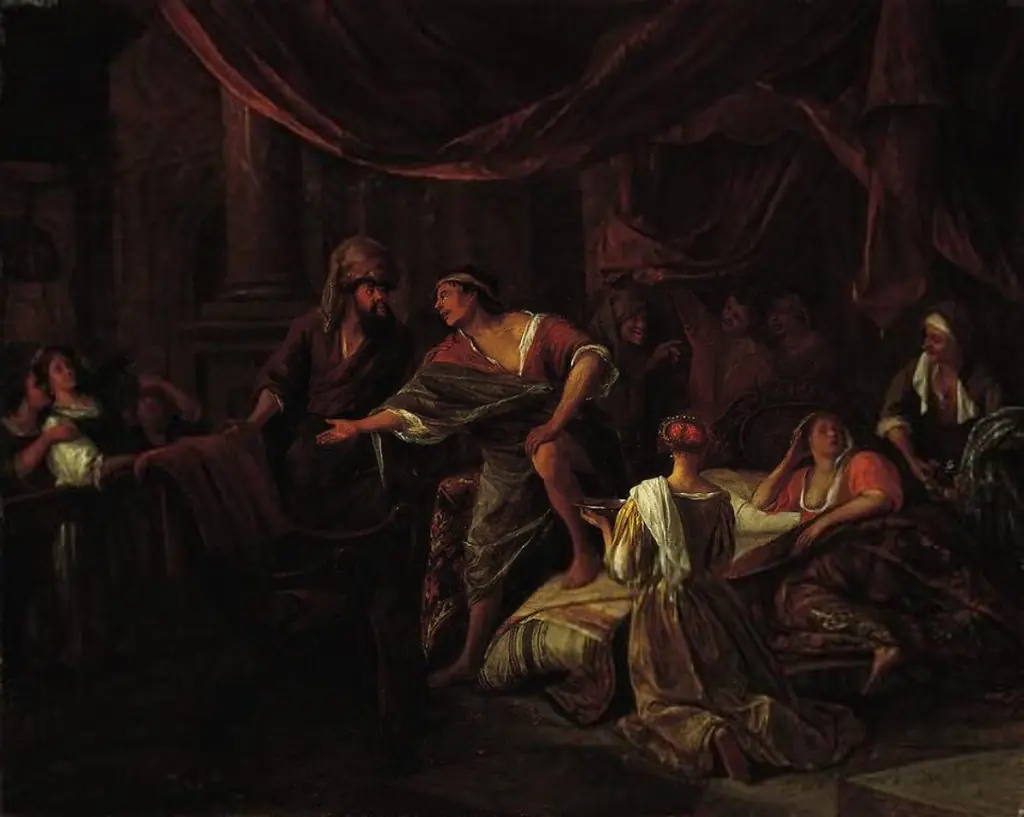 Jacob Confronting Laban
 Family scene
 Laban Searching for His Stolen Gods
 The City of Antwerp pay tribute to the Austrian dynasty
 Leonora Christina being Examined in Prison
 The Circumcision