Artwork
Portrait of a Venetian Gentleman
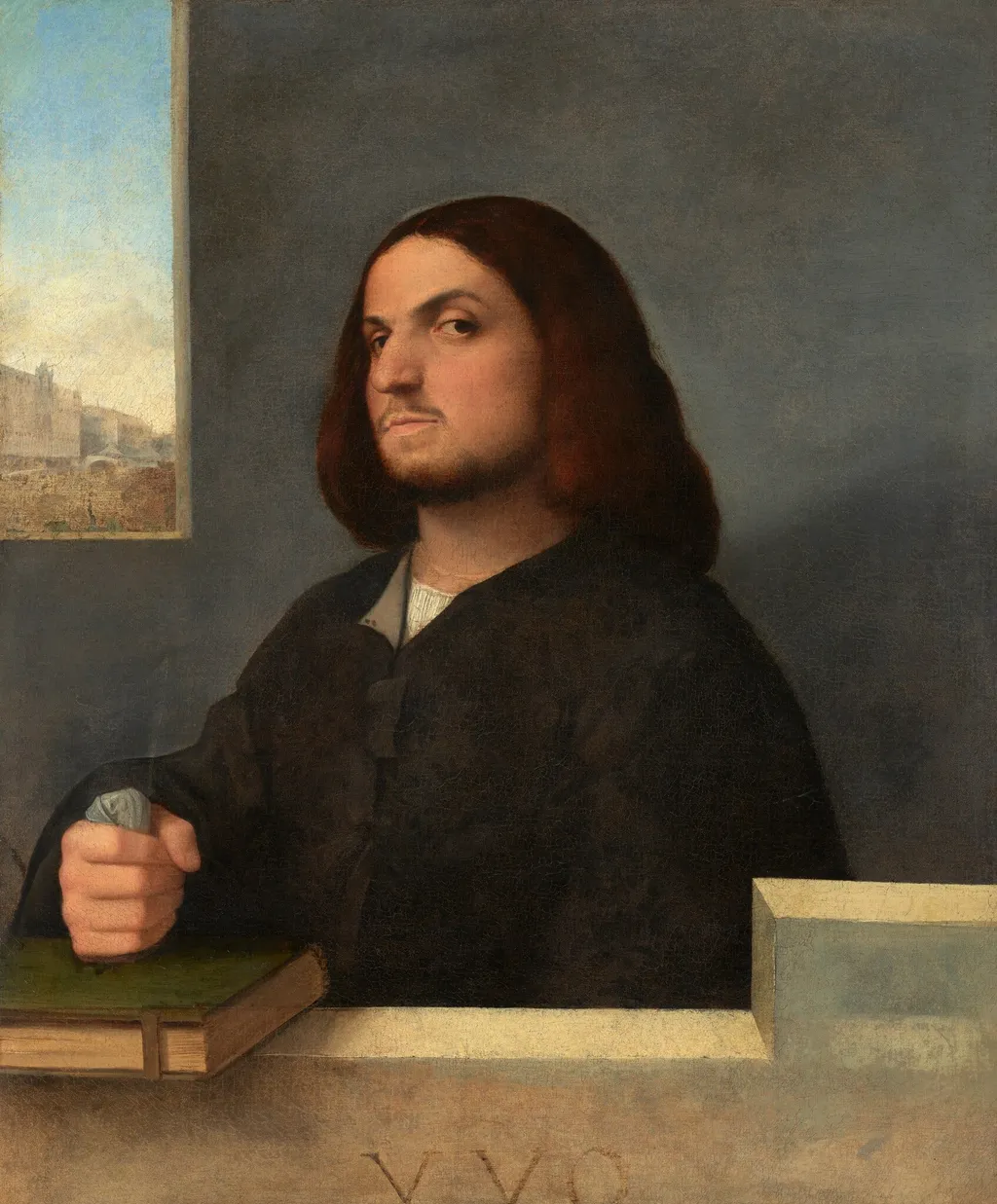
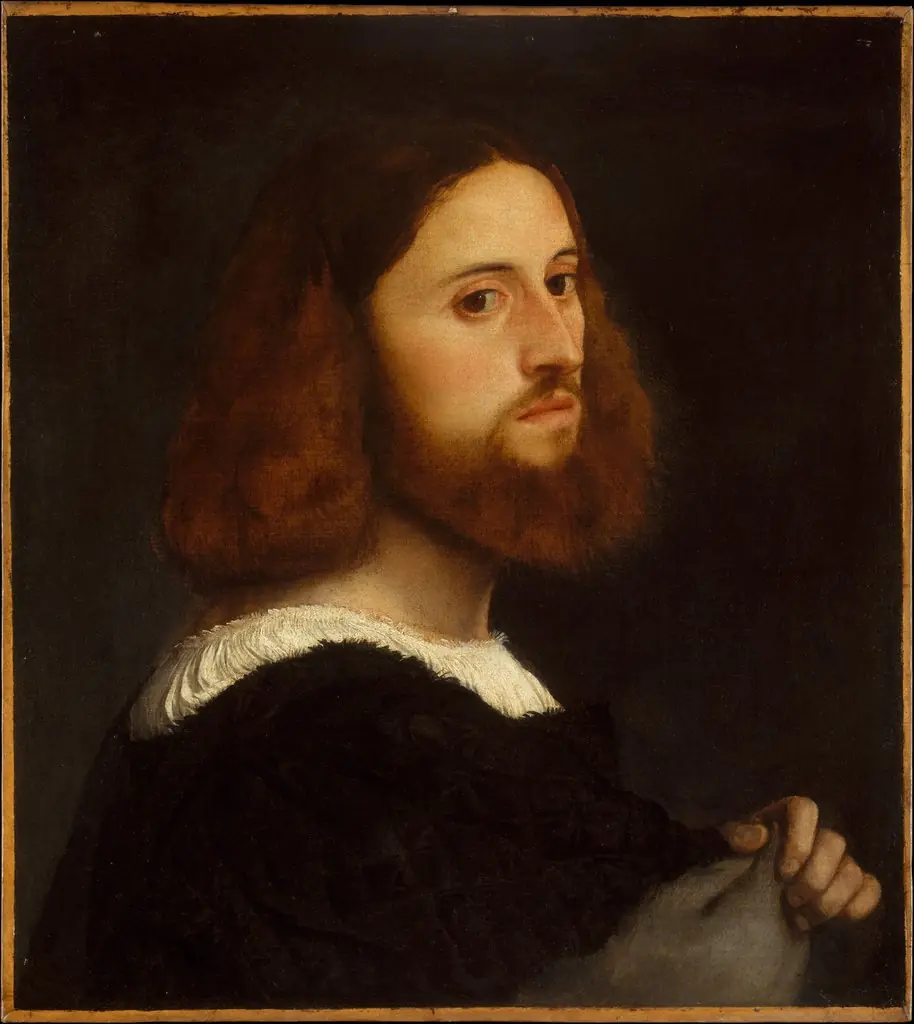
Portrait of a Venetian Gentleman is an oil painting by the High Renaissance artist Giovanni Cariani. It dates from 1512 and is held in the collection of the National Gallery of Art.
- Inscription
- Inscribed:lower center on parapet: VVO
About this work
A man in a dark coat stands in sunlight, his right hand gripping a closed book. Light catches his face and glove but leaves the other hand in shadow. Cariani painted it in Venice around 1510.
Most portraits show open books or gestures; this clenched fist is unusual, as if he is about to speak or act.
Subject & Meaning
The subject's face is slightly upturned, his expression calculating and almost cruel, intensified by direct sidelong eye contact.
The painting depicts a young Venetian gentleman, about thirty years old, in half-length and turned three-quarters to the left. His right hand, clutching a handkerchief, rests as a clenched fist on a book atop a parapet, a motif that, combined with the work's earlier title Portrait of a Lawyer, suggests legal acumen or assertive intellect. Through a window at upper left, a distant fortified city on a hill is visible.
The subject's face is slightly upturned, his expression calculating and almost cruel, intensified by direct sidelong eye contact. The mysterious inscription 'VVO' on the parapet may be a motto ('Virtus vincit omnia' or 'VIVO' meaning 'from life'). The iconography, book, fist, window, and inscription, emblematizes knowledge, power, and worldly engagement.
Stylistically, the head rotation and physiognomy echo Giorgione, while the expanded volume and imperious gesture reflect Titian's influence, creating a portrait of a confident, shrewd individual.
Technique & Style
Painted in oil on canvas, the portrait measures 76.2 × 63.5 cm. The sitter is shown half-length, turned three-quarters left, with his right hand clenched into a fist on a book resting on a parapet. A window with a distant fortified city appears at upper left; another unseen window casts a diagonal light ray on the background, though the primary illumination comes from the front. His expression is calculating and almost cruel, intensified by sidelong eye contact and the closed fist.
Stylistically, the rotated head and physiognomy recall Giorgione, particularly the older figure in The Three Philosophers, while the volumetric forms, imperious gesture, and forceful color are closer to Titian. A mysterious inscription "VVO" appears on the two-level parapet, possibly alluding to "VIVO" or the motto "Virtus vincit omnia."
History & Provenance
Painted by Giovanni Cariani around 1510, the portrait is first documented in the 19th century in a private London collection. It passed through several owners: Robert P. Nichols, then William Graham (sold at Christie's in 1886 as Portrait of a Lawyer); Colnaghi's; Henry Doetsch (sold 1895 as by Licinio); and George Kemp, 1st baron Rochdale, who owned it from at least 1897 until 1905. In 1917 or 1918 it was acquired by Duveen Brothers, then sold to Henry Goldman of New York (1920–at least 1926).
Duveen reacquired it and sold it to the Samuel H. Kress Foundation in 1937, which donated it to the National Gallery of Art in 1939. The painting was previously attributed to Giorgione, Titian, or Sebastiano del Piombo before being assigned to Cariani.
The painting is held in the National Gallery of Art, Washington, D.C., in its Gallery 10. It belongs to the Samuel H. Kress Collection and was gifted by the Kress Foundation in 1939. Its exhibition history includes the Fiftieth Anniversary Exhibition, Le Siècle de Titien: l'âge d'or de la peinture à Venise.
Context
The painting, long subject to scholarly debate, was historically attributed to Giorgione, Titian, and Sebastiano del Piombo; one theory held that it was begun by Giorgione and completed by Titian after the former's death in 1510. Modern scholarship assigns it to Giovanni Cariani, situating it within the Venetian school and High Renaissance movement. Critical analysis highlights the synthesis of Giorgione's influence, evident in the sitter's rotated head and facial type, with Titian's bold volumes and decisive color, as seen in the imperious fist and expanded form.
The work was included in the major exhibition 'Le Siècle de Titien: l'âge d'or de la peinture à Venise,' underscoring its significance in Venetian portraiture. Thus the portrait occupies a notable place in the study of early sixteenth-century Venetian painting, reflecting the interconnections among its leading masters.
Overview
Cariani's Portrait of a Venetian Gentleman, painted in Venice around 1510, is an oil on canvas depicting a man in a dark coat. The subject stands illuminated by sunlight, which highlights his face and gloved right hand. In this hand, he firmly grasps a closed book, while his left hand remains in shadow. The painting captures a moment of quiet intensity, characteristic of early 16th-century Venetian portraiture.
Own this work as a print
Artist & collection
Artist
Giovanni Cariani (c. 1490–1547), also known as Giovanni Busi or Il Cariani, was an Italian painter of the high-Renaissance, active in Venice and the Venetian mainland, including Bergamo, thought to be his native city.