Artwork
Giustiniani Portrait
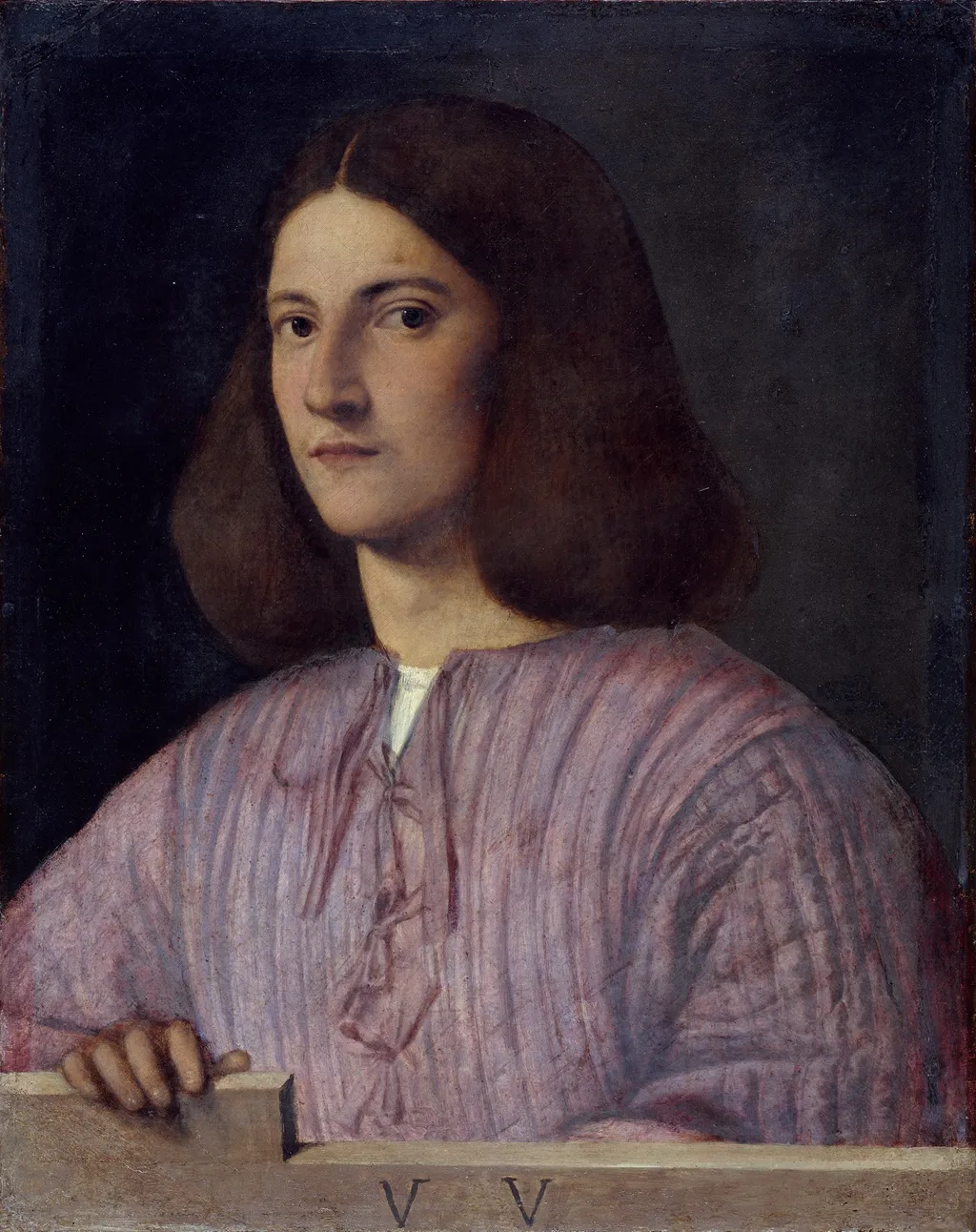
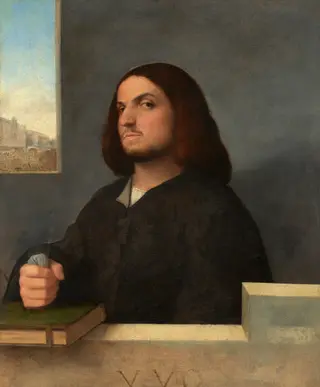
Giustiniani Portrait is a paint painting by the High Renaissance artist Giorgione. It dates from 1503 and is held in the collection of the Gemäldegalerie Berlin.
About this work
Giorgione made this portrait around 1505, and it’s known for how he plays with light and shadow.
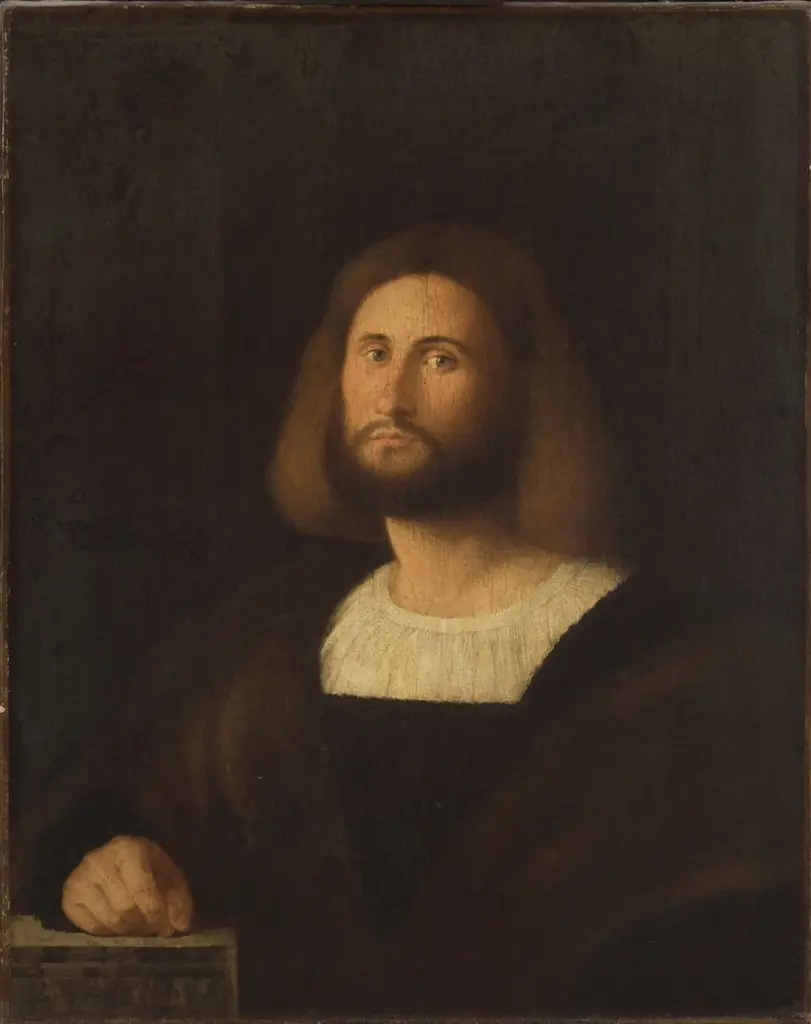
This painting shows a young man with dark hair and a serious look. He’s wearing a loose, purple-brown shirt with a white collar peeking out. His hand rests on a ledge, and the background is plain and dark.
The letters "V V" are painted on the ledge in front of him. Giorgione made this portrait around 1505, and it’s known for how he plays with light and shadow.
Next, look up chiaroscuro to see how artists use light and dark to create depth.
Overview
The Giustiniani Portrait, also known as the Portrait of a Young Man, is an oil on canvas painting measuring 58 by 46 centimeters, attributed to the Venetian Renaissance master Giorgione and dated to approximately 1503. The work is held in the Gemäldegalerie, Berlin, and is widely regarded as one of the few portraits accepted by scholars as coming from Giorgione's own hand, despite the absence of inscriptions, source materials, or documentation that can authenticate it. The painting occupies a significant position in art history as a pivotal example of the transition from late 15th-century Venetian portraiture to the High Renaissance, demonstrating the classical harmony, psychological depth, and technical innovation that would define the era.
Subject & Meaning
The portrait depicts an unidentified young adult male shown in half-length, his body rotated almost imperceptibly from a frontal position while his face is presented in three-quarter view. His gaze meets the viewer directly with a cool, self-assured expression emanating from the corners of his eyes. The subject wears a pale violet, quilted garment that fastens with bows at the front, the uppermost of which has come undone to reveal a white shirt beneath. His shoulder-length brown hair is parted at the center and falls in a pageboy style. The most enigmatic element of the composition is the stone balustrade on which the sitter rests his right hand, bearing the carved Roman letters "V V." These initials have generated considerable scholarly debate. They have been interpreted as the sitter's own initials, or alternatively as Latin mottos: "Virtus Vincit" (Virtue Conquers) or "Vivo Vivus" (I, a living being, am depicted living), the latter drawing analogy with inscriptions on Roman portraits and tomb monuments. The inscription, though added later, likely reproduces an original feature. The overall mood of melancholic introspection and the sitter's dignified bearing suggest an emphasis on individual character and inner life that aligns with Renaissance humanist ideals.
Technique & Style
The painting is executed in oil on canvas, a medium that afforded Giorgione greater flexibility and depth of color than traditional tempera. Light falls from the left, illuminating the face, neck, and hand while casting soft shadows that model the forms with subtle gradation. The brushwork is smooth and blended in the flesh tones, with slightly more visible strokes in the fabric and background, which exhibits fine craquelure throughout. The paint surface shows particular refinement in the rendering of textures, from the soft modeling of the face to the palpable quality of the quilted garment. The dark, nearly uniform background shifts from deep brown to grayish tones, creating a dramatic contrast that isolates the figure and enhances the three-dimensionality of the composition. The handling of paint demonstrates Giorgione's characteristic softness and meticulous attention to the interplay of light and shadow. The motif of the hand resting on a stone balustrade is not native to Venetian tradition and may reflect Northern European influence, possibly derived from portraits by Hans Memling that Giorgione could have encountered in Venetian collections, or alternatively from the example of Leonardo da Vinci. In its classical harmony and balanced composition, the work has been compared to Raphael, marking Giorgione's accomplished transition toward the High Renaissance style.
History & Provenance
The painting's modern name derives from its long residence in the Giustiniani Collection in Padua, where it remained until 1884. In that year it passed into the possession of the art historian Jean Paul Richter, who attributed the work to Giorgione. Richter sold the painting in 1891 to Wilhelm von Bode, the influential museum director and scholar, through whose acquisition it entered the collections of the Staatliche Museen zu Berlin (Berlin State Museums). The work is now housed in the Gemäldegalerie, Berlin. The dating of the painting has been a matter of scholarly controversy. Pignatti (1978) and Pallucchini (1981) placed it around 1506, roughly contemporary with the Laura in Vienna. C. Hornig (1976) proposed a date of 1500/01, while A. Ballarin (1978/79) suggested an even earlier dating of 1497/98. The current consensus tends toward approximately 1503, though the range of scholarly opinion reflects the difficulty of establishing a precise chronology for Giorgione's oeuvre given the absence of documentary evidence for most of his works.
Context
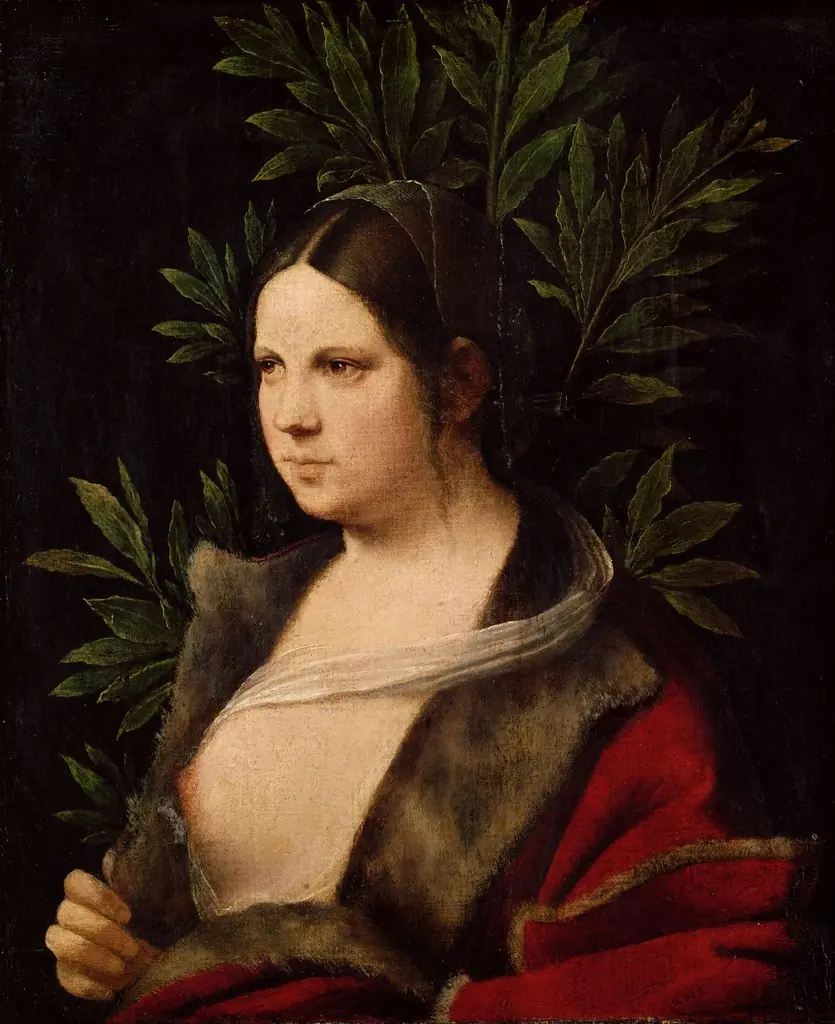
The Giustiniani Portrait belongs to the small core of works accepted by scholars as autograph paintings by Giorgione, a group that includes remarkably few portraits: the Laura (Kunsthistorisches Museum, Vienna, dated 1506 by inscription), the Portrait of an Old Woman (Gallerie dell'Accademia, Venice), the Giustiniani Portrait itself, and the less prominent male Terris Portrait (Fine Arts Gallery, San Diego, dated 1510 by inscription). This scarcity underscores the exceptional status of the work within Giorgione's corpus. The painting has also been at the center of significant attribution debates. D. Rosand (1978) wrongly assigned it to the young Titian, a view shared by Paul Joannides (2001), who argued for Titian's authorship based on what he described as the "symphonic interaction of flesh, hair, fingernails, chemise and the astonishing quilted jacket." Peter Humfrey, by contrast, has defended the traditional attribution to Giorgione, comparing the portrait's dreamy introspection and delicate foreshortening to the Castelfranco Altarpiece of circa 1500. The Royal Academy of Arts' 2016 exhibition "In the Age of Giorgione" brought this debate to public attention, with the two scholars presenting their contrasting positions. Some observers have proposed that both attributions may contain partial truth, suggesting collaborative work between Giorgione and members of his workshop, including the young Titian, who is known to have completed some of Giorgione's unfinished works after the master's death from plague in 1510.
Legacy
The Giustiniani Portrait has exercised profound influence on the development of Venetian and European portraiture. Its portrait type, characterized by classical harmony, psychological penetration, and the subtle melancholic atmosphere that suffuses the image, became decisive for the young Titian and for artists of the Giorgionesque tradition such as Cariani. The work represents a definitive break from the precedents of late 15th-century Venetian portraiture by Antonello da Messina and Giovanni Bellini, establishing a new standard for the representation of individual character that would resonate throughout the High Renaissance and beyond. The painting's cultural afterlife is marked by its continued centrality in scholarly discourse regarding Giorgione's oeuvre and the attribution problems that attend it. The public debate between Humfrey and Joannides at the Royal Academy in 2016 exemplifies the enduring fascination the work exerts, as does the suggestion by some commentators that the painting may embody the collaborative practices of the Renaissance workshop, thus complicating traditional notions of single authorship. As one of the few broadly accepted Giorgione portraits, the Giustiniani Portrait remains essential for understanding the evolution of Venetian painting and the emergence of the High Renaissance portrait tradition in Northern Italy.
Own this work as a print
Artist & collection