Artwork
Rocks and a Hill Town, China
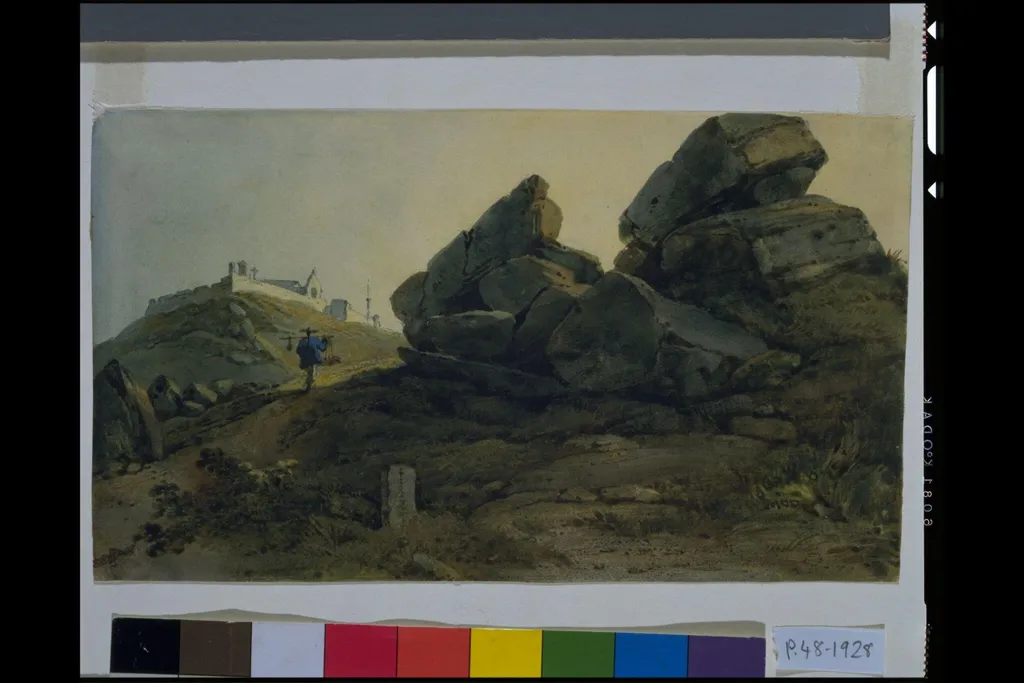
Rocks and a Hill Town, China is a watercolor work on paper by the Patna School of Painting artist George Chinnery. It dates from 1825 and is held in the collection of the Victoria and Albert Museum.
About this work
Overview
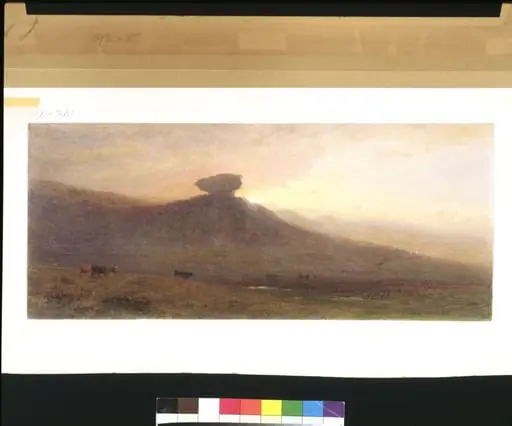
George Chinnery’s watercolour titled Rocks and a Hill Town, China portrays a quiet landscape where a modest settlement rests among rolling hills. In the foreground, sizable stones dominate the composition, while a solitary figure walks toward the distant town, lending a subtle narrative of movement within an otherwise still scene.
Subject & Meaning
The work captures a tranquil moment in a Chinese hill town, emphasizing the harmony between natural rock formations and human habitation. The lone traveler suggests daily life continuing amidst the serene environment, inviting contemplation of the relationship between people and their surrounding terrain.
Technique & Style
Executed in watercolour, Chinnery employs delicate washes and soft brushwork to render atmospheric light on the rocks and distant buildings. The palette is muted, with gentle tonal transitions that create a dreamlike ambience, characteristic of his later landscape practice.
History & Provenance
The painting entered the Victoria & Albert Museum in 1928 through the bequest of James Orange, a co‑founder of the Hong Kong architectural firm Leigh & Orange. It forms part of a larger donation of eighteen Chinnery pieces, encompassing oils, watercolours, drawings and sketchbooks, drawn from Orange’s private collection.
Context
Chinnery, originally trained in London for miniature portraiture, shifted to landscape and oil painting after moving to Dublin in 1796. He later settled in China, where he produced a substantial body of work documenting local scenery and architecture, of which this watercolour is a representative example.
Own this work as a print
Artist & collection
Artist
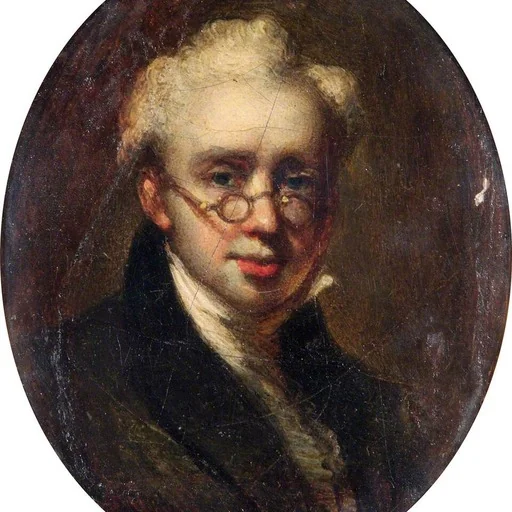
George Chinnery (Chinese: 錢納利; 5 January 1774 – 30 May 1852) was an English painter who spent most of his life in Asia, especially India and southern China.

 Agglestone, near Swanage, Dorsetshire
 A Dell in Devonshire
 On the Wharfe, Yorkshire
 Untitled
 View near Ilfracombe
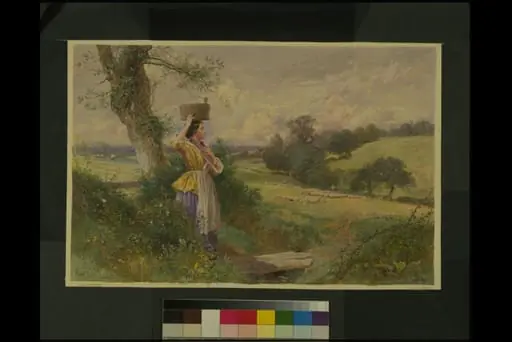 The Milkmaid
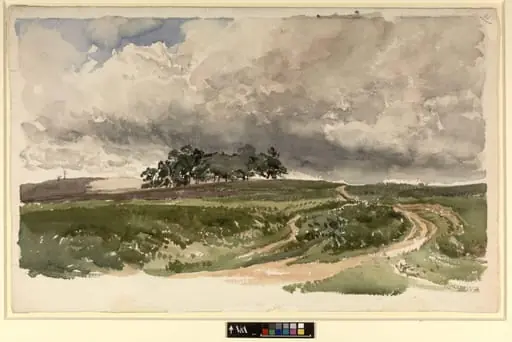 A Heath Scene
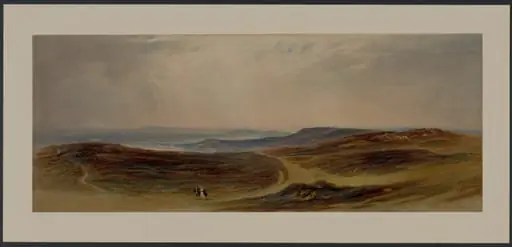 The Valley of the Tyne, My Native Country near Henshaw
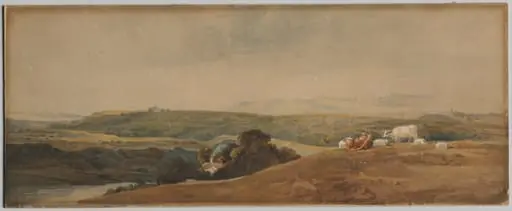 Mountains and Cattle
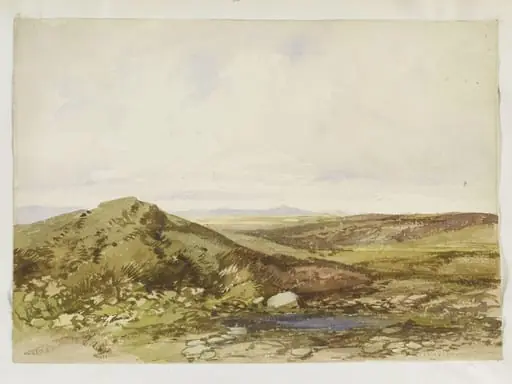 Watercolour in album of 51 drawings and watercolours by James Duffield Harding
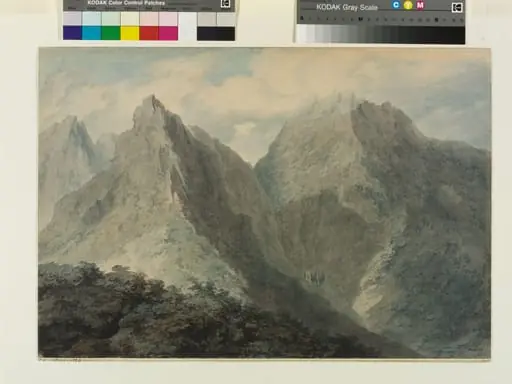 View in the Island of Elba
- A Chinese River