Artwork
Egge (Harrow)
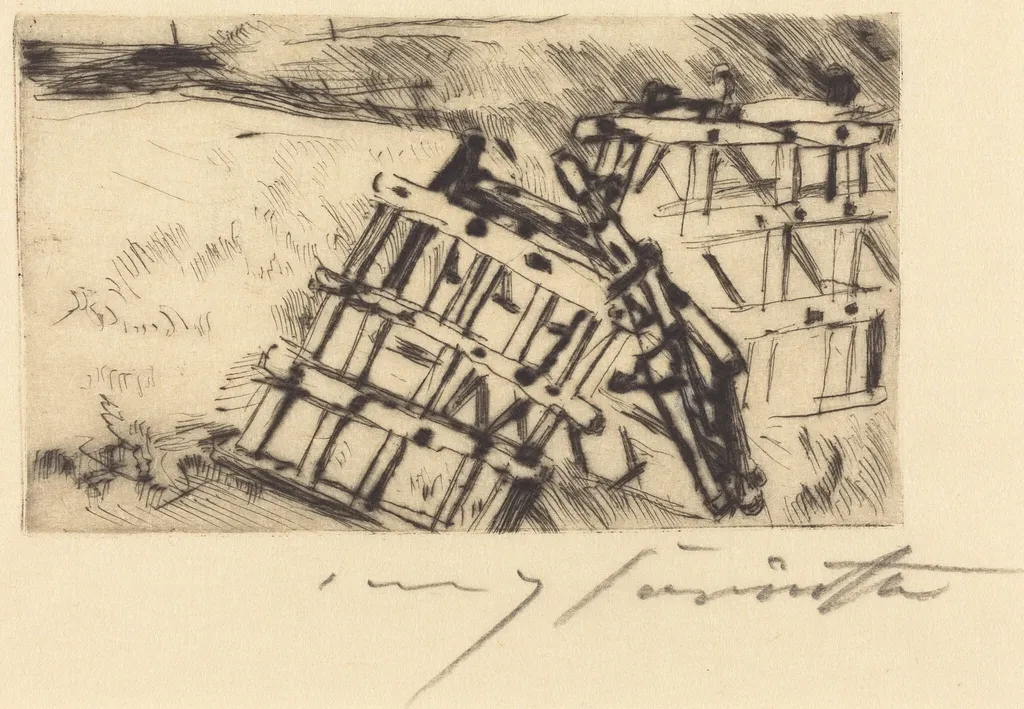
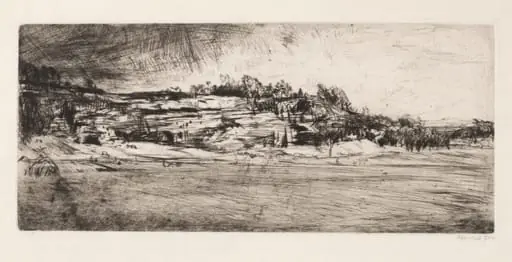
Egge (Harrow) is an ink print by Lovis Corinth. It dates from 1916 and is held in the collection of the National Gallery of Art.
- Inscription
- Inscribed:lower right in graphite: Lovis Corinth; lower left edge in graphite by unknown hand: Egge
About this work
Overview
The work captures a rural structure, likely a harrow shed, through rapid, incised lines that convey urgency and physicality.
Created in 1916, Egge (Harrow) is a drypoint print by German artist Lovis Corinth, executed in black ink on wove paper. The work captures a rural structure, likely a harrow shed, through rapid, incised lines that convey urgency and physicality. Corinth’s shift toward expressive abstraction after his 1911 stroke is evident in the work’s raw, unrefined quality, departing from his earlier naturalism toward a more visceral visual language.
Subject & Meaning
The subject is a utilitarian farm building, rendered without idealization. Its angular form and sparse details suggest a functional structure, perhaps associated with agricultural labor. Scattered, minimally defined figures at the base imply human presence without narrative focus.
The image avoids sentimentality, instead emphasizing the starkness of rural life and the artist’s immediate, almost documentary response to his surroundings.
Technique & Style
Corinth employed drypoint, a printmaking method in which lines are scratched directly into a metal plate, producing a characteristic burr that holds ink and creates soft, grainy edges. The resulting lines are uneven, urgent, and tactile, resembling a sketch made in haste. The absence of tonal shading and the textured paper enhance the work’s rawness, reinforcing the expressive, gestural quality that defined his post-stroke style.
History & Provenance
Made during World War I, the print reflects Corinth’s retreat from urban artistic circles to rural settings, where he sought respite and renewed subject matter. Though he had previously led the Berlin Secession, his work by 1916 had moved beyond institutional affiliations. Egge (Harrow) belongs to a series of prints from this period, documenting everyday structures with heightened emotional intensity, likely created in his private studio or on location.
Context
In the mid-1910s, German artists were redefining representation amid social upheaval and war. Corinth’s turn to expressive line and emotional immediacy aligned with broader shifts in German art, though his approach remained rooted in direct observation rather than abstraction. His focus on humble, functional architecture distinguished him from contemporaries exploring myth or symbolism, grounding his work in the tangible world.
Legacy
The print exemplifies Corinth’s late-period synthesis of observation and emotional intensity, influencing later expressionist printmakers who valued the physicality of mark-making. Its unpolished aesthetic challenged traditional notions of finish in printmaking, affirming the expressive potential of process over precision. Today, it stands as a quiet testament to an artist’s evolving perception in the face of personal and historical transformation.
Own this work as a print
Artist & collection
Artist
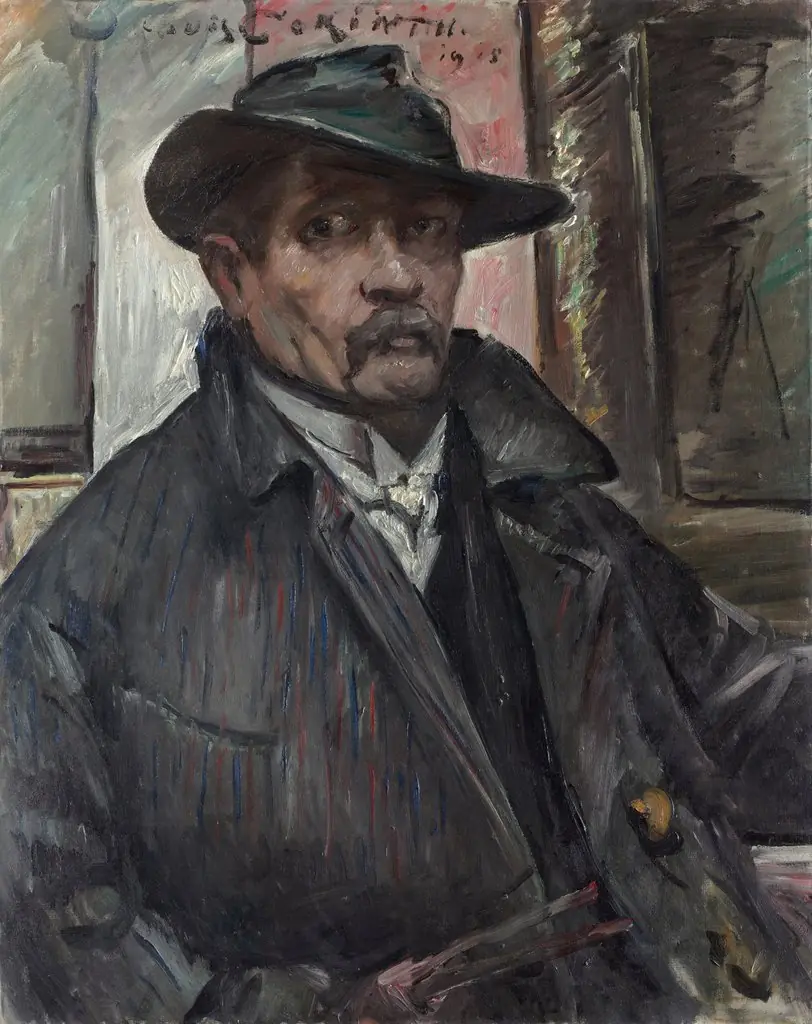
Lovis Corinth (21 July 1858 – 17 July 1925) was a German artist and writer whose mature work as a painter and printmaker realized a synthesis of impressionism and expressionism.

 Spring at Cardross
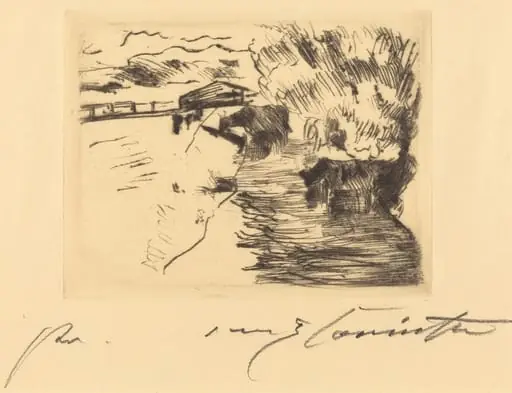 Am see (On a Lake)
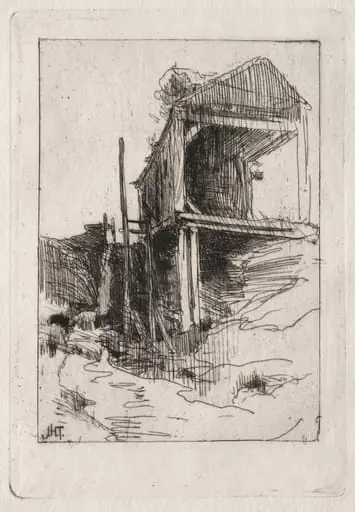 Old Mill, Branchville, Connecticut
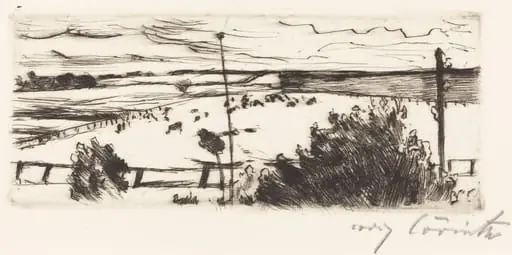 Küste (Seascape)
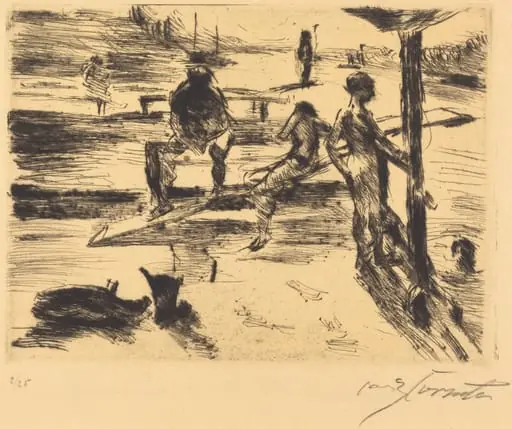 Badeanstalt (Bathing Place)
 Cottage on a Hillside (Chaumiere sur le coteau)
 Brücke mit Tafel (Bridge with Sign)
 Fishing Boats, Hastings
 Wagon Going to Town (Le Charriot allant a la ville)
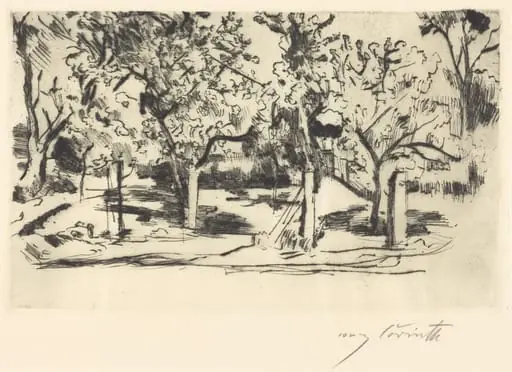 Obstgarten (Orchard)
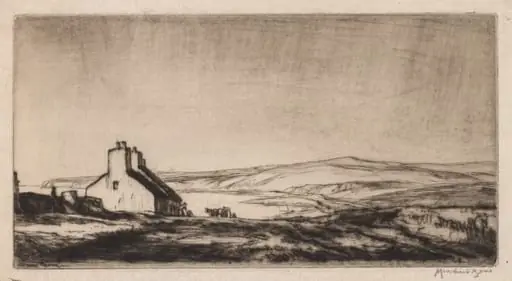 Third Study for 'The Ballantrae Road'
- Der Neue See (The New Lake)