Artwork
Mrs. Hedwig Berend
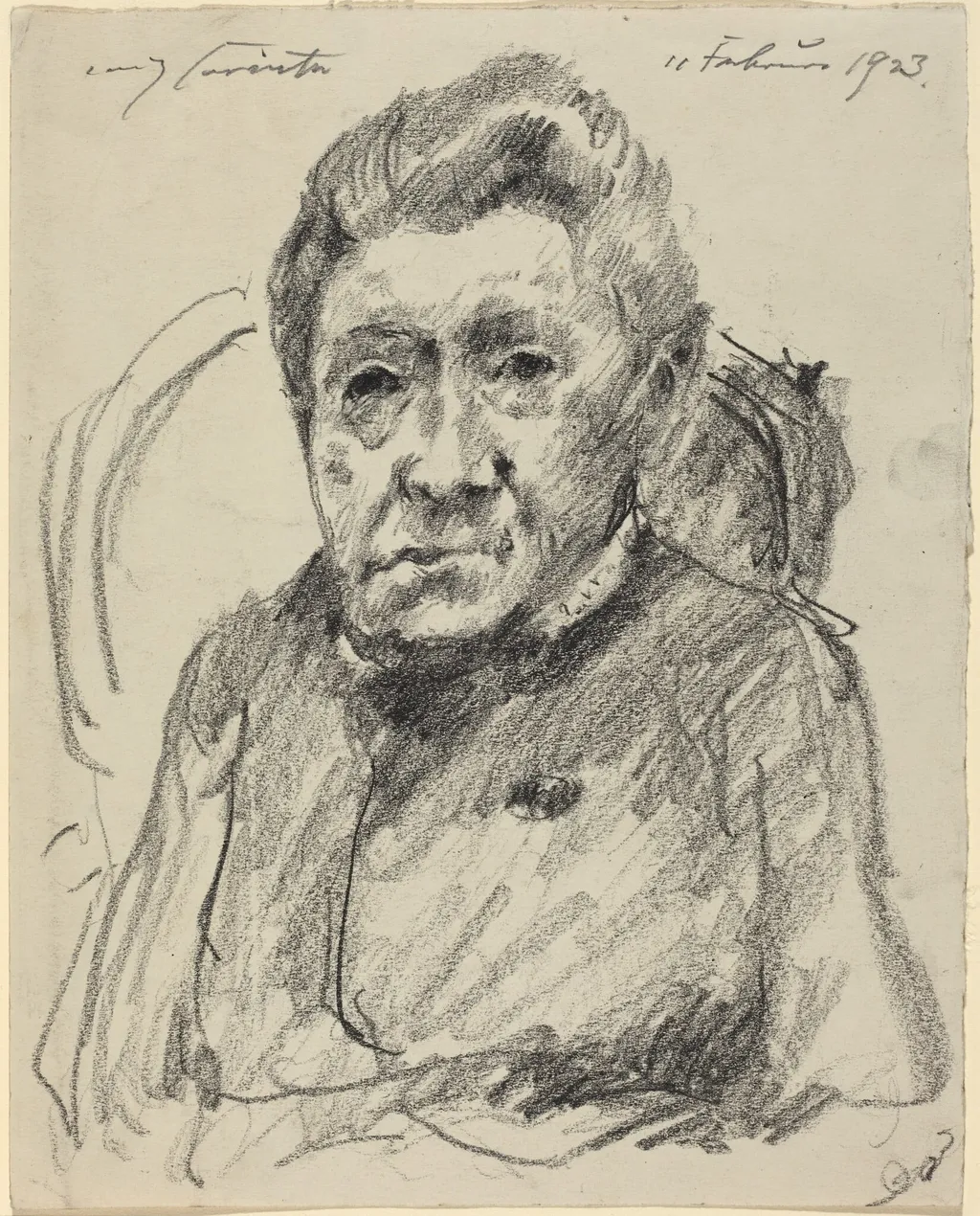
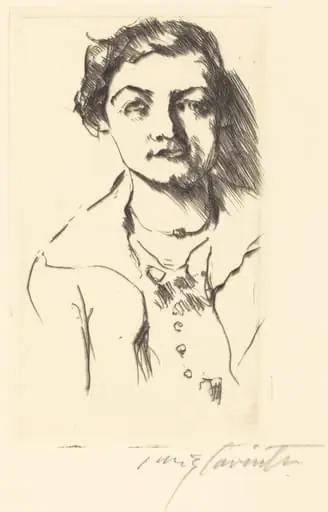
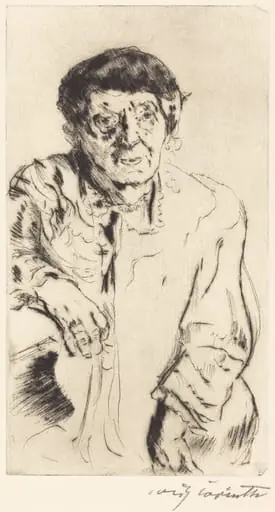
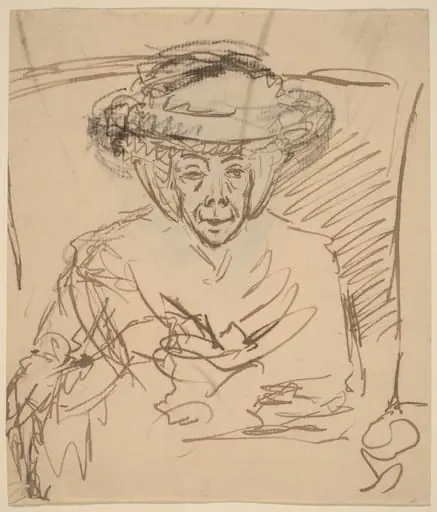
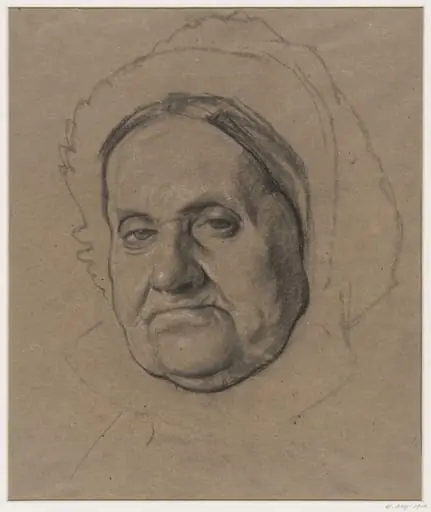
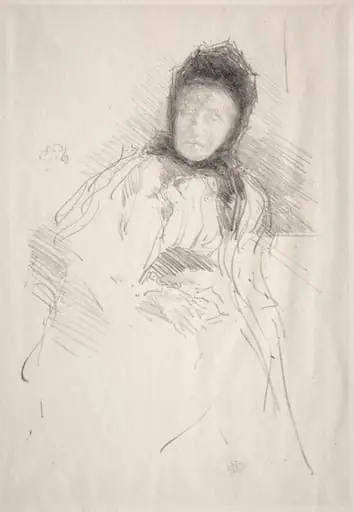
Mrs. Hedwig Berend is a graphite drawing by Lovis Corinth. It dates from 1923 and is held in the collection of the National Gallery of Art. Created in 1923, the drawing titled Mrs.
- Inscription
- Inscribed:upper left: Lovis Corinth; upper right: 11 Februar 1923.
About this work
Overview
), the work depicts a seated woman from the chest up and is held in the collection of the National Gallery of Art in Washington, D.
Mrs. Hedwig Berend is a 1923 portrait drawing by the German artist Lovis Corinth (1858-1925), executed in black chalk on wove paper. Measuring 31.6 by 25.4 cm (12 7/16 by 10 in.), the work depicts a seated woman from the chest up and is held in the collection of the National Gallery of Art in Washington, D.C., under accession number 1974.40.1. The drawing exemplifies Corinth's late portrait style, combining vigorous, expressive mark-making with penetrating psychological observation of an elderly sitter. It represents a significant example of German Expressionist portraiture on paper and has been featured in two major exhibitions at the National Gallery since its acquisition.
Subject & Meaning
The drawing portrays Hedwig Berend, an older woman shown seated and facing slightly to her right with her head turned toward the viewer. Her dark hair is upswept and pulled back, and she wears a dark garment with a high collar secured by a brooch or clasp at the neck. The sitter's hands are not visible in the composition. Corinth's focus falls intensely on Berend's face, where concentrated dark tones around the collar and hair frame her features. The minimal background, with light shading suggesting a chair back behind her left shoulder, functions to isolate the subject and direct attention to her expression. The portrait conveys a sense of quiet dignity and lived experience, with the artist's expressive handling emphasizing psychological presence over social status or idealization. The directness of the gaze and the unidealized treatment of age align with Corinth's broader commitment to unvarnished human truth in portraiture.
Technique & Style
The medium is black chalk on wove paper, creating an entirely monochromatic image ranging from pale gray to deep black. Corinth employs vigorous, textured hatching and crosshatching as his primary means of modeling form, with looser, more gestural strokes in the clothing and background contrasting with more concentrated dark tones in the collar and hair areas. The technique shows the expressive, painterly quality characteristic of Corinth's late work, where quick, emphatic marks build volume and atmosphere without recourse to precise linear definition. The paper itself shows slight aging and uneven edges, consistent with its century-old history. Handwritten inscriptions appear in the upper left and upper right corners, integrating the work's facture with its documentary function. The overall effect balances spontaneity of execution with structural solidity, demonstrating Corinth's mastery of chalk as a medium for expressive portraiture.
History & Provenance
The drawing is dated by inscription to 11 February 1923, with Corinth's signature appearing in the upper left and the date in the upper right. Its provenance includes an unidentified collector marked by an eagle stamp, followed by Ms. Mine Corinth Klopter, presumably a relative of the artist. The National Gallery of Art acquired the work as part of the Ailsa Mellon Bruce Fund, though the exact year of acquisition is not specified in the available sources. The drawing has been exhibited twice at the National Gallery of Art: first in 1993-1994 as part of the exhibition Lovis Corinth (no. 43), and subsequently in 2001-2002 in A Century of Drawing (no. 48).
Context
Lovis Corinth was a central figure in German art from the late nineteenth century until his death in 1925, associated with the Berlin Secession and later with Expressionism, though his work resisted easy categorization within any single movement. By 1923, Corinth had recovered from a debilitating stroke in 1911 that had partially paralyzed his left side and fundamentally altered his working method; his post-stroke works are often characterized by a more raw, immediate, and emotionally direct quality. Mrs. Hedwig Berend belongs to this late period, when Corinth produced numerous portraits of family members, friends, and acquaintances with unsparing psychological candor. The drawing's placement in the National Gallery of Art's collection, supported by the Ailsa Mellon Bruce Fund, reflects its recognition as a significant work within Corinth's oeuvre and within twentieth-century German drawing more broadly. The two exhibitions at the National Gallery demonstrate sustained institutional interest in the work as representative of both Corinth's individual achievement and the broader history of modern drawing practice.
Legacy
Mrs. Hedwig Berend occupies an important place in the corpus of Lovis Corinth's late drawings, illustrating the artist's continued vitality and expressive power in the final years of his life. As a publicly held work in the National Gallery of Art, it contributes to the accessibility of Corinth's art for American and international audiences, particularly given its status as a No Copyright work in the United States that has been made available through digital platforms. The drawing's reproduction and circulation through commercial print vendors and stock image archives indicates its function as a representative image of Corinth's portraiture, though such reproductions vary in quality and accuracy. Within Corinth scholarship, the work serves as a document of the artist's late graphic style and his sustained engagement with portraiture as a means of humanistic exploration. The direct, unflinching characterization it presents continues to resonate with viewers as an example of early twentieth-century portraiture that prioritizes psychological truth over conventional beauty.
Own this work as a print
Artist & collection
Artist
Lovis Corinth (21 July 1858 – 17 July 1925) was a German artist and writer whose mature work as a painter and printmaker realized a synthesis of impressionism and expressionism.