Artwork
Verschiedene Tierstudien (Animal Studies)
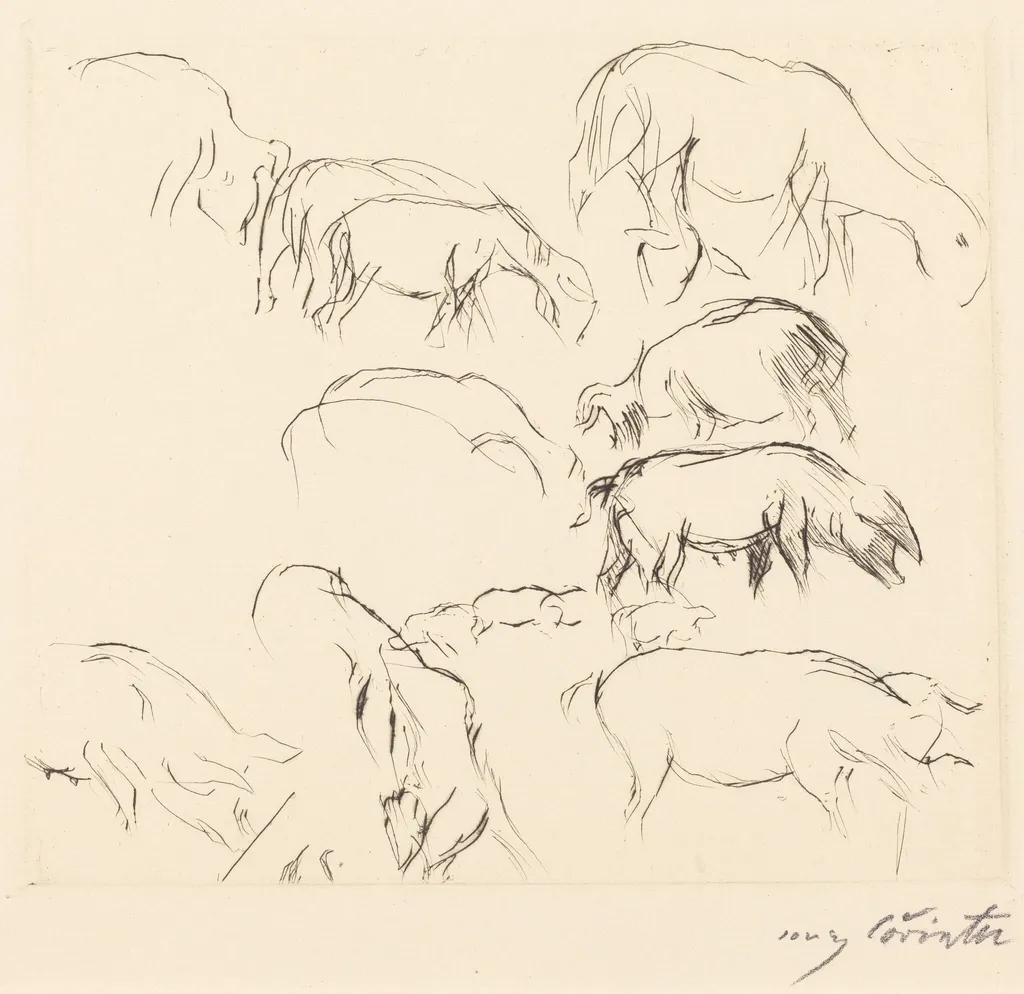
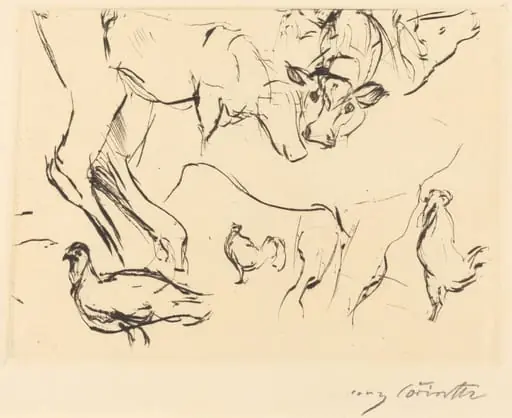
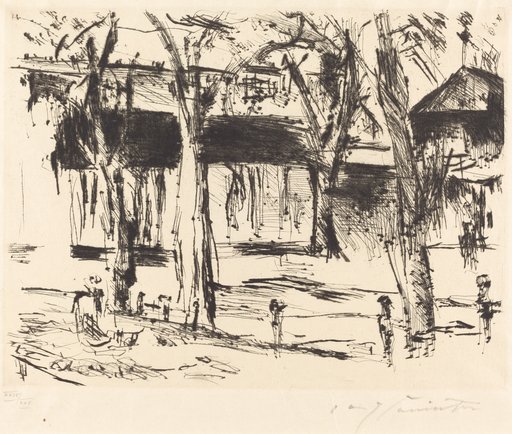
Verschiedene Tierstudien (Animal Studies) is an ink print by Lovis Corinth. It dates from 1917 and is held in the collection of the National Gallery of Art.
- Inscription
- Inscribed:lower right in graphite: Lovis Corinth; lower left edge in graphite by unknown hand: 299; lower left verso in graphite by unknown hand: Schw. 299 C
About this work
Overview
The work belongs to a phase in his career following a stroke in 1911, which shifted his approach toward more spontaneous, gestural mark-making.
Lovis Corinth produced Verschiedene Tierstudien in 1917 as a drypoint print on laid paper. The work belongs to a phase in his career following a stroke in 1911, which shifted his approach toward more spontaneous, gestural mark-making. Unlike earlier naturalistic renderings, these animal studies embrace immediacy and tactile texture, reflecting his engagement with modernist currents in early 20th-century German art.
Subject & Meaning
The print presents a group of animals, possibly horses or bovines, rendered without clear hierarchy or spatial order. Their forms overlap and dissolve into one another, suggesting observation in motion rather than posed study. The lack of narrative context emphasizes the act of seeing itself, aligning with Corinth’s interest in capturing transient visual experiences over idealized representation.
Technique & Style
Corinth employed drypoint, scratching directly into a metal plate with a hard-pointed tool to create dense, grainy lines. The resulting print retains the roughness of the original marks, with uneven ink deposits and faint, fading edges. The light beige paper enhances the sense of fragility, reinforcing the sketch-like quality and the immediacy of the artist’s hand.
History & Provenance
Created during Corinth’s tenure with the Berlin Secession, where he later became president, this print emerged from a period of intense artistic reevaluation. Though not part of a formal series, it reflects his broader exploration of animal subjects in the years after his illness, as he increasingly turned to intimate, rapid studies as a means of artistic renewal.
Context
In post-1911 Germany, artists were moving away from academic traditions toward expressive, personal modes of representation. Corinth’s animal studies align with this shift, echoing the influence of Impressionist light and Expressionist energy. His work during this time resonated with contemporaries seeking emotional authenticity over polished finish.
Legacy
These studies exemplify Corinth’s late style: unrefined, emotionally direct, and rooted in the physicality of mark-making. While not widely exhibited during his lifetime, they have since become important references for understanding how trauma and artistic evolution intersected in early modern German printmaking.
Own this work as a print
Artist & collection
Artist
Lovis Corinth (21 July 1858 – 17 July 1925) was a German artist and writer whose mature work as a painter and printmaker realized a synthesis of impressionism and expressionism.