Artwork
A Swiss Cottage
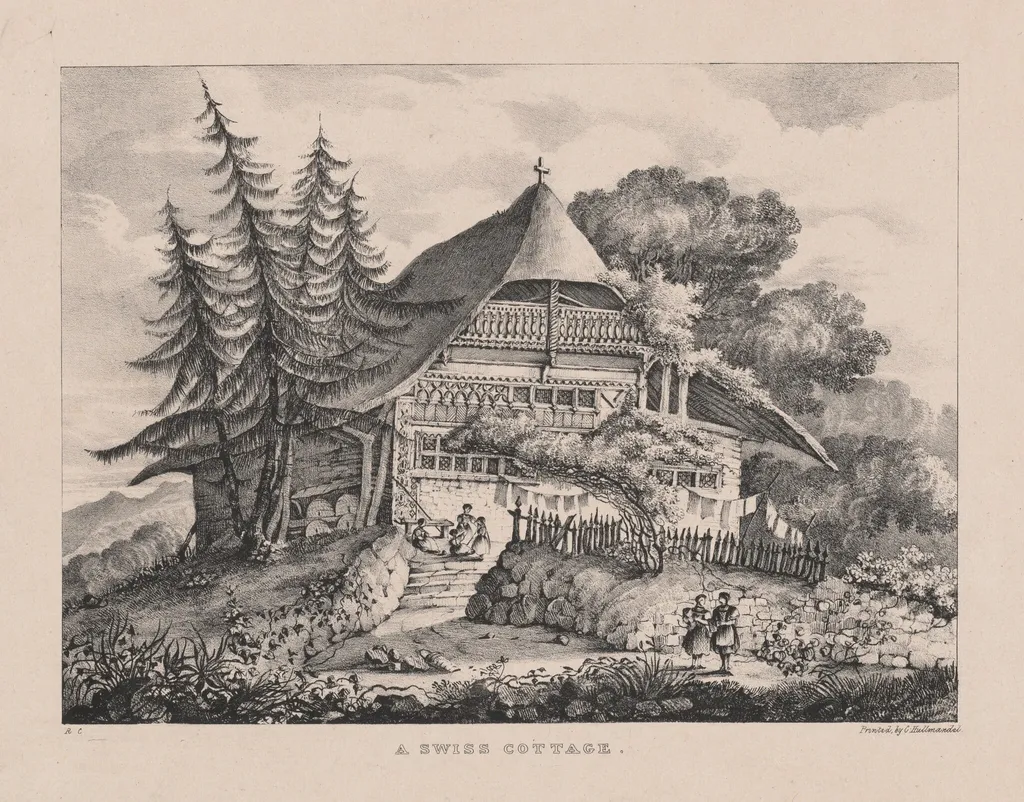
A Swiss Cottage is an ink print by the Romanticist artist Richenda Cunningham. It dates from 1825 and is held in the collection of the National Gallery of Art.
- Inscription
- Inscribed:lower left in stone: R. C.; lower right in stone: Printed by C. Hullmandel; lower center in stone: A SWISS COTTAGE
About this work
Overview
Figures are engaged in quiet domestic activities, seated on steps, tending a garden, or carrying baskets, suggesting a tranquil rural scene.
A Swiss Cottage is a lithograph on chine colle, dated around 1825, by the British artist Richenda Cunningham. The print depicts a modest wooden dwelling nestled among tall pine trees, with a small cross atop its steeply pitched roof. Figures are engaged in quiet domestic activities, seated on steps, tending a garden, or carrying baskets, suggesting a tranquil rural scene. Though titled as Swiss, the architecture aligns more closely with Alpine European vernacular than Swiss-specific forms.
Subject & Meaning
The scene presents an idealized vision of rural life, emphasizing harmony between people and nature. The presence of a cross hints at spiritual or moral serenity, while the absence of grandeur or ornamentation underscores simplicity and self-sufficiency. The figures, though small, are integral to the composition, reinforcing the theme of quiet domesticity rather than picturesque tourism or exoticism often associated with Alpine imagery of the period.
Technique & Style
Cunningham employed lithography on chine colle, a method allowing fine detail on delicate paper adhered to a heavier support. The lines are fluid and lightly sketched, characteristic of early 19th-century lithographic practice, where the artist’s hand remained visible. The soft tonal gradations and lack of heavy shading create an airy, intimate atmosphere, aligning with the gentle mood of the subject rather than dramatic contrast.
History & Provenance
The work originates from the early decades of lithography’s adoption in Britain, a time when the medium was increasingly used for topographical and domestic subjects. Richenda Cunningham, though not widely documented, was part of a circle of amateur and professional printmakers producing small-scale works for private collections. The print’s survival suggests it was held in domestic or regional collections, likely circulated among middle-class patrons interested in rural idylls.
Context
In the 1820s, European interest in mountainous regions grew alongside Romantic ideals of nature and simplicity. While Swiss cottages were popular motifs in travel literature and art, Cunningham’s version reflects a more localized, less stereotyped interpretation. Her depiction avoids theatricality, instead capturing a quiet, lived-in environment that resonates with contemporary British tastes for pastoral tranquility and moralized rural life.
Legacy
A Swiss Cottage stands as a modest example of early lithographic practice by a female artist in a field dominated by male professionals. It reflects the expanding accessibility of printmaking for personal and domestic expression. Though not widely exhibited or studied, the work contributes to understanding how ordinary scenes of rural life were visually codified and circulated in early 19th-century Britain.
Own this work as a print
Artist & collection

- The Monastery in the Forest
 The Courtyard
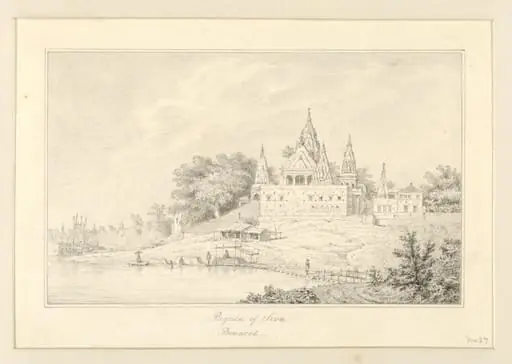 Pagoda of Siva, Benares
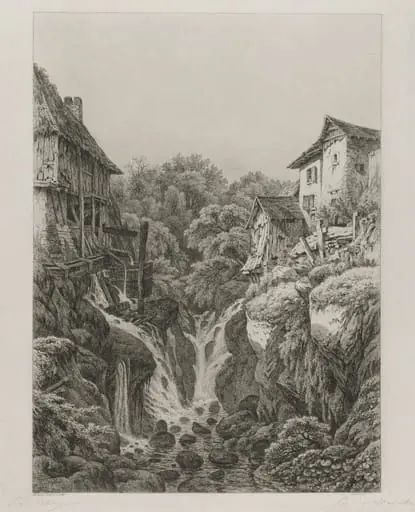 The Mill and Waterfall of Grésy near Aix-les-Bains
 Eingang ins Lauterbrunnental
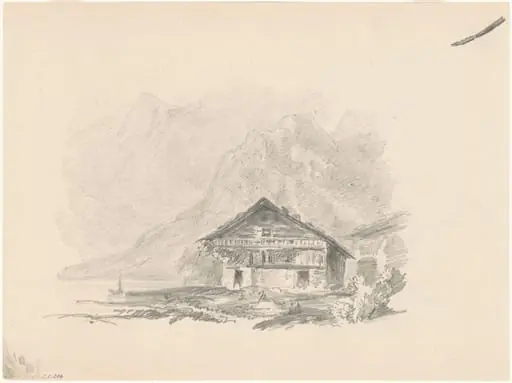 Swiss Chalet
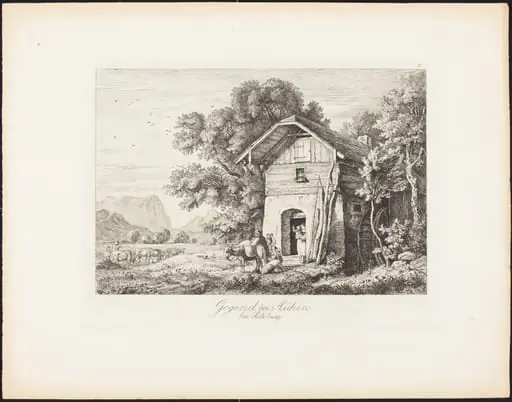 Gegend bei Aichen bei Salzburg (The Region near Aichen near Salzburg)
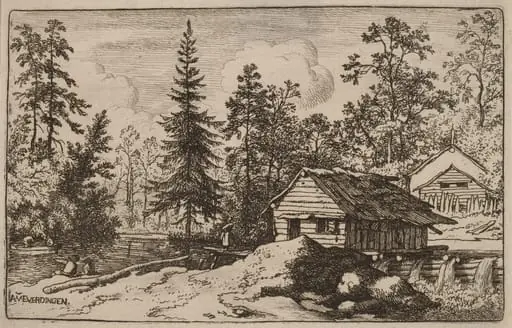 Woman in a Riverscape Looking towards a Boat
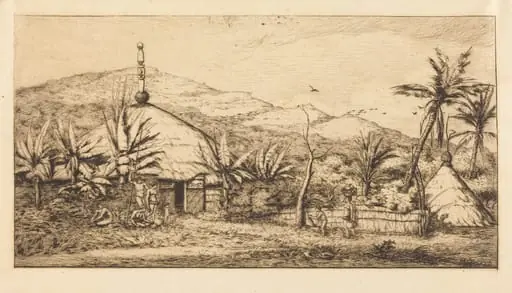 Nouvelle-Calédonie: Grande case indigène sur le chemin de Ballade à Poepo, 1845 (New Caledonia: Large Native Hut on the Road from Balade to Puebo, 1845)
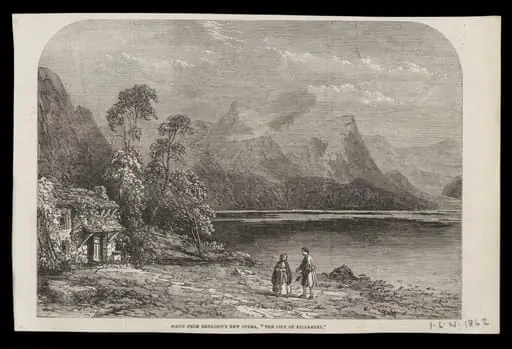 H Beard Print Collection
 The Path by the Kochelsee
 Stone Bridge over A Mountain Brook