Artwork
Cain Killing Abel
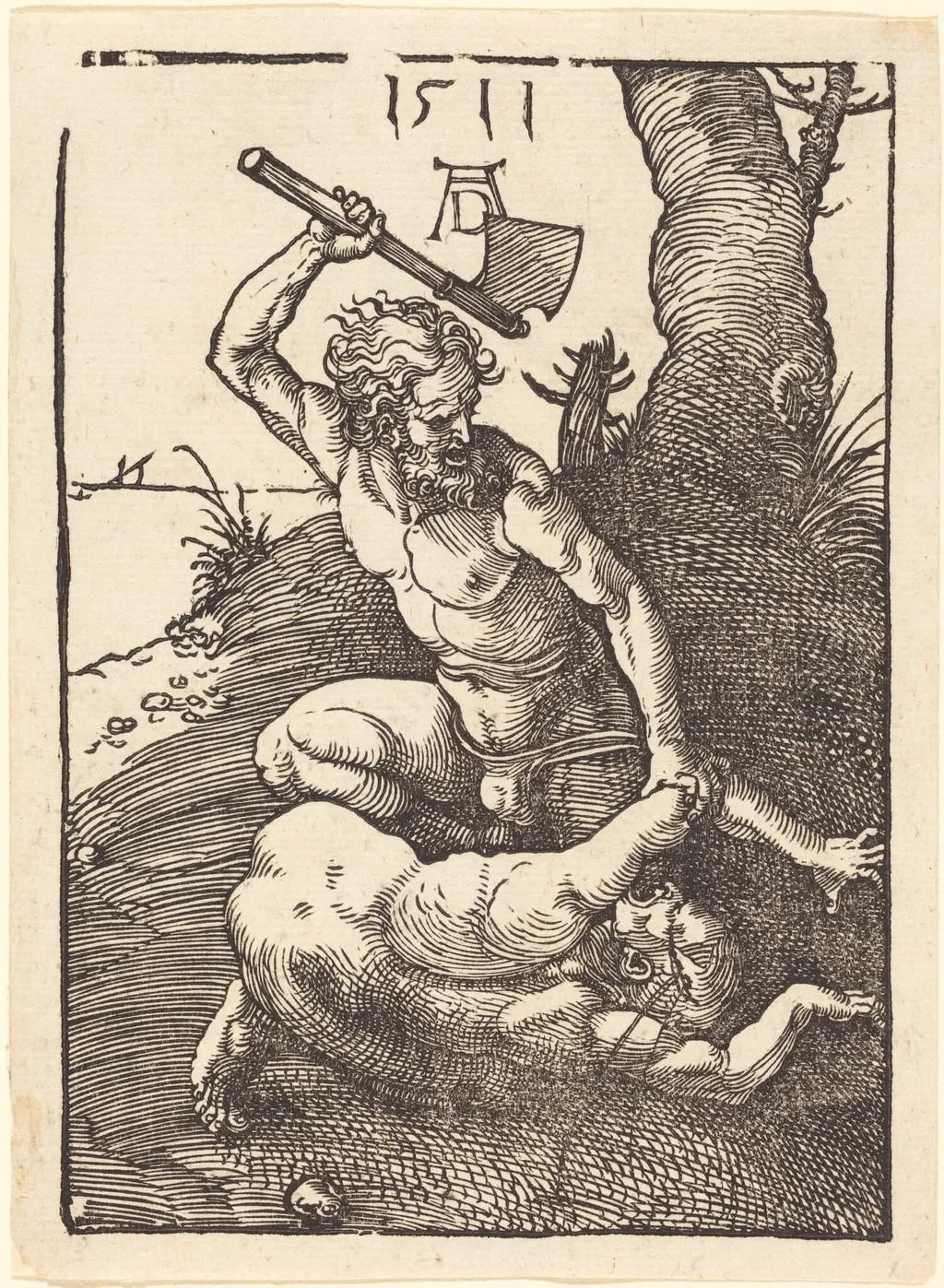
Cain Killing Abel is an ink print by the Northern Renaissance artist Albrecht Dürer. It dates from 1511 and is held in the collection of the National Gallery of Art.
- Inscription
- Inscribed:in plate, top center: 1511 / AD [artist's monogram]; verso, upper left, in red colored pencil by a later hand: 156; verso, lower center, in graphite by a later hand: B.1. / CA [?] 114; verso, lower center, in graphite by a later hand: C.18565; verso, lower right, in graphite by a later hand: 44; verso, lower left, in graphite by a later hand: 1_-[?] verso, lower left, in graphite by a later hand: no. 1 in Legno
About this work
Albrecht Dürer’s woodcut shows Cain swinging a club at Abel while Adam and Eve watch from above.
Albrecht Dürer’s woodcut shows Cain swinging a club at Abel while Adam and Eve watch from above. The figures are stark against blank space, no background, just lines. The tension is all in Cain’s face and the raised arm.
This was made in 1511. Dürer used woodcut to tell Bible stories in bold black and white. The technique lets light hit the figures like stage spotlights.
Look up Dürer, Albrecht next.
Technique & Style
Executed in 1511, this work is a woodcut printed on laid paper. As a print from the German Renaissance, the piece utilizes the relief printing technique characteristic of Albrecht Dürer's graphic oeuvre. The composition depicts the biblical figures of Cain and Abel, rendered through the stark contrasts and linear precision achievable with the woodblock medium.
The specific impression held by the National Gallery of Art demonstrates the artist's handling of the medium to convey narrative drama through form and shadow.
History & Provenance
Albrecht Dürer created the woodcut Cain Killing Abel in 1511. Executed on laid paper, this print belongs to the artist's graphic oeuvre from the German Renaissance. The specific impression held by the National Gallery of Art was acquired in 1929 by Lessing J. Rosenwald of Jenkintown, Pennsylvania.
Rosenwald subsequently donated the work to the museum in 1943, where it remains part of the institution's Prints collection.
The print Cain Killing Abel by Albrecht Dürer is held at the National Gallery of Art in Washington, D.C. It entered the collection through the Rosenwald Collection, acquired by Lessing J. Rosenwald in 1929 and gifted to the museum in 1943. The work is cataloged under inventory number 1943.8.10085. It has been part of exhibitions at the National Gallery of Art, including the 1943 Rosenwald Collection exhibition and subsequent displays of German Renaissance prints.
Overview
Cain Killing Abel is a 1511 woodcut by Albrecht Dürer, portraying a pivotal biblical scene with stark simplicity.
Subject & Meaning
The print depicts the moment before Cain strikes Abel, with Adam and Eve observing from above. Tension is conveyed through Cain's facial expression and raised club-wielding arm, emphasizing the dramatic intensity of the fratricide.
Context
Within Dürer's oeuvre, this work reflects his interest in exploring religious themes through printmaking, a medium that allowed for widespread dissemination of his interpretations of biblical narratives.
Legacy
As a representative of Dürer's woodcut technique, Cain Killing Abel contributes to the artist's legacy in elevating printmaking as a vehicle for complex, emotionally charged subjects.
Own this work as a print
Artist & collection
Artist
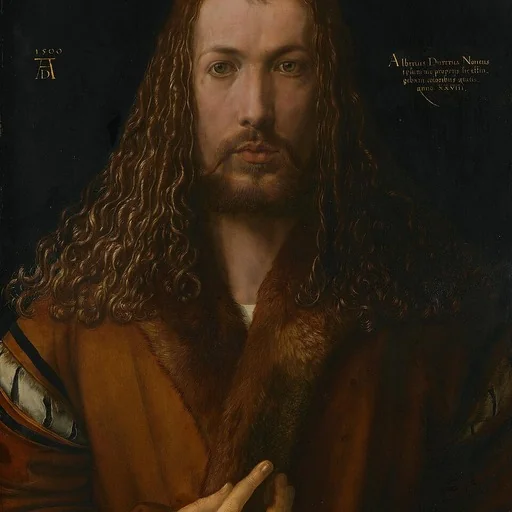
Albrecht Dürer spent his life in Nuremberg, a busy German city where artists traded prints like currency.

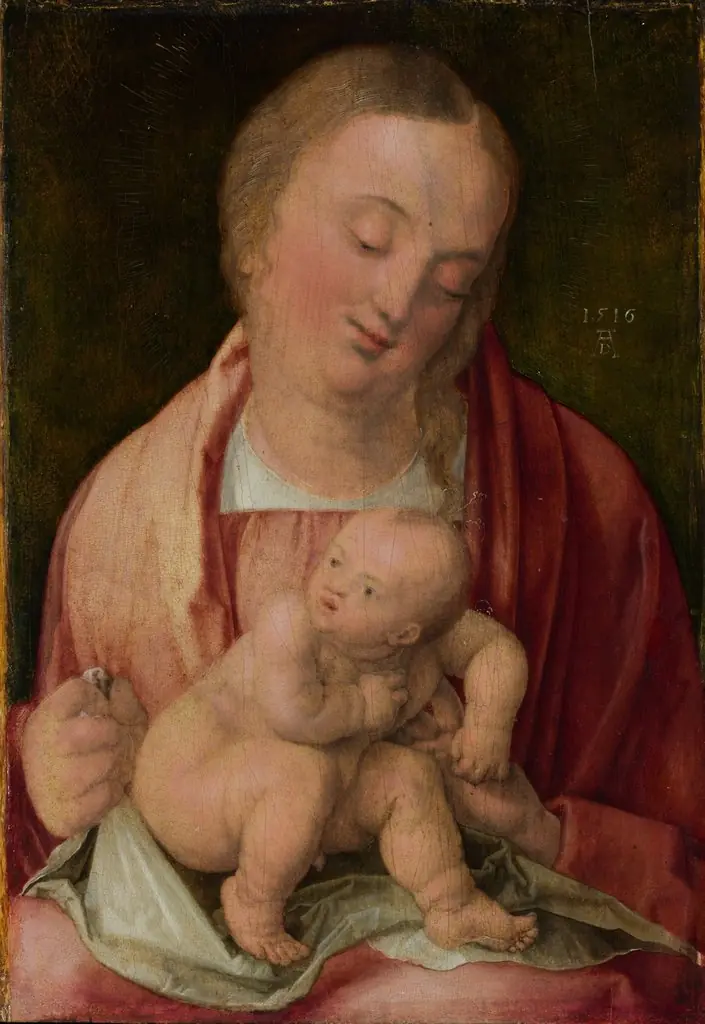
![Madonna and Child [obverse], by Albrecht Dürer](https://artifactworldgallery.com/img/albrecht-durer--madonna-and-child-obverse--d7b8ebf05d22ebe5-w320.webp)
![Lot and His Daughters [reverse], by Albrecht Dürer](https://artifactworldgallery.com/img/albrecht-durer--lot-and-his-daughters-reverse--b4ebf9b282faa17a-w320.webp)