Artwork
The Suicide of Lucretia
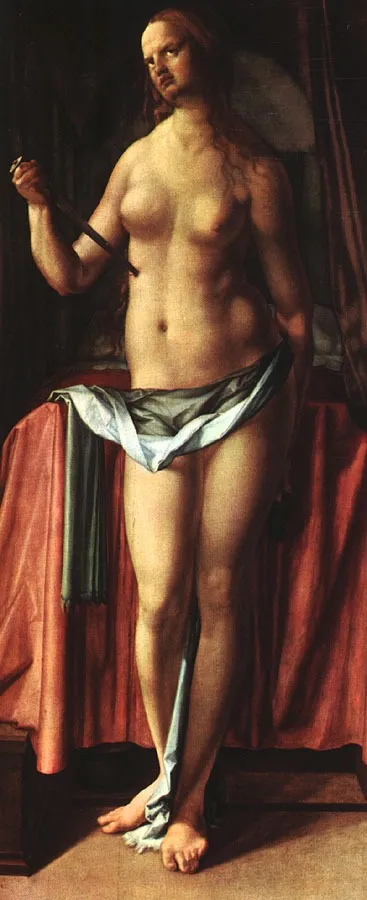
The Suicide of Lucretia is an oil painting by the Northern Renaissance artist Albrecht Dürer. It dates from 1518 and is held in the collection of the Bavarian State Painting Collections.
About this work
Albrecht Durer painted The Suicide of Lucretia in oil in 1518. Tall and narrow, it focuses on a single moment: Lucretia as she takes her life, choosing death over dishonor after a terrible crime. The format presses all attention onto that one figure and that one act.
Subject & Meaning
The work represents a stark confrontation with death and disgrace, characterized by a bloodless execution that contrasts with contemporary treatments.
The painting depicts the ancient Roman heroine Lucretia committing suicide to avoid the shame of rape by Sextus Tarquinius. Dürer portrays her standing in a cramped room before the bridal bed where the assault occurred, gazing upward as if summoning divine witness while stabbing herself below the right breast. This specific wound placement intentionally echoes Christ's lance wound, infusing the scene with religious symbolism despite the pagan subject.
The work represents a stark confrontation with death and disgrace, characterized by a bloodless execution that contrasts with contemporary treatments. Art historians interpret the figure's mechanical gesture and sour expression not as a traditional exaltation of feminine virtue, but rather as an awkward, almost parodic study of mortality. The composition avoids pagan sensuality, focusing instead on the internal tragedy and the physical reality of the act.
Technique & Style
The Suicide of Lucretia is executed in oil on a limewood panel, measuring approximately 168 by 74–75 cm, and is signed and dated 1518. Dürer applied the paint with notable finesse, particularly in the rendering of the textiles, which incorporate a varied palette of red, blue, and green pigments. The work is composed in a tall, narrow format, accommodating the figure's monumental, statuesque stance and contrapposto pose.
Stylistically, the painting is anchored in the German Renaissance, yet it lacks the pagan sensuality of Dürer's 1507 Adam and Eve panel. Critics have remarked on the figure's unnaturally elongated and disproportional anatomy, her austere and awkward expression, and a mechanical quality in the suicidal gesture. The wound is positioned below the right breast rather than at the center of the belly, echoing Christ's lance wound, and the act is rendered bloodless, without the spatterings typical of contemporary treatments. The white drapery around the figure's hips is a later addition dating to around 1600.
History & Provenance
Signed and dated 1518, this oil painting on lime panel represents Albrecht Dürer's second treatment of the subject, following a 1508 ink and wash drawing currently held in the Albertina, Vienna. The composition likely originated years prior to the final execution, evolving from studies on human proportion connected to the artist's 1507 Adam and Eve. During the 17th century, white drapery was added to cover the figure's hips, and the panel was for a period concealed behind a depiction of Lucretia by Lucas Cranach the Elder.
The painting is currently housed in the Alte Pinakothek, Munich, as part of the Bavarian State Painting Collections.
Legacy
The Suicide of Lucretia has historically been regarded as one of Albrecht Dürer's most unpopular works, often described by critics as exhibiting austerity and awkwardness. Prominent art historians, including Max Friedländer and Erwin Panofsky, have commented unfavorably on its perceived grotesque proportions and the figure's sour expression. Fedja Anzelewsky characterized the painting as a parody rather than an exaltation of the classical feminine form.
Consequently, the work was long obscured behind a similar painting by Lucas Cranach the Elder in the Alte Pinakothek. Despite this critical dismissal, the piece has inspired specific later artists. Giorgio de Chirico paid homage to the work in 1922 by replicating Lucretia's self-inflicted wound gesture in his own painting.
Overview
Albrecht Dürer's painting, The Suicide of Lucretia, created in 1518, is an oil on lime panel work housed in the Alte Pinakothek, Munich. It portrays the ancient Roman figure Lucretia at the precise moment she takes her own life. The composition emphasizes the dramatic climax of her narrative, presenting a focused and intense depiction of her final act.
Artist & collection
Artist
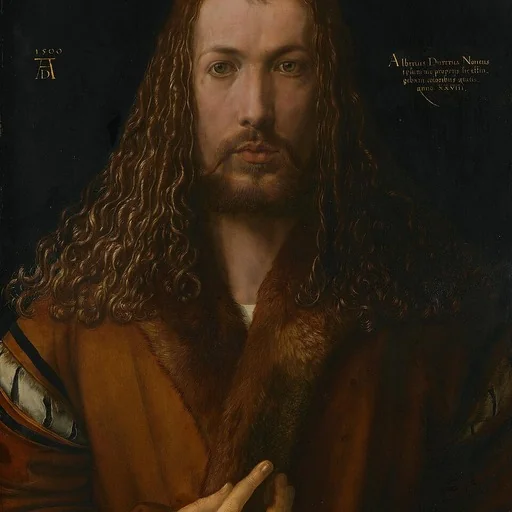
Albrecht Dürer spent his life in Nuremberg, a busy German city where artists traded prints like currency.

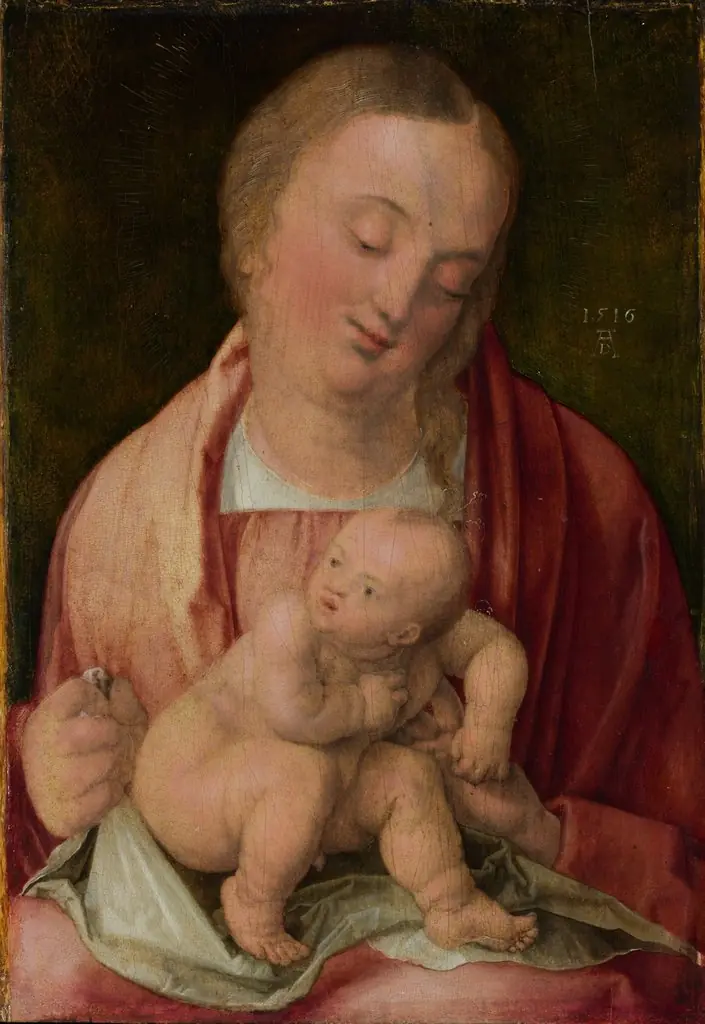
![Madonna and Child [obverse], by Albrecht Dürer](https://artifactworldgallery.com/img/albrecht-durer--madonna-and-child-obverse--d7b8ebf05d22ebe5-w320.webp)
![Lot and His Daughters [reverse], by Albrecht Dürer](https://artifactworldgallery.com/img/albrecht-durer--lot-and-his-daughters-reverse--b4ebf9b282faa17a-w320.webp)