Artwork
Madonna and Child [obverse]
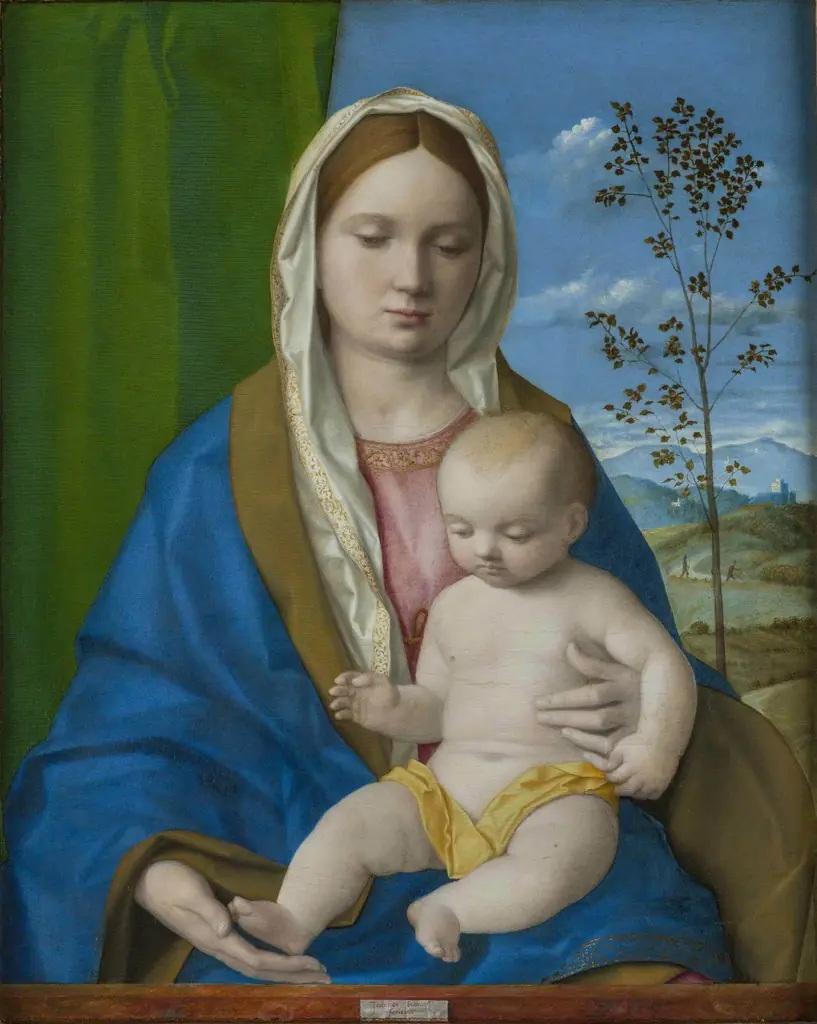
![Madonna and Child [obverse], by Albrecht Dürer, oil, 1498](https://artifactworldgallery.com/img/albrecht-durer--madonna-and-child-obverse--d7b8ebf05d22ebe5-w1024.webp)
Madonna and Child [obverse] is an oil painting by the Northern Renaissance artist Albrecht Dürer. It dates from 1498 and is held in the collection of the National Gallery of Art.
- Inscription
- Inscribed:lower left coat-of-arms: (Gules, a chapé emanating from the dexter flank argent, charged with a dexter gyron sable); crest: (out of a wreath of the liveries the torso of an armless Moorish woman proper, habited gules, crined and braided sable, earringed Or, wearing a "flying head band" (fliegende Binde) twisted gules and argent); mantling: (gules, lined argent); lower right coat-of-arms: (rendered heraldically indescribable by later additions)
About this work
Subject & Meaning
The red cushion and tassels allude to Christ's Passion, while Mary's serious, distant gaze suggests her foreknowledge of his fate.
The obverse depicts the Virgin Mary and the Christ Child in a domestic interior, with a window opening onto a distant landscape. The child, standing on a cushion, holds a fruit, a symbol of Original Sin and the future Redemption. The red cushion and tassels allude to Christ's Passion, while Mary's serious, distant gaze suggests her foreknowledge of his fate.
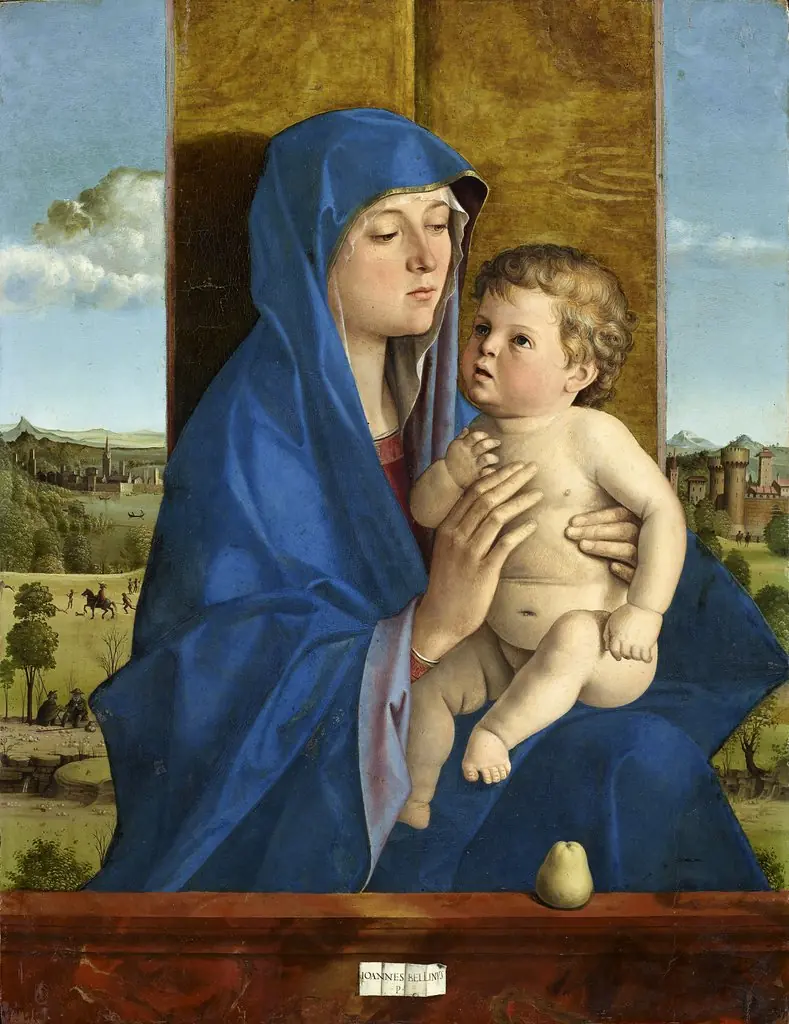
Coats of arms in the lower corners identify the donors as Wolf Haller and Ursula Koberger, indicating the panel was likely a private devotional image commissioned for the couple's personal worship. The composition recalls Venetian models, particularly Giovanni Bellini, which Dürer encountered during his first Venetian journey.
Technique & Style
The obverse is an oil painting on a panel of four boards with vertical grain. Underdrawing, likely in iron gall ink, appears in the child's body and the Madonna's face; pentimenti include the child's left foot and the lower-right coat of arms. The panel is generally well preserved but shows cracks, craquelure, and minor retouches, including later ultramarine blue (produced after 1828).
Stylistically, Dürer employs meticulous fine painting, modeling the Madonna's volumetric form in a blue mantle that enhances plasticity. The child stands on a red cushion holding a fruit, a symbol of Original Sin, while the red padding and tassels allude to Christ's Passion. The composition, with a window opening onto a distant landscape, echoes Giovanni Bellini's Venetian schemas, which Dürer saw during his first Venice sojourn. The balanced arrangement and attention to marble veining further reveal Italianate influence.
History & Provenance
The painting likely originated as a private devotional commission for Wolf III Haller and his wife Ursula Koberger, as indicated by the Haller and Koberger coats of arms in the lower corners. Anton Koberger, Dürer's godfather, may have commissioned it as a wedding gift. The dating is debated: proposals range from 1495 to 1505, but scholarly consensus places it between 1496 and 1499, influenced by Dürer's exposure to Giovanni Bellini during his first Venetian sojourn.
The work first surfaced in 1932 when it was sold at Christie's, London, as a Bellini. After cleaning revealed the reverse panel, it was reattributed to Dürer and acquired by Baron Heinrich Thyssen-Bornemisza by 1934. In 1950, the Samuel H. Kress Foundation purchased it, gifting it to the National Gallery of Art, Washington, in 1952 by exchange. Earlier provenance may include the Haller family, Paul von Praun, and Charles à Court Repington.
The painting is held at the National Gallery of Art, Washington, D.C., as part of the Samuel H. Kress Collection. It entered the museum's collection in 1952 through an exchange from the Samuel H. Kress Foundation. Before its acquisition by the NGA, the work was in the collection of Baron Heinrich Thyssen-Bornemisza at Villa Favorita, Lugano, where it was exhibited from 1934 and known as the 'Madonna Thyssen.'
Context
This painting, initially attributed to Giovanni Bellini when it appeared at auction in 1932, was recognized as a secure work of Albrecht Dürer by Max J. Friedländer in 1934. Scholarly dating has ranged from 1495 to 1505; proposed dates include 1498–1502 (Friedländer), 1497–1499 (Panofsky), and ca. 1496–1498 (Tietzes, Anzelewsky, Stechow). The work exemplifies Dürer's engagement with Venetian models after his first trip to Venice (1494–1495) while retaining Northern stylistic traits such as the child's contorted pose and the detailed landscape.
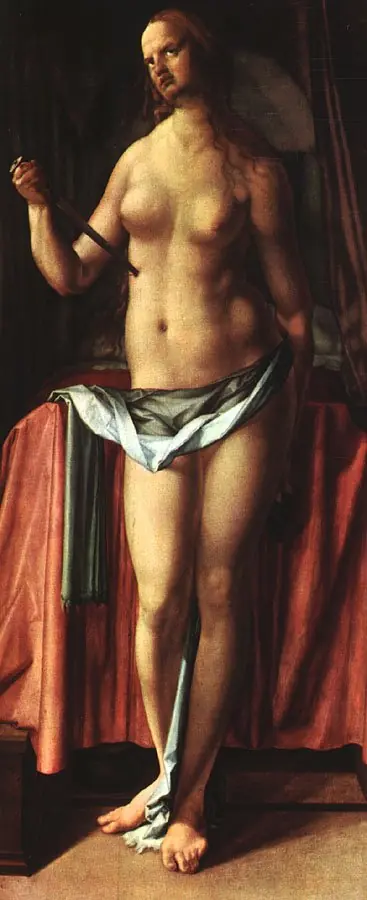
It is one of Dürer's few double-sided panels, and the unique pairing of a Madonna and Child with Lot and His Daughters has prompted varied iconographic interpretations. The identification of the Haller and Koberger coats of arms established the likely patrons, linking the work to Dürer's Nuremberg milieu.
Legacy
The painting's legacy was shaped by its rediscovery and reattribution. When it appeared on the art market in 1932, it was initially attributed to Giovanni Bellini, until Max J. Friedländer confirmed it as a work by Albrecht Dürer in 1934, establishing its place in the artist's canon. Thereafter known as the 'Madonna Thyssen,' it was held in the Thyssen-Bornemisza collection before entering the Kress Collection and finally the National Gallery of Art in Washington, D.C., where it remains a highlight of the early German Renaissance holdings.
Scholars consider it one of the best-preserved works from Dürer's early period, and its unusual double-sided composition, with Lot and His Daughters on the reverse, has generated ongoing iconographic discussion.
Overview
Albrecht Dürer's Madonna and Child, an oil on panel painting from 1496-1499, is housed in the National Gallery of Art, Washington, DC. This devotional work, also known as the Haller Madonna, presents a tender depiction of the Virgin and Christ Child. Uniquely, its reverse side features another complete painting by Dürer, Lot and His Daughters, making it a significant example of the artist's early Renaissance output and versatility.
Own this work as a print
Artist & collection
Artist
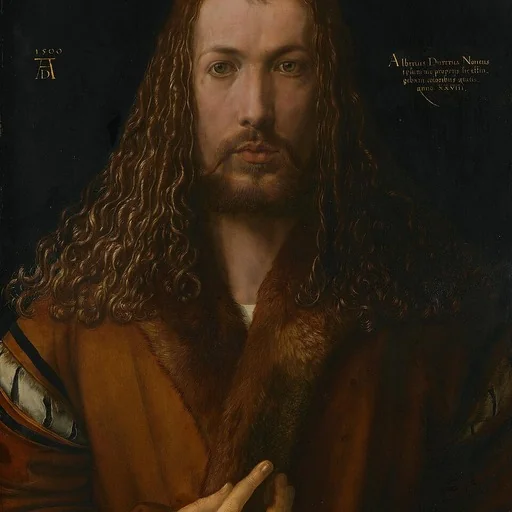
Albrecht Dürer spent his life in Nuremberg, a busy German city where artists traded prints like currency.

![Lot and His Daughters [reverse], by Albrecht Dürer](https://artifactworldgallery.com/img/albrecht-durer--lot-and-his-daughters-reverse--b4ebf9b282faa17a-w320.webp)