Artwork
Christ on the Cross Between the Virgin and Saint John
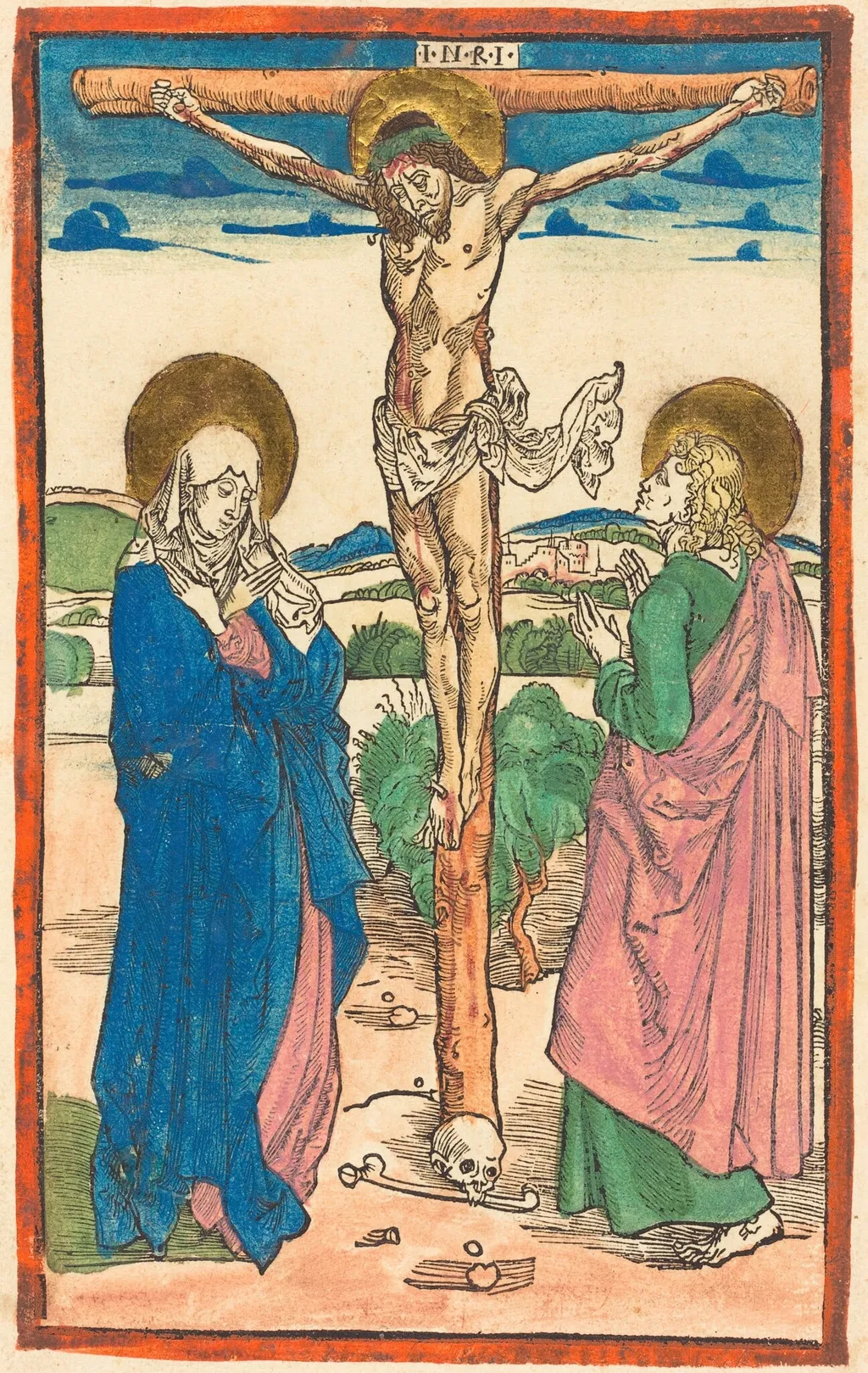
Christ on the Cross Between the Virgin and Saint John is an ink print by the Northern Renaissance artist Albrecht Dürer. It dates from 1493 and is held in the collection of the Rosenwald Collection.
- Inscription
- Inscribed:verso, bottom right, in graphite by a later hand: 15641
About this work
Dürer added watercolor and gold leaf to make it feel special, like a painting.
This woodcut shows Jesus on a cross. His arms are outstretched. Below him stand Mary and John the Apostle, their faces looking up. The background is dark with gold leaf details around the cross.
Hand-colored prints like this were rare in 1493. Most woodcuts stayed black and white. Dürer added watercolor and gold leaf to make it feel special, like a painting.
Check out how gold glows in watercolor. See it in person at the National Gallery of Art, Washington.
Subject & Meaning
Albrecht Dürer's 1493 woodcut depicts the traditional crucifixion group, featuring Jesus Christ on the cross flanked by the Virgin Mary and John the Apostle. Based on the New Testament narrative, the composition centers on the suffering of Christ as the primary subject. The inclusion of Mary and John adheres to established Christian iconography, representing the grieving mother and the beloved disciple standing at the foot of the cross.
This arrangement emphasizes the theological significance of the Passion, focusing on the moment of sacrifice and the immediate human response of sorrow and witness. The work serves as a devotional image, likely intended for private meditation within the context of the Opus speciale missarium.
Technique & Style
Executed in 1493, this work is a woodcut printed with ink on laid paper. The impression features extensive hand-coloring applied using watercolor and gouache, with gold leaf added for decorative emphasis. Stylistically, the composition adheres to German Renaissance conventions, depicting a crucifixion group that includes Jesus Christ flanked by the Virgin Mary and John the Apostle.
The image measures 21.9 cm in height and 13.8 cm in width. As a print derived from the "Opus speciale missarium," it demonstrates the artist's engagement with religious graphic arts during this period.
History & Provenance
Albrecht Dürer created the woodcut Christ on the Cross Between the Virgin and Saint John in 1493. The work entered the collection of Martin Aufhäuser in Munich, Holland, and later Los Angeles before being acquired by Lessing J. Rosenwald in Jenkintown, Pennsylvania, on 19 August 1939. Rosenwald subsequently gifted the print to the National Gallery of Art in Washington, D.C., in 1943.
The hand-colored woodcut is held by the National Gallery of Art in Washington, D.C. It entered the collection in 1943 as a gift from Lessing J. Rosenwald of Jenkintown, Pennsylvania, who had purchased it on 19 August 1939 (recorded under Rosenwald references L1760c and L1932d). Its earlier provenance traces to Martin Aufhäuser (1875–1944), whose collection was dispersed through Munich, Holland, and Los Angeles.
Documentation of the work's provenance draws on the Gallery Archives' Rosenwald Papers (Box 9), Lessing J. Rosenwald's Recollections of a Collector (Jenkintown, 1976), and Richard S. Field's Fifteenth Century Woodcuts and Metalcuts (Washington, D.C., 1965). While the National Gallery of Art is the holding institution for this impression, impressions of the same woodcut are also recorded at the Metropolitan Museum of Art, the British Museum, and the Kupferstichkabinett Berlin.
Context
Albrecht Dürer's 1493 woodcut Christ on the Cross Between the Virgin and Saint John is a significant work within the German Renaissance, illustrating the artist's early mastery of printmaking. Created as part of the Opus speciale missarium, the piece depicts the crucifixion group drawn from the New Testament, featuring Jesus Christ flanked by Mary and John the Apostle. The work's survival in major public collections, including the Metropolitan Museum of Art, the British Museum, and the Kupferstichkabinett Berlin, underscores its historical importance and enduring scholarly interest.
Its presence in the Rosenwald Collection at the National Gallery of Art further highlights its status as a key example of Dürer's graphic output from the late fifteenth century.
Legacy
The print has shaped scholarly discourse on early German Renaissance art and reinforced Dürer's reputation as a master of printmaking, cited in studies of religious imagery and print history. Its inclusion in major museum collections, such as the Metropolitan Museum of Art and the National Gallery of Art, has contributed to its recognition as a key example of the period, influencing exhibitions and academic curricula. The work's technical innovation in woodcut technique and its narrative composition have been frequently referenced in art historical literature, cementing its status as a landmark piece in the development of Northern Renaissance art.
Overview
Albrecht Dürer’s 1493 woodcut presents the crucifixion scene with Christ on the cross flanked by the Virgin Mary and Saint John. The composition centers on the cross, its darkened backdrop accentuated by applied gold leaf, while the figures below gaze upward, creating a solemn, vertical arrangement that emphasizes the central theological event.
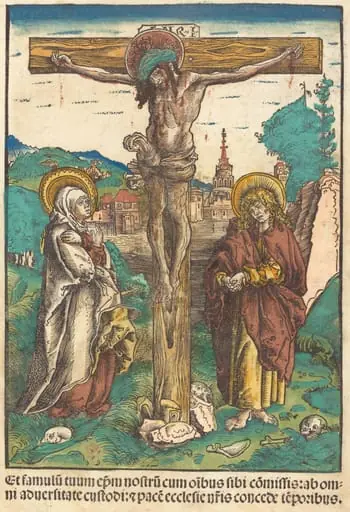
Own this work as a print
Artist & collection
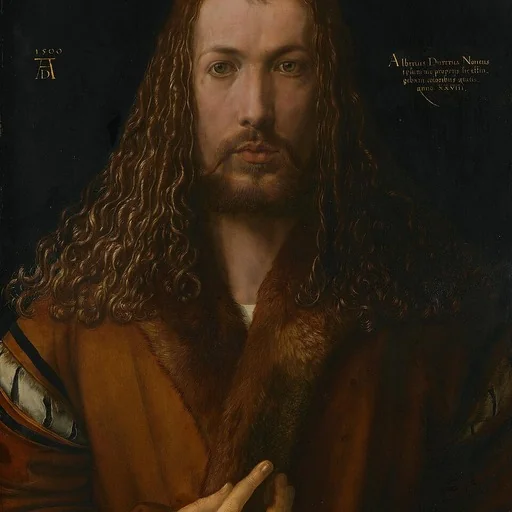
Artist
Albrecht Dürer spent his life in Nuremberg, a busy German city where artists traded prints like currency.
![Madonna and Child [obverse], by Albrecht Dürer](https://artifactworldgallery.com/img/albrecht-durer--madonna-and-child-obverse--d7b8ebf05d22ebe5-w320.webp)
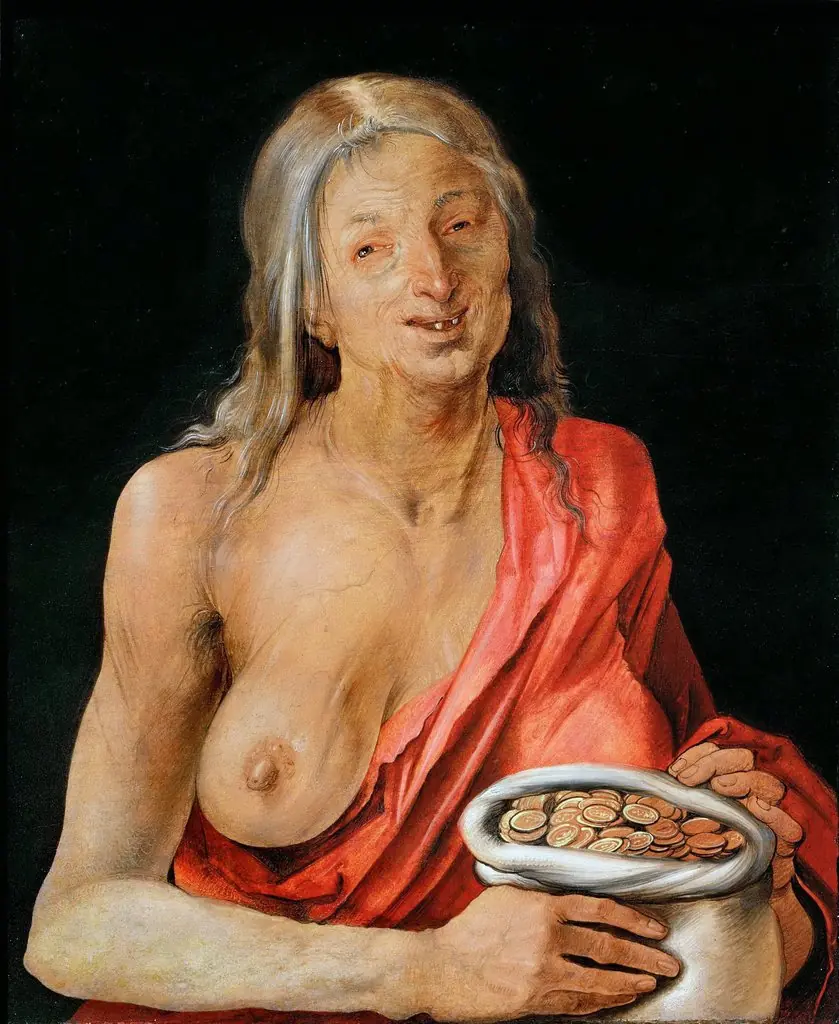
![Lot and His Daughters [reverse], by Albrecht Dürer](https://artifactworldgallery.com/img/albrecht-durer--lot-and-his-daughters-reverse--b4ebf9b282faa17a-w320.webp)
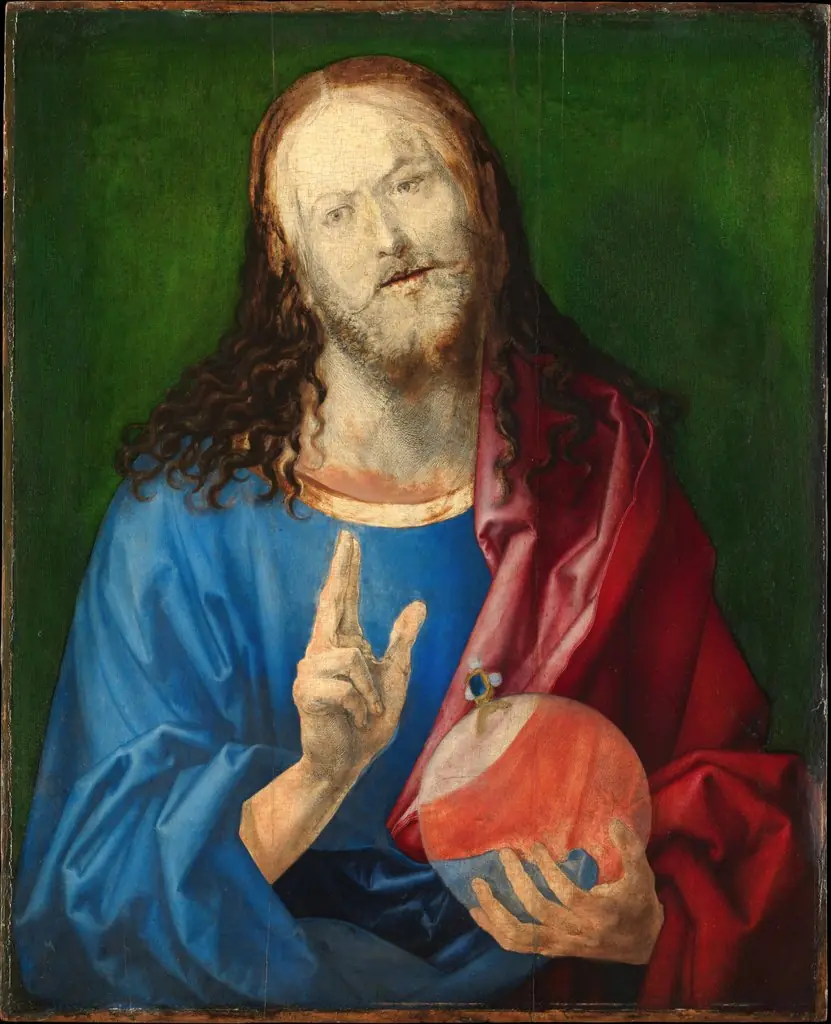
- Christ on the Cross Between the Virgin and Saint John
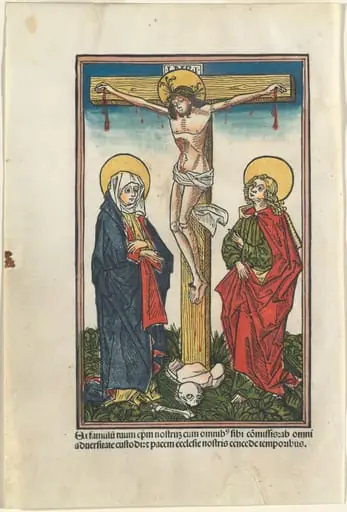 Christ on the Cross with the Virgin and Saint John
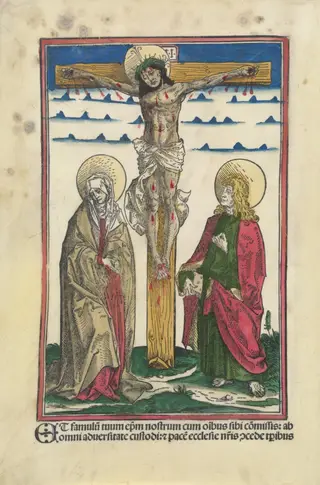 Christ on the Cross with the Virgin and Saint John
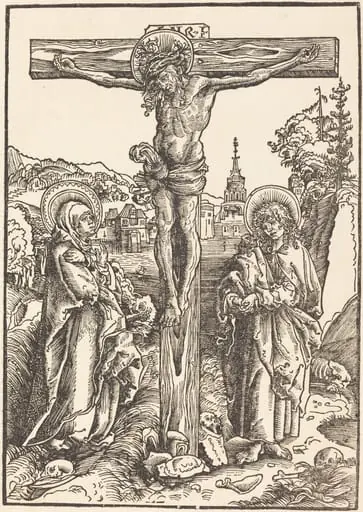 Christ on the Cross Between the Virgin and Saint John
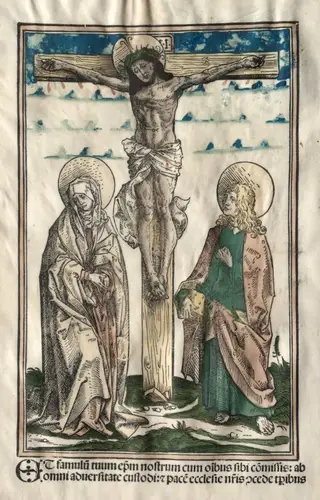 Christ on the Cross between Mary and John
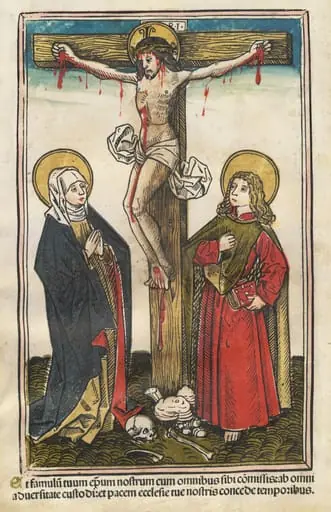 Christ on the Cross with the Virgin and Saint John
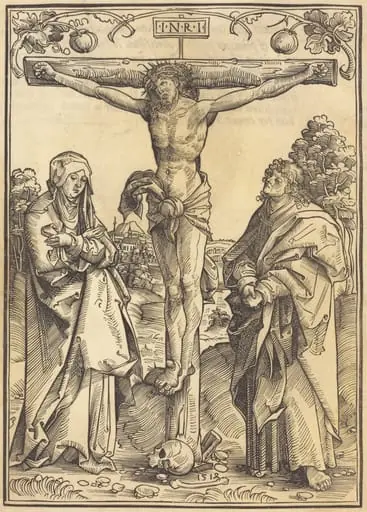 Christ on the Cross with the Virgin and Saint John the Evangelist
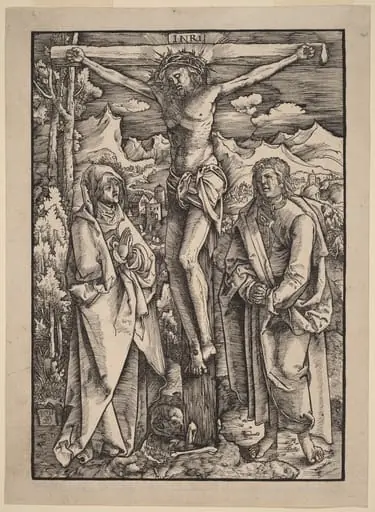 Christ on the Cross between the Virgin and Saint John