Artwork
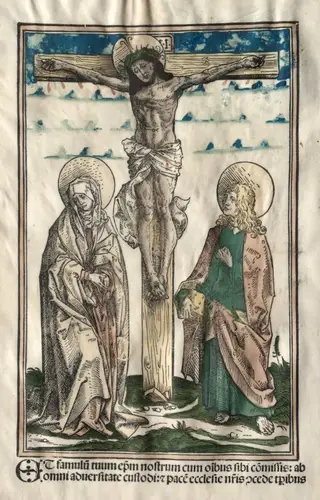
Christ on the Cross with Mary and Saint John
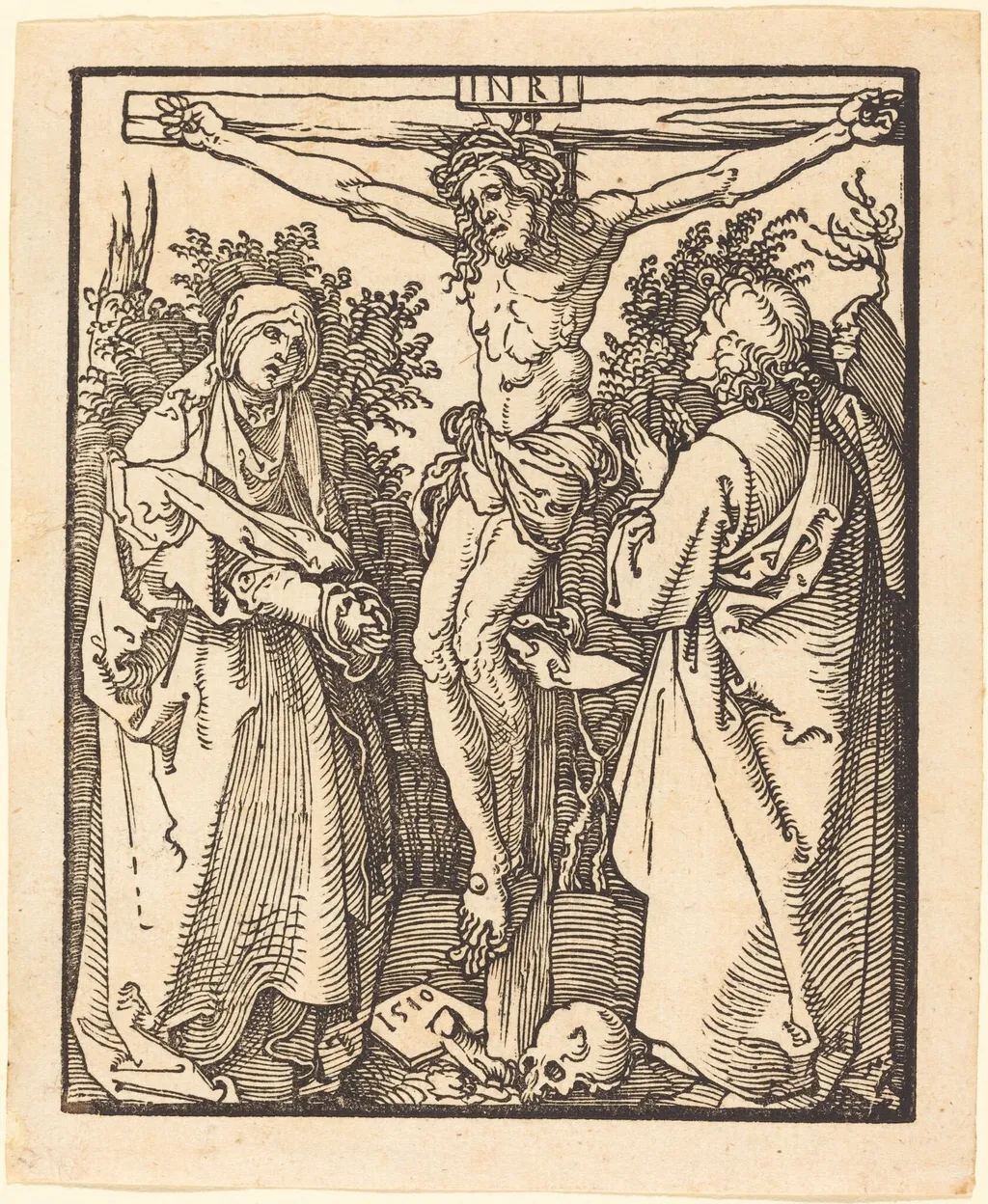
Christ on the Cross with Mary and Saint John is an ink print by the Northern Renaissance artist Albrecht Dürer. It dates from 1510 and is held in the collection of the National Gallery of Art.
- Inscription
- Inscribed:in block, bottom center, on tablet at foot of cross: 1510; verso, top left, in red color pencil by a later hand: 211; verso, lower center, in graphite by a later hand: CD 97a; verso, lower left, in graphite by a later hand: C. 185[2?]3; verso, lower left, in graphite by a later hand: 26 [?]; verso, lower left, in graphite by a later hand: 3; verso, lower right, in graphite by a later hand: 65; verso, bottom center, in graphite by a later hand: B 55
About this work
Subject & Meaning
The composition reflects the German Renaissance emphasis on narrative clarity and emotional restraint in religious scenes.
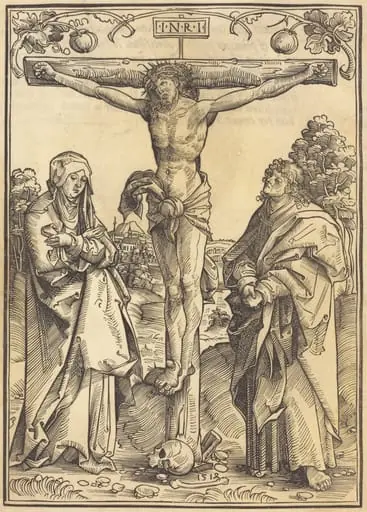
The print shows the crucifixion of Jesus with Mary and John the Baptist standing at the foot of the cross. The composition reflects the German Renaissance emphasis on narrative clarity and emotional restraint in religious scenes. Dürer drew on New Testament accounts to depict the moment of Christ's death, using the woodcut medium to convey both spiritual gravity and precise visual detail.
The work belongs to the Rosenwald Collection and is held by the National Gallery of Art in Washington, D.C.
Technique & Style
Christ on the Cross with Mary and Saint John is a woodcut printed on laid paper, executed in 1510 as part of Albrecht Dürer's religious printmaking output associated with the German Renaissance. The support is laid paper, and the image is classified as a print rather than a painting or drawing, reflecting Dürer's command of relief printmaking on a small scale, with the sheet measuring roughly 12 by 9.7 centimeters.
The composition centers on the crucifixion of Jesus, flanked by Mary and John the Baptist, and is rendered with the dense linear hatching and tightly modeled contours characteristic of Dürer's mature woodcut style. The work is held in the Rosenwald Collection at the National Gallery of Art in Washington, D.C., where it has been preserved as part of a distinguished group of prints.
History & Provenance
Albrecht Dürer created this woodcut on laid paper in 1510. The work depicts the crucifixion of Jesus, flanked by Mary and John the Baptist.
The print entered the collection of Lessing J. Rosenwald in Jenkintown, Pennsylvania, in 1929. Rosenwald subsequently donated the artwork to the National Gallery of Art in Washington, D.C., in 1943, where it remains part of the Rosenwald Collection.
The woodcut is held by the National Gallery of Art in Washington, D.C., as part of the Prints in the National Gallery of Art and the Rosenwald Collection. It entered the collection in 1929 when it was purchased by Lessing J. Rosenwald of Jenkintown, Pennsylvania, whose collector's marks Lugt 1760b and Lugt 1932d are recorded on the impression. Rosenwald subsequently gave the print to the National Gallery of Art in 1943, establishing its current institutional ownership.
Legacy
The print established Dürer's mastery of religious imagery within the German Renaissance, influencing subsequent printmakers through its emotive composition and technical precision. Its acquisition by Rosenwald and subsequent donation to the National Gallery of Art cemented its role in preserving the artist's legacy within American museum collections, while its frequent scholarly reference has reinforced scholarly appreciation of Northern European devotional printmaking.
Overview
Albrecht Dürer’s 1510 woodcut presents the crucifixion scene with the central figure of Christ on the cross flanked by two mournful companions. The composition is rendered in stark black lines on laid paper, emphasizing the solemnity of the moment through a limited visual vocabulary and strong tonal contrasts.
Context
The piece belongs to a wave of religious imagery produced in the wake of the Reformation, when printed media became a primary vehicle for disseminating biblical narratives. Dürer’s mastery of woodcut technique positioned him among the leading artists who merged fine art sensibilities with the reproducibility of prints.
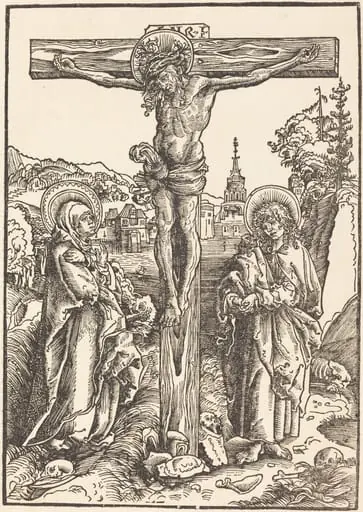
Own this work as a print
Artist & collection
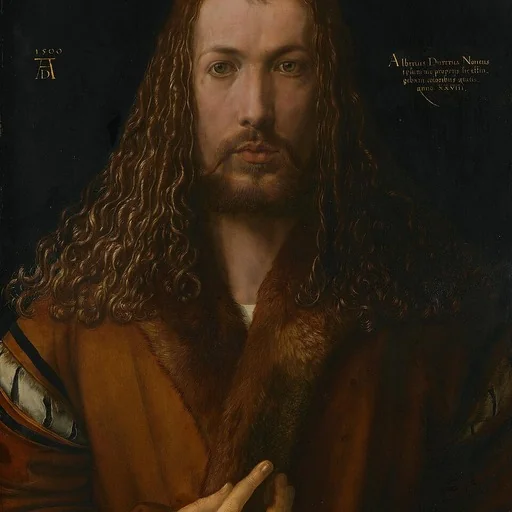
Artist
Albrecht Dürer spent his life in Nuremberg, a busy German city where artists traded prints like currency.

![Madonna and Child [obverse], by Albrecht Dürer](https://artifactworldgallery.com/img/albrecht-durer--madonna-and-child-obverse--d7b8ebf05d22ebe5-w320.webp)
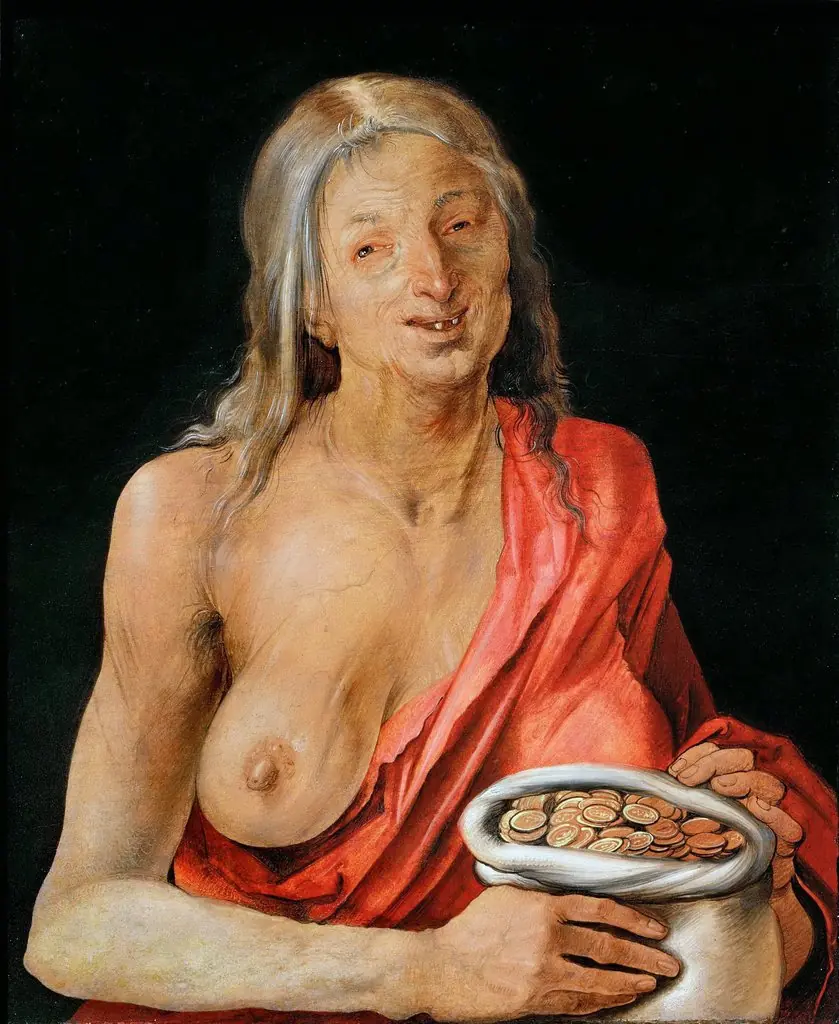
![Lot and His Daughters [reverse], by Albrecht Dürer](https://artifactworldgallery.com/img/albrecht-durer--lot-and-his-daughters-reverse--b4ebf9b282faa17a-w320.webp)
- Christ on the Cross Between the Virgin and Saint John
 Christ on the Cross with the Virgin and Saint John the Evangelist
 Christ on the Cross with the Virgin and Saint John
 Christ on the Cross with Mary, St. John, Mary Magdalen and St. Stephen
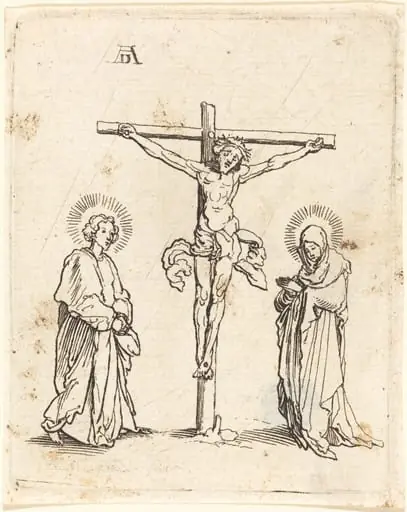 Christ on the Cross Between Saint John and Mary
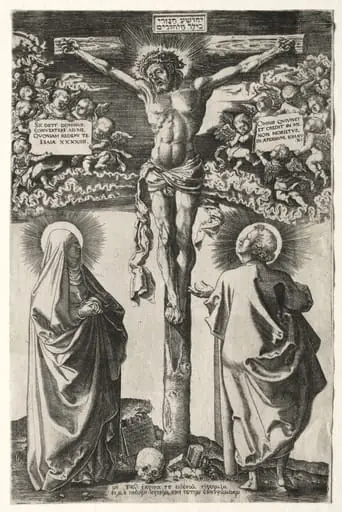 Christ on the cross between the virgin and St. John
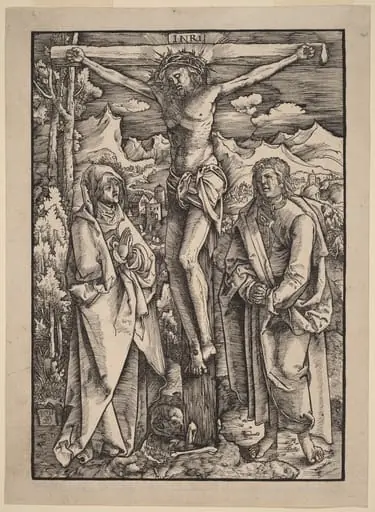 Christ on the Cross between the Virgin and Saint John
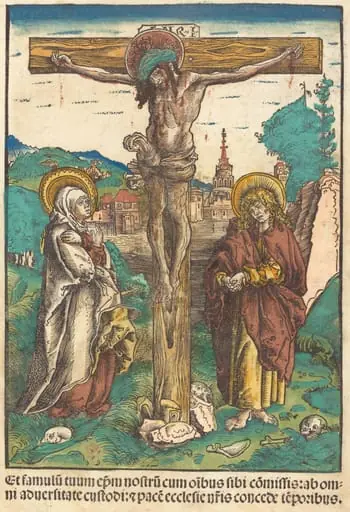 Christ on the Cross Between the Virgin and Saint John
 Christ on the Cross between Mary and John