Artwork
Knight, Death and Devil
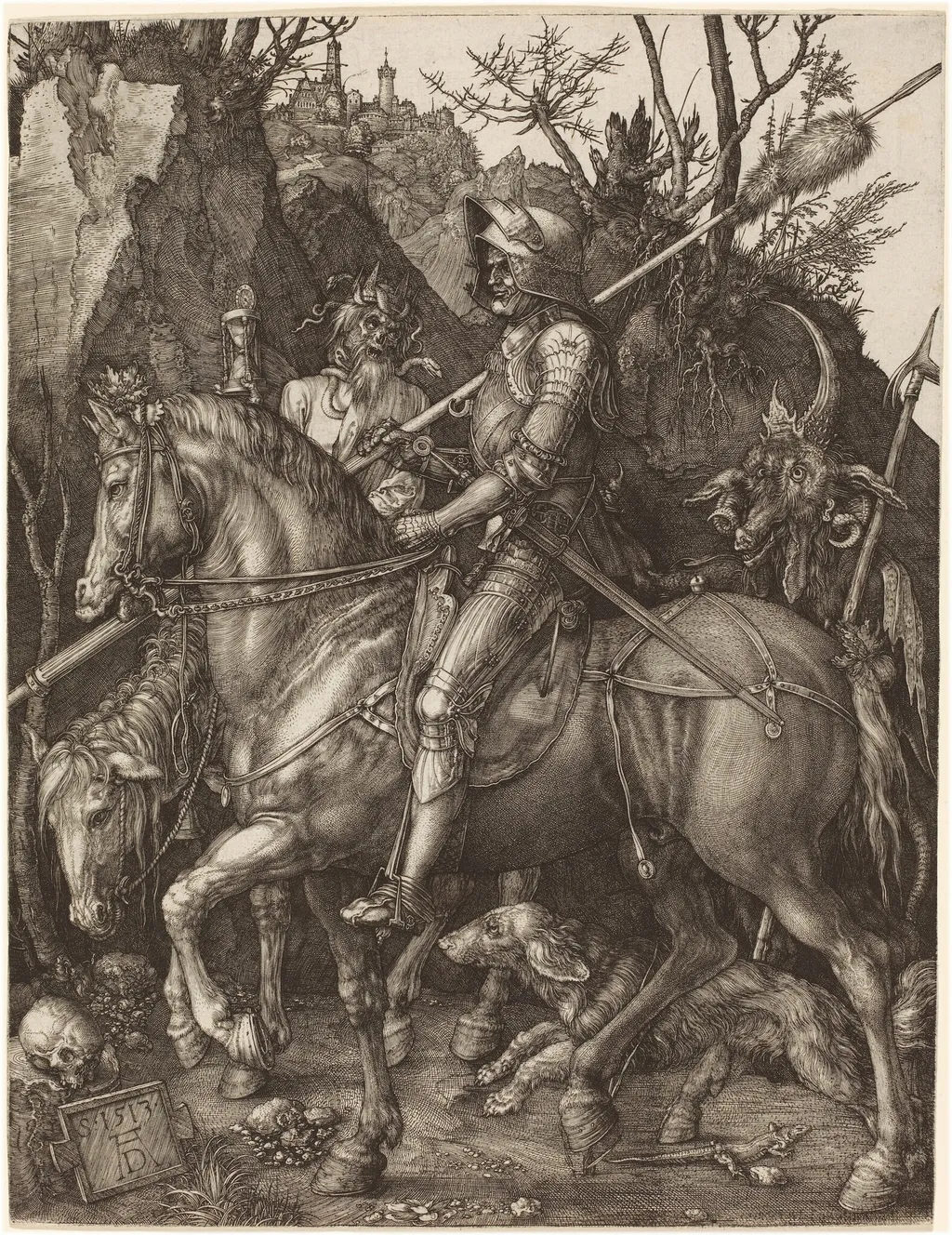
Knight, Death and Devil is an ink print by the Northern Renaissance artist Albrecht Dürer. It dates from 1513 and is held in the collection of the British Museum.
- Inscription
- Inscribed:in plate, bottom left on tablet: S 1513 / AD [artist's monogram]; verso, lower left, in graphite by a later hand: [illegible] Brooks [?] Coll [?]; verso, bottom left, in graphite by a later hand: B-20 [upside down]
About this work
Technique & Style
Knight, Death and Devil is an engraving executed by Albrecht Dürer in 1513 on laid paper using a copper plate, measuring 24.
Knight, Death and Devil is an engraving executed by Albrecht Dürer in 1513 on laid paper using a copper plate, measuring 24.8 × 19 cm. The composition centers on a fully armored knight on horseback who rides resolutely forward through a narrow gorge, flanked by allegorical figures: a goat-headed devil and Death, the latter riding a gaunt horse and holding an hourglass. The print’s handling is characterized by fine, precise burin work that renders the knight’s armor, the horse’s anatomically modeled body, and the surrounding thickets of gnarled branches and roots with equal descriptive clarity. Formally, the image blends Gothic stylistic traits with Renaissance proportional rigor; interlocking curvilinear contours define the horse’s outline, while the knight’s chin visually merges into the line of his helmet.
The knight’s steadfast gaze forward contrasts with the shadowy, attenuated figures of Death and the Devil, whose attenuated forms dissolve into the dark background. A skull lies in the lower foreground, underscoring the memento mori theme.
History & Provenance
Created in 1513 in Nuremberg, Knight, Death and the Devil is a copper engraving on laid paper by Albrecht Dürer. The work was not a specific commission but was produced while Dürer served Emperor Maximilian I, during a period when the artist largely ceased painting to focus on engravings. The piece is dated and signed by the artist on a tablet inscribed with "S. 1513," marking it as one of his three master prints.
Known provenance includes the collection of Yorck von Wartenburg in Klein Öls, Silesia, followed by W.G. Russell Allen. A specific impression was gifted to the National Gallery of Art in Washington, D.C., in 1941 as part of the Rosenwald Collection. The work measures 24.8 cm in height and 19 cm in width.
The work is held in several major institutions including the National Gallery of Art in Washington, D.C., the Staatliche Kunsthalle Karlsruhe, the Cleveland Museum of Art, the Israel Museum, the Museum Boijmans Van Beuningen, and the Bamberg State Library. Its provenance traces from Yorck von Wartenburg [1805-1865] in Klein Öls, Silesia (Lugt 2669), to W.G. Russell Allen [1882-1955], and finally to a gift to the NGA in 1941. The engraving measures 24.8 cm in height and 19 cm in width, was made in Nuremberg in 1513 on laid paper using copper engraving, and is cataloged under inventory numbers associated with these collections.
Exhibition history includes its inclusion in the National Gallery of Art's holdings and its appearance in exhibitions such as "Déjà-vu? – Die Kunst der Wiederholung von Dürer bis YouTube" at the Karlsruhe institution, which contextualized the work within broader discourses on copying and artistic influence.
Context
Albrecht Dürer's Knight, Death and Devil (1513) is a large copper engraving created during a period when the artist largely abandoned painting and woodcut to focus on printmaking. It belongs to his series of Meisterstiche, alongside Melencolia I and St. Jerome in His Study, and exemplifies the German Renaissance's engagement with allegory and humanist thought. The composition depicts a heavily armored knight on horseback, accompanied by a dog, traversing a narrow gorge flanked by a goat-headed devil and the skeletal figure of Death riding a pale horse.
The work is rich with symbolic elements: the dog signifies fidelity (fides), the hourglass held by Death represents transience, and the oak leaves and armor symbolize steadfast faith. Interpretations of its meaning have long centered on Christian resilience, with scholars linking it to Erasmus's Enchiridion militis Christiani and Psalm 23. Erwin Panofsky noted its likely inspiration in Erasmus's treatise, emphasizing its moral allegory of confronting 'flesh, the Devil, and the world.'
Some 19th- and 20th-century interpretations, including those by Moritz Thausing and Sten Karling, have associated it with temperaments, moral allegory, or even critiques of contemporary social ideals, though later appropriations by Nazi ideology co-opted its imagery for propagandistic purposes. The engraving's complex iconography, blending Gothic stylistic elements with Northern naturalism, continues to invite scholarly debate over its theological, philosophical, and historical dimensions.
Overview
Albrecht Dürer’s 1513 engraving titled Knight, Death and the Devil is a compact yet densely composed work on laid paper. Measuring only a few inches, it presents a solitary armored rider traversing a foreboding forest, flanked by the personifications of Death on a pale horse and a horned devil lurking nearby. The scene is rendered with striking clarity, inviting repeated examination.
Subject & Meaning
The composition juxtaposes a resolute knight with two ominous figures: Death, clutching an hourglass, and a demonic creature bearing horns. The rider’s calm demeanor amid the threatening entourage has prompted centuries of scholarly debate, with interpretations ranging from an allegory of moral steadfastness to a meditation on the inevitability of mortality and the presence of evil.
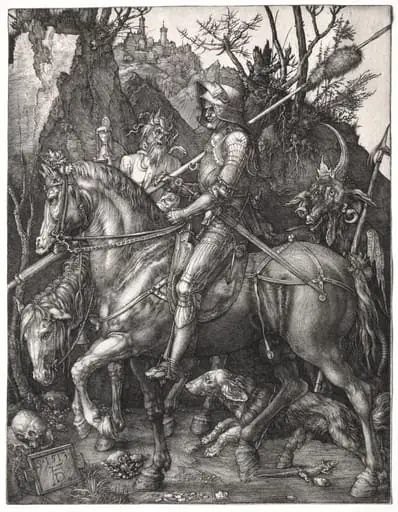
Own this work as a print
Artist & collection
Artist
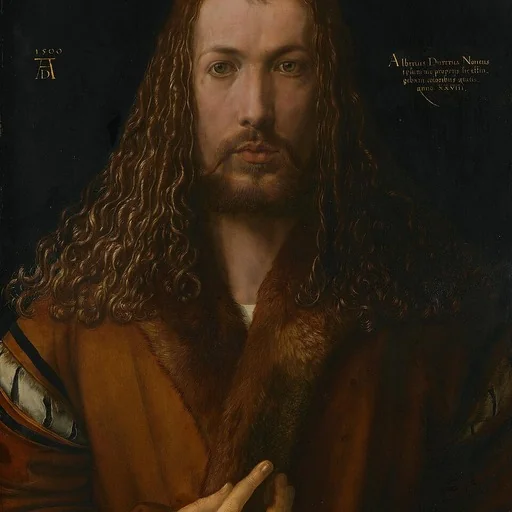
Albrecht Dürer spent his life in Nuremberg, a busy German city where artists traded prints like currency.

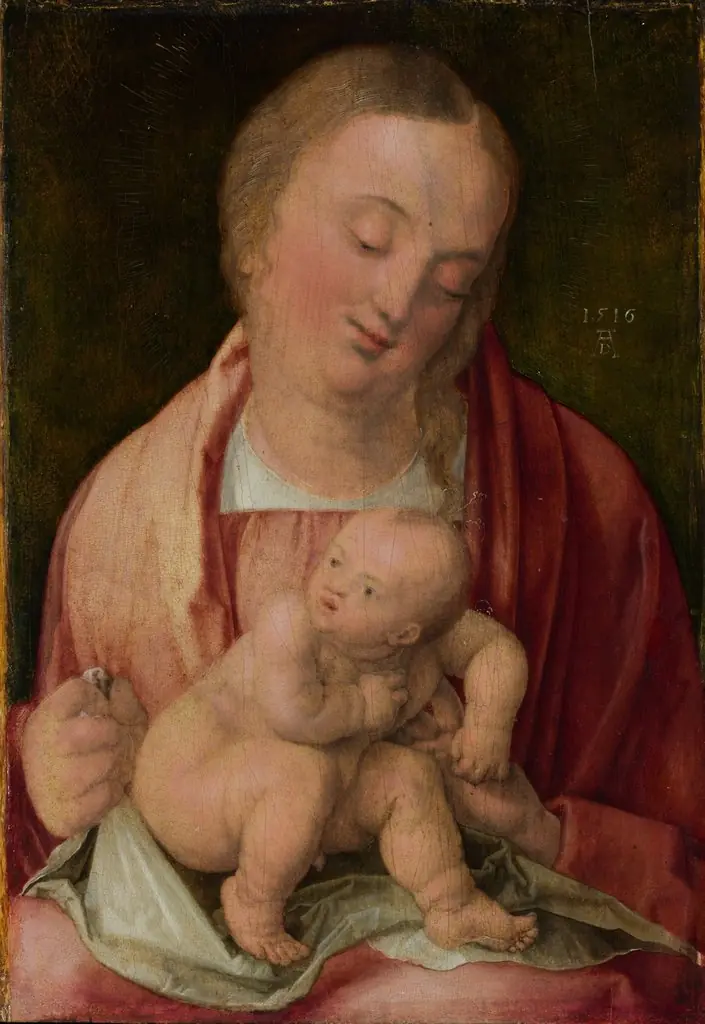
![Madonna and Child [obverse], by Albrecht Dürer](https://artifactworldgallery.com/img/albrecht-durer--madonna-and-child-obverse--d7b8ebf05d22ebe5-w320.webp)
![Lot and His Daughters [reverse], by Albrecht Dürer](https://artifactworldgallery.com/img/albrecht-durer--lot-and-his-daughters-reverse--b4ebf9b282faa17a-w320.webp)