Artwork
Peasant Couple Dancing
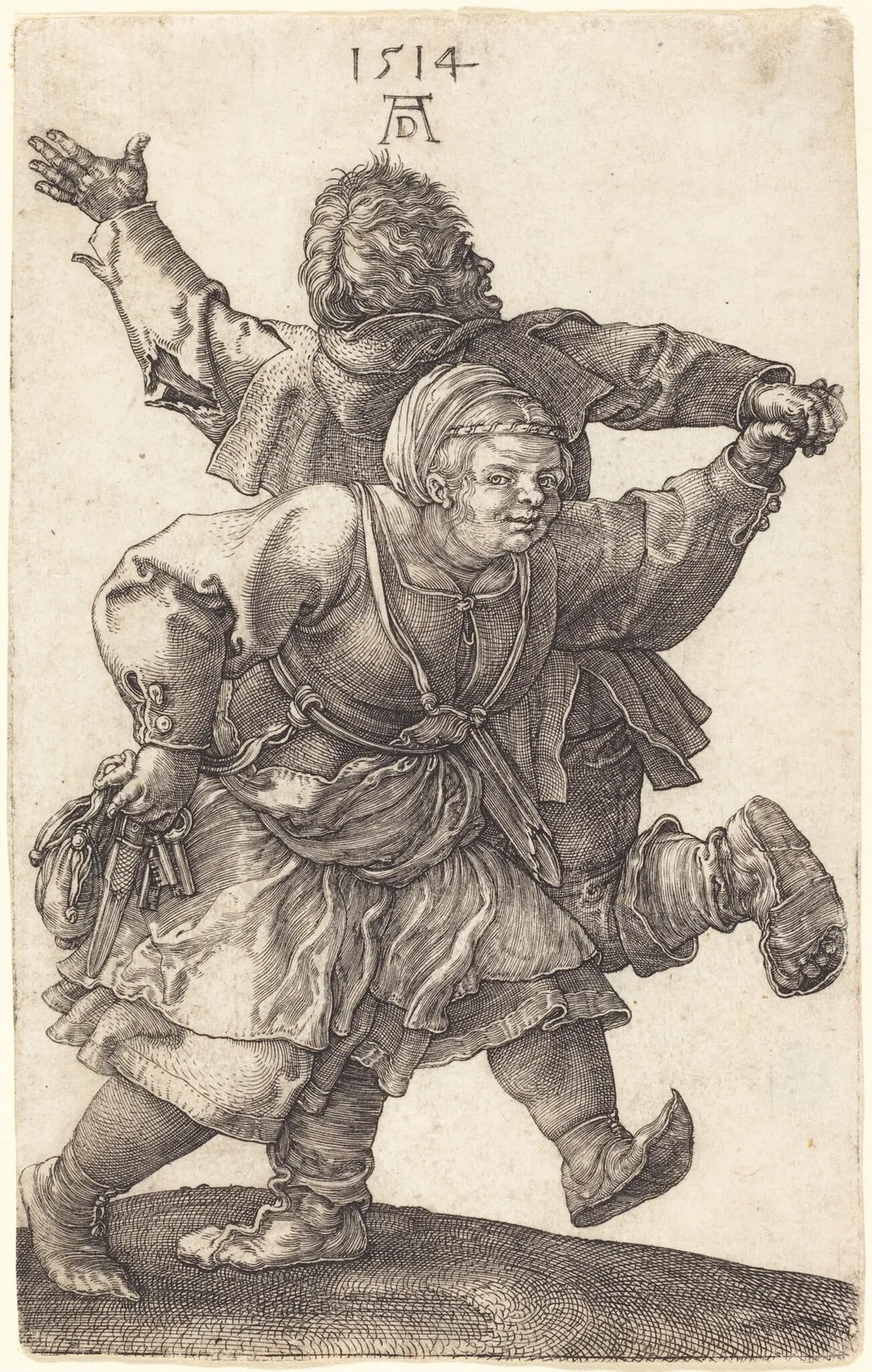
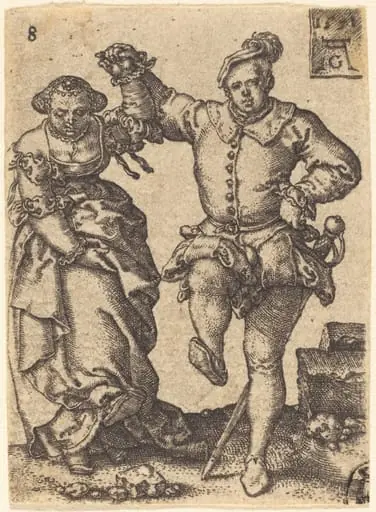
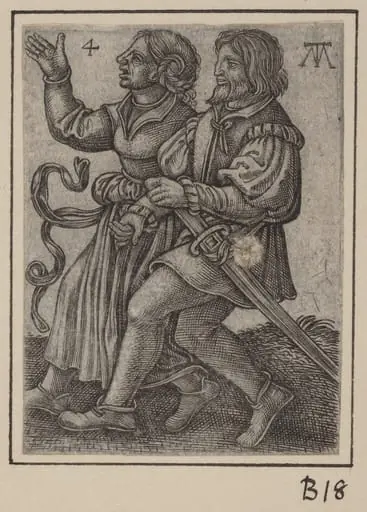
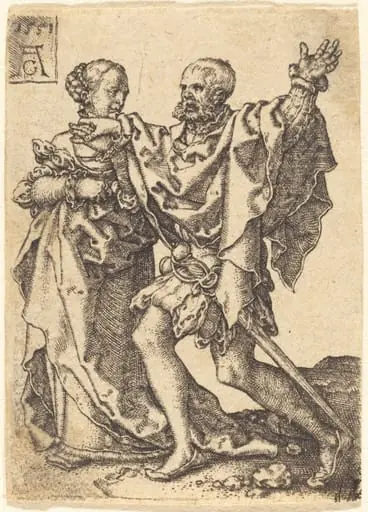
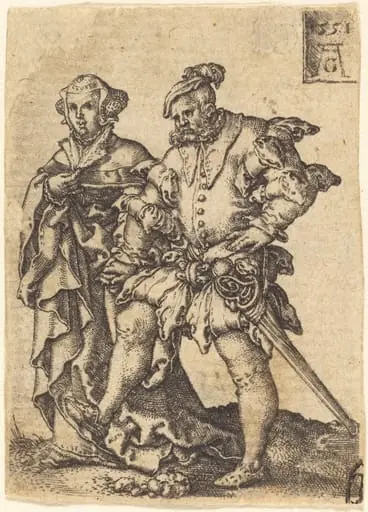
Peasant Couple Dancing is an ink print by the Northern Renaissance artist Albrecht Dürer. It dates from 1514 and is held in the collection of the British Museum.
- Inscription
- Inscribed:in plate, top center: 1514 / AD [artist's monogram]; verso, upper left, in graphite by a later hand: B90; verso, lower left, in graphite by a later hand: M57; verso, lower right, in graphite by a later hand: P2.; verso, lower left, in graphite by a later hand: → [?]; verso, lower left, in graphite by a later hand: B 90.; verso, lower left, in graphite by a later hand: 68; verso, lower right, in graphite by a later hand: S [?] 4. [erased]; verso, lower right, in graphite by a later hand: 33; verso, bottom center, in graphite by a later hand: B-6553 [upside down]
About this work
Subject & Meaning
This depiction aligns with genre scenes that document everyday activities of the period, offering insight into historical attitudes toward agrarian culture.
The engraving shows a man and woman engaged in a lively dance, embodying rustic celebration within the German Renaissance tradition. The figures symbolize communal festivity and the vitality of peasant life, reflecting contemporary interpretations of rural customs. The work's subject captures a moment of joyous movement, emphasizing social interaction among farmers.
This depiction aligns with genre scenes that document everyday activities of the period, offering insight into historical attitudes toward agrarian culture. The composition highlights the couple's dynamic connection through posture and gesture, reinforcing themes of partnership and shared labor. The engraving's creation in Nuremberg (1514) situates it within the artistic milieu of Albrecht Dürer, a central figure of the German Renaissance.
Technique & Style
Peasant Couple Dancing is an engraving printed in ink on laid paper, a printmaking technique that allowed Dürer to render the rustic dancers with finely controlled linework. The sheet measures 11.6 by 7.3 cm, a small, intimate format typical of his engraved genre studies. Stylistically, the work belongs to the German Renaissance, with Dürer applying precise hatching and contour lines to convey the figures' movement, peasant attire, and the rhythmic energy of the dance.
The use of laid paper, a support with visible chain lines, is consistent with early sixteenth-century printmaking practice in Nuremberg, where the work was produced.
History & Provenance
Albrecht Dürer created the engraving Peasant Couple Dancing in 1514 in Nuremberg, working on laid paper with ink. The earliest documented owner in the provenance chain is Marsden Jasael Perry of Providence, Rhode Island, whose collector's mark (Lugt 1880) appears on the sheet. Lessing J. Rosenwald of Jenkintown, Pennsylvania, acquired the print from Perry in 1928, recorded under his marks Lugt 1760b and Lugt 1932d.
Rosenwald subsequently gave the engraving to the National Gallery of Art in 1943, where it entered the museum's collection as part of the Rosenwald gift.
The work is held by the National Gallery of Art in Washington, D.C., where it entered the collection through the Rosenwald gift in 1943. Its inventory number is Lugt 1932d, and it has been part of exhibitions at the National Gallery of Art and the Chester Beatty Library. The print is also documented in the Rosenwald Collection and has been shown at institutions including the Cleveland Museum of Art and the Staatsgalerie Stuttgart.
Overview
Peasant Couple Dancing is an engraving created by Albrecht Dürer in 1514. It is a print on laid paper, made using a metal plate and a sharp tool.
Own this work as a print
Artist & collection
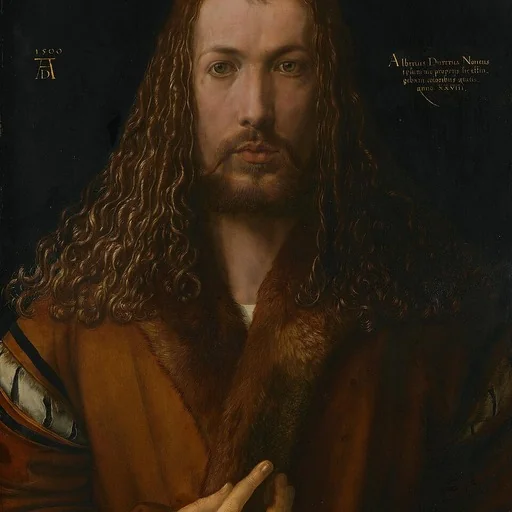
Artist
Albrecht Dürer spent his life in Nuremberg, a busy German city where artists traded prints like currency.

![Madonna and Child [obverse], by Albrecht Dürer](https://artifactworldgallery.com/img/albrecht-durer--madonna-and-child-obverse--d7b8ebf05d22ebe5-w320.webp)
![Lot and His Daughters [reverse], by Albrecht Dürer](https://artifactworldgallery.com/img/albrecht-durer--lot-and-his-daughters-reverse--b4ebf9b282faa17a-w320.webp)