Artwork
Gaspar-François de Fontenay
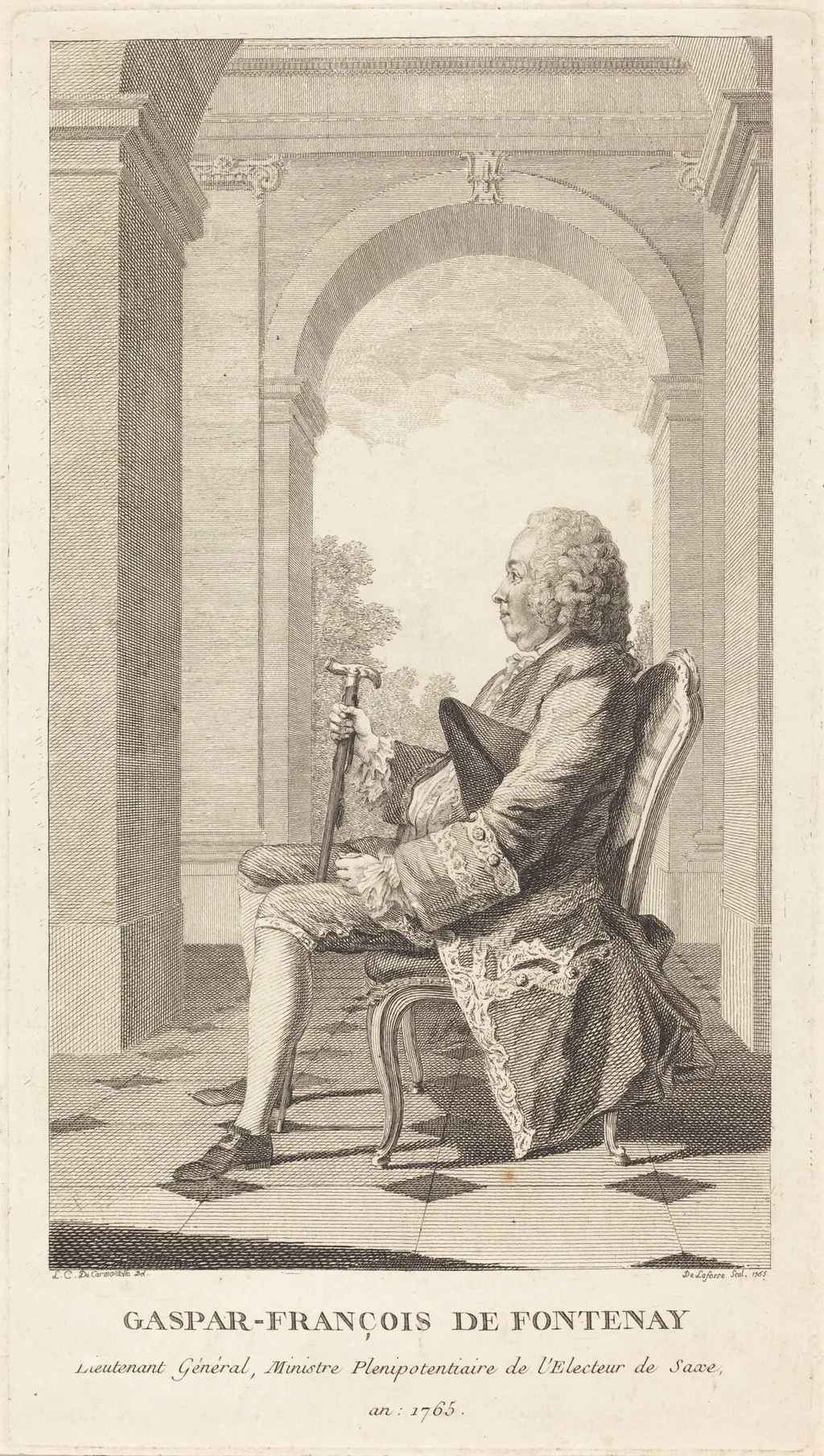
Gaspar-François de Fontenay is an ink print by the Romanticist artist Jean-Baptiste Delafosse. It dates from 1765 and is held in the collection of the National Gallery of Art.
- Inscription
- Inscribed:lower left in plate: L.C. De Carmontelle Del.; lower right in plate: DeLafosse Scul. 1765.; across bottom in plate: GASPAR-FRANÇOIS DE FONTENAY / Lieutenant Général, Ministre Plenipotentaire de l'Electeur de Saxe, / an: 1765.
About this work
The name below reads Gaspar-François de Fontenay, with titles like Lieutenant Général and the year 1765 carved into the print.
This black-and-white engraving shows an older man sitting in a high-backed chair by a window. He holds a walking stick in one hand and rests the other on a small dog curled on his lap. His powdered wig and fancy coat suggest wealth or rank. Outside the window, a tree and distant buildings are faintly sketched.
The name below reads Gaspar-François de Fontenay, with titles like Lieutenant Général and the year 1765 carved into the print. This wasn’t painted, it was etched into metal using fine lines.
Want to see how artists used this technique to create depth? Look up engraving.
Overview
Jean‑Baptiste Delafosse’s 1765 engraving portrays Gaspar‑François de Fontenay, a senior military officer, seated in an elevated chair beside a window. The monochrome image captures the sitter with a walking stick in one hand and a small dog curled on his lap, his attire and powdered wig indicating high social standing.
Subject & Meaning
The composition emphasizes de Fontenay’s authority and leisure, juxtaposing his dignified posture with the domestic presence of the dog. The faint view through the window, showing a tree and distant structures, provides a subtle backdrop that situates the figure within an interior space while alluding to the world beyond.
Technique & Style
Executed as an engraving on laid paper, Delafosse employed fine incised lines on a metal plate to render delicate tonal variations. The use of cross‑hatching creates depth and texture in the clothing, the fur of the dog, and the architectural elements, exemplifying mid‑18th‑century printmaking methods.
History & Provenance
The print bears the sitter’s name, titles such as Lieutenant Général, and the date 1765, indicating it was likely produced contemporaneously as a portrait for personal or official use. Its survival on paper suggests it was part of a limited distribution, perhaps among de Fontenay’s acquaintances or military peers.
Context
During the Enlightenment, engraved portraits served both documentary and decorative purposes, offering a reproducible means of commemorating notable individuals. Delafosse’s work aligns with the period’s emphasis on rational representation and the growing demand for portraiture among the French aristocracy and military elite.
Artist & collection