Artwork
清 丁雲鵬(款) 十八羅漢圖 卷|The Eighteen Luohans
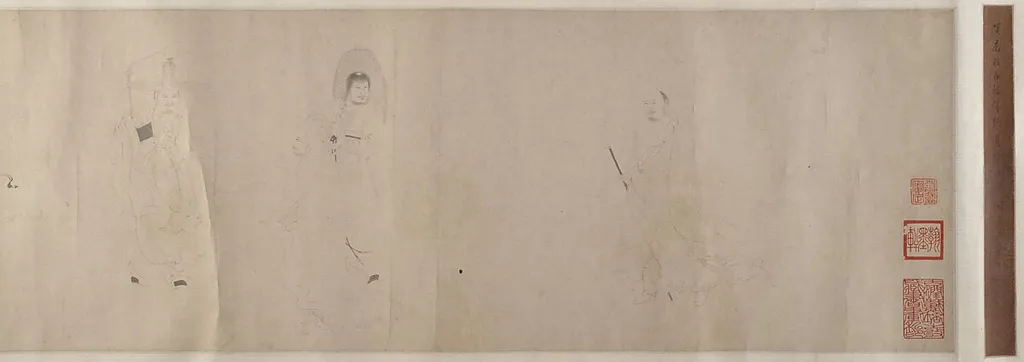
清 丁雲鵬(款) 十八羅漢圖 卷|The Eighteen Luohans is an ink painting by the Chinese Orthodox School artist Ding Yunpeng. It is held in the collection of the Metropolitan Museum of Art. The hand‑scroll presents a procession of eighteen luohans, the enlightened disciples of the Buddha, rendered in monochrome ink on paper.
About this work
Subject & Meaning
The composition emphasizes communal veneration and the transmission of Buddhist doctrine through visual narrative.
The painting, titled "The Eighteen Luohans" by Ding Yunpeng (1849), depicts a group of Buddhist arhats, known as the Eighteen Luohans, rendered in ink on paper as a handscroll.
As a religious work, it conveys the Buddhist ideal of enlightenment and the collective guidance of the Buddha’s disciples, using the traditional iconography of each arhat to symbolize distinct aspects of the path.
The composition emphasizes communal veneration and the transmission of Buddhist doctrine through visual narrative.
Technique & Style
The scroll is executed as a handscroll in ink on paper, employing fine brushwork and delicate ink washes to delineate the figures and landscape elements. The composition unfolds horizontally with meticulous detail, characteristic of later literati modes, while retaining the expressive line and attenuated forms associated with Ming-dynasty figure painting.
The handling balances linear precision with atmospheric modulation, using diluted ink to suggest volume and recession within a restrained palette. Stylistically, the rendering aligns with Qing-period figure conventions, emphasizing elongated proportions and serene facial types to convey the luohans’ spiritual equipoise.
History & Provenance
Ding Yunpeng executed The Eighteen Luohans as a handscroll in 1849, employing ink on paper in China. The work, classified as a religious painting, depicts the Buddhist figure of a man among the Luohans. Its dimensions measure 21 cm in height by 233.7 cm in width.
The piece entered the collection of the Metropolitan Museum of Art, where it remains on display. No documentation indicates a specific commissioning patron; the work appears to have been created for personal or devotional purposes. The dating of 1849 is confirmed by both the artist’s inscription and the museum’s catalog entry.
The handscroll is held in the collection of the Metropolitan Museum of Art, as recorded in its Wikidata entry.
No accession number, acquisition date, or specific gallery location is provided in the available sources, and no exhibition history is documented.
Overview
The hand‑scroll presents a procession of eighteen luohans, the enlightened disciples of the Buddha, rendered in monochrome ink on paper. Arranged along a continuous landscape, the figures alternate between seated postures on rocky outcrops and ethereal positions suspended among clouds, creating a rhythmic visual narrative across the length of the scroll.
Context
Luohan series were a popular devotional theme in Chinese Buddhist art, especially during the Qing era, when court patronage encouraged the production of religious imagery for both private worship and public display. Ding’s rendition reflects this tradition while showcasing his personal mastery of ink technique.
Artist & collection


- 壺天樂聚|Merry Gatherings in the Magic Jar
 Kenshu, Monk with Shrimp
 Kenshu, Monk with Shrimp
 群仙図屏風|Immortals
 Album of Daoist and Buddhist Themes: Procession of Daoist Deities: Leaf 20
 Album of Daoist and Buddhist Themes: Procession of Daoist Deities: Leaf 10
 Chinese Emperor (Hsi-yu t'u)
 牧松周省筆 破墨山水図|Splashed-Ink Landscape
 烏丸光広筆 十牛図歌賛図巻|Ten Oxherding Songs
 Untitled