Artwork
Prometheus Being Chained by Vulcan
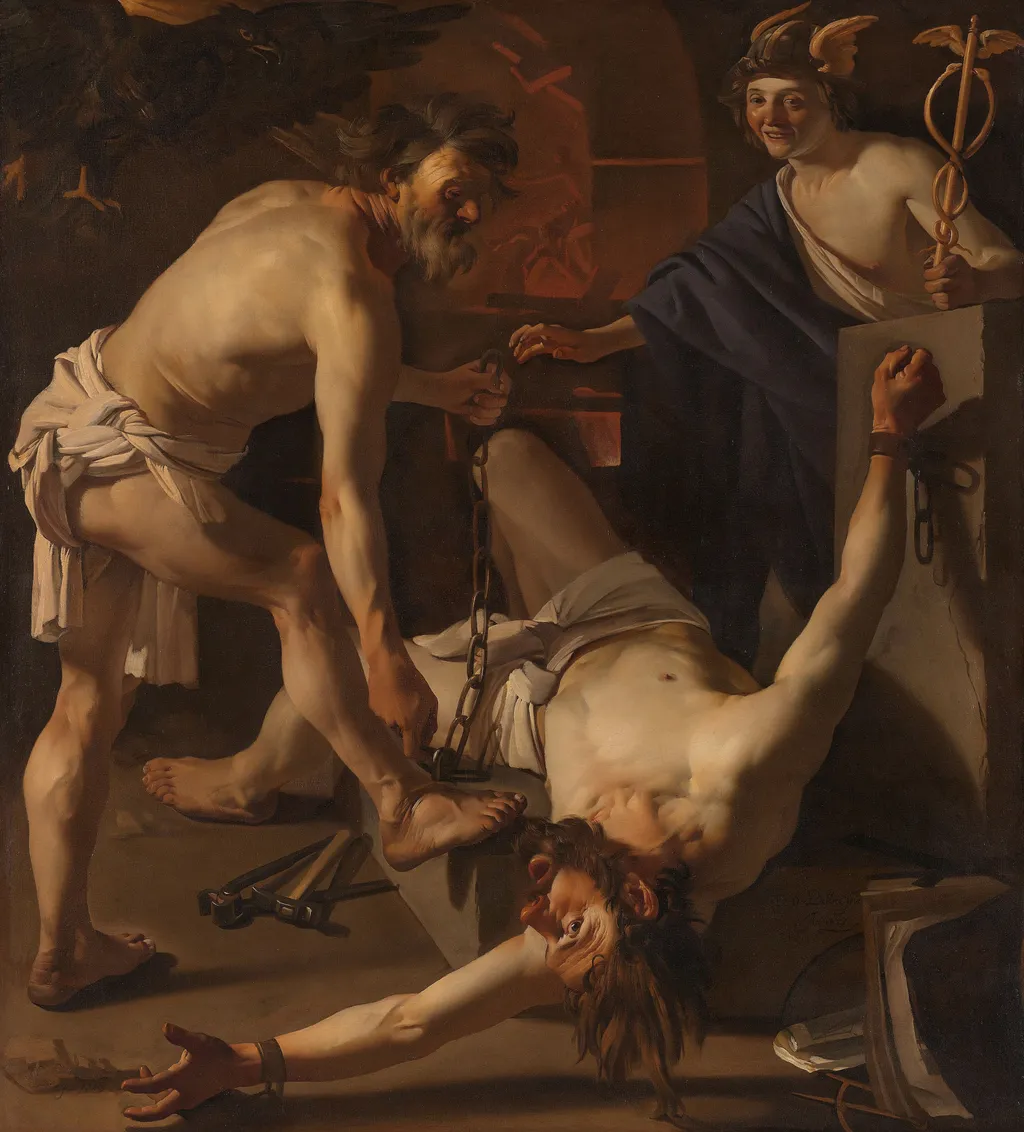
Prometheus Being Chained by Vulcan is an oil painting by the Early Baroque Italian artist Dirck van Baburen. It dates from 1623 and is held in the collection of the Rijksmuseum.
About this work
Subject & Meaning
The work visualizes Prometheus’s eternal torment, his liver to be consumed daily by an eagle, a motif partially visible at the upper left.
The painting depicts the Greco-Roman myth of Prometheus’s punishment for stealing fire from the gods and sharing it with humanity. In the scene, Vulcan, the club-footed blacksmith god, chains the defiant Titan to a rocky surface as retribution. Mercury, the messenger god, oversees the act, reinforcing the narrative’s divine authority.
The work visualizes Prometheus’s eternal torment, his liver to be consumed daily by an eagle, a motif partially visible at the upper left. Such iconography underscores the consequences of defying divine order and the transference of forbidden knowledge to mortals. The pairing of this painting with Baburen’s Adam and Eve in a 1707 sale suggests a thematic link to creation and humanity’s origins, reinforcing the moral and philosophical dimensions of the myth.
Technique & Style
Executed in oil paint on canvas in 1623, the work is painted on a support measuring 201 cm in height and 182 cm in width. The composition exemplifies Baroque chiaroscuro, using strong contrasts of light and shadow to model the figures and heighten dramatic effect. Prometheus’s tense musculature and Vulcan’s concentrated exertion are rendered with careful anatomical definition and volumetric drapery, while Mercury’s presence is signaled by a shaft of light that enters from the upper left.
Two signatures are present: one is visible beneath Prometheus’s right shoulder and a second was revealed during later restoration at the lower left near his hand.
History & Provenance
The painting Prometheus Being Chained by Vulcan was created in 1623 by Dirck van Baburen, a member of the Utrecht School, aligning with the artist’s known period of activity during the early 1620s. Executed in oil on canvas, it measures 201 cm in height and 182 cm in width.
The work entered the collection of the Rijksmuseum in Amsterdam, where it remains today, displayed in gallery 2.1. Historical records indicate that by the early eighteenth century the painting was held alongside another work by Baburen, Adam and Eve, which was sold at auction in 1707; this pairing has led to speculation that the two paintings may have formed a thematic pair related to creation myths.
Context
Executed in 1623, this oil painting by Dirck van Baburen stands as a defining work of the Utrecht School, exemplifying the dramatic chiaroscuro techniques characteristic of the Baroque era. The composition visualizes a specific Greco-Roman myth where Vulcan, assisted by Mercury, chains Prometheus to a rock as punishment for stealing fire, with the predatory eagle partially visible in the upper left. Scholarly attention has noted the unusual presence of two signatures on the canvas: one clearly located below Prometheus's right shoulder and a second revealed at the lower left during restoration efforts.
Art historical analysis suggests a thematic link to Baburen's lost painting of Adam and Eve; records indicate the two works were sold together at auction in 1707, leading to conjecture that they originally functioned as a paired illustration of creation myths involving clay and fire.
Legacy
The painting influenced later artists through its dramatic Baroque chiaroscuro and mythological narrative, particularly its depiction of Prometheus bound to a rock while Vulcan and Mercury observe, a motif that resonated in subsequent Baroque works. Its dual signatures, visible on the right shoulder of Prometheus and discovered during restoration on the lower left, have been noted in scholarly analyses of the work's provenance. The painting's pairing with Adam and Eve, suggested by a 1707 auction record, underscores its role in early modern artistic cycles of creation mythologies.
Overview
Prometheus Being Chained by Vulcan is a 1623 oil painting by Dirck van Baburen, associated with the Utrecht School of the Baroque period. The work depicts a pivotal scene from Greco-Roman mythology, characterized by dramatic chiaroscuro.
Own this work as a print
Artist & collection

 Studied in the Caravaggio & Baroque course